Allbirds Just Sold for $39 Million. They Raised $270 Million in Their IPO. What Every DTC Brand Should Learn From the Wreckage.
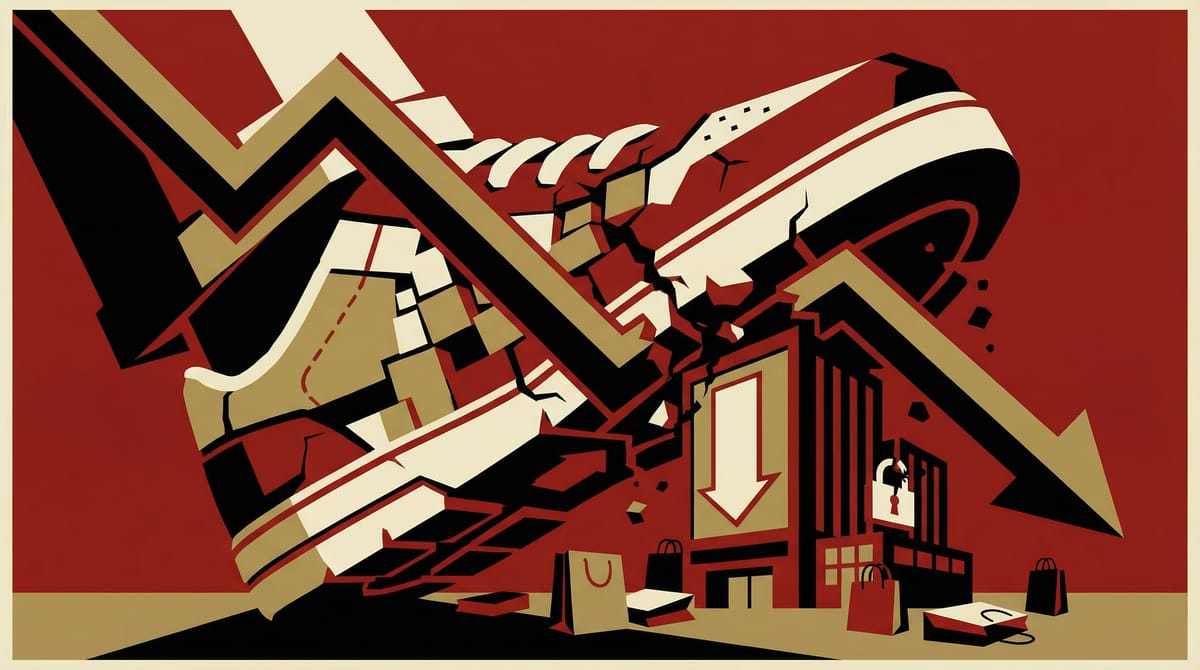
On Monday, Allbirds announced it's selling everything to American Exchange Group for $39 million. The brand, the intellectual property, the remaining inventory. All of it. This is the same company that closed its first day of trading in November 2021 at a $4 billion market cap. The same company that raised $270 million in its IPO. That's a 99% decline from peak valuation.
The coverage this week has mostly framed this as a "cautionary tale about DTC" or a "sign that sustainable brands can't scale." I think both of those readings miss the more specific and more useful lesson. Allbirds didn't fail because DTC is broken or because consumers don't care about sustainability. Allbirds failed because they stopped being the thing people originally loved them for.
The part that actually worked
Before the IPO, Allbirds had something most DTC brands never get: genuine word of mouth. The original Wool Runner solved a narrow problem for a specific audience. Urban professionals in their 30s and 40s who wanted a comfortable, decent-looking shoe and liked the sustainability angle. Digital was 89% of their sales. They hit $100 million in revenue faster than most DTC brands get to $10 million.
The product was the marketing. People wore the shoes, other people asked what they were, the cycle continued. The carbon labeling was a small detail that cost almost nothing to implement but gave every customer a ready-made talking point. "These shoes have a lower carbon footprint than basically anything else you can buy" is the kind of sentence people actually say at dinner.
Their US brand awareness was only about 15%, which sounds bad until you realize the 15% who knew about them were buying. That's a conversion story, not an awareness story.
Where it fell apart
After the IPO, the growth pressure changed the strategy. Public markets wanted to see revenue acceleration, and the Wool Runner, however beloved, was one product in one category. The response was aggressive expansion.
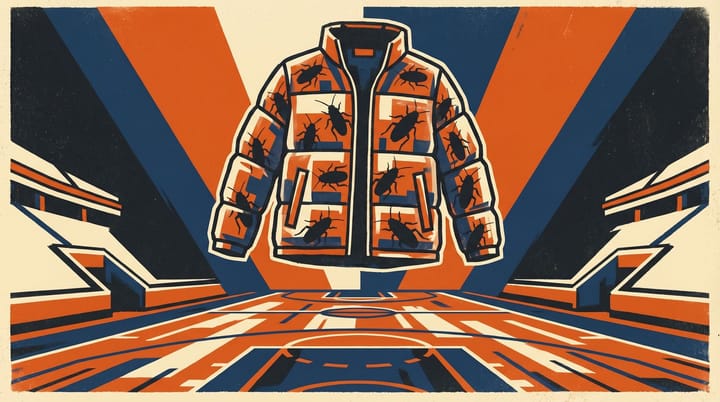
Running shoes to compete with Nike and Hoka. Underwear. Puffer jackets. Golf shoes. Apparel. Co-founder Tim Brown later acknowledged they "created products that haven't quite met the mark." In a Wall Street Journal interview, both founders admitted that trying to attract customers younger than their 30-40 core didn't work.
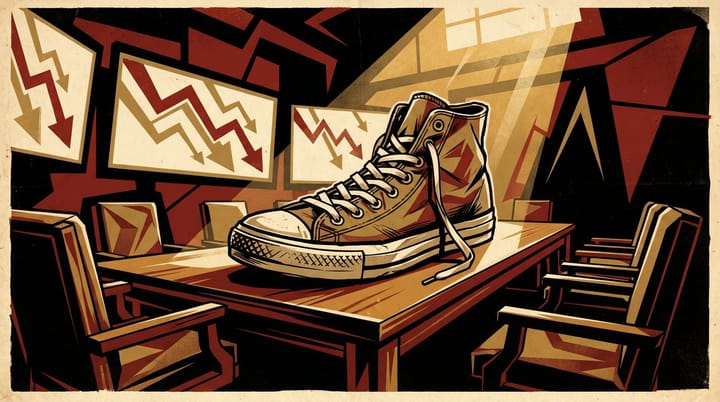
The math tells the rest of the story. Revenue peaked around $300 million in 2022. It has declined every single quarter since. By 2024, annual revenue was down to $189 million (a 25% year-over-year drop). By Q3 2025, the annualized run rate was roughly $140 million. They never turned a profit. Not in a single quarter across the entire life of the company.
They also opened 35+ retail stores, burning cash on leases and buildouts for locations that didn't convert well enough to justify the cost. By February 2026, nearly all US stores were closed. Two outlets and two London shops are what remain.
The marketing lesson most people are getting wrong
The popular takeaway is "DTC is dead" or "sustainability doesn't sell." Neither is accurate.
Allbirds proved that DTC works exceptionally well when the product is genuinely remarkable and the audience is tightly defined. The Wool Runner didn't need a massive ad budget because the product generated its own distribution through conversations. That's the hardest thing in marketing to manufacture, and Allbirds had it naturally.
What killed them was the belief that a $100 million brand built on one remarkable product could become a $1 billion brand by launching a bunch of unremarkable products. Running shoes are a brutally competitive category. When you're up against Nike's R&D budget and Hoka's cult following, "we're the sustainable option" isn't enough of a differentiation to win on the shelf. You need to be the best running shoe, not the most sustainable running shoe. They weren't close.
The expansion also confused the existing customer. When you're "the comfortable wool shoe company" and you start selling puffer jackets and golf shoes, your core customer doesn't expand their basket. They wonder what happened to the brand they liked.
What's actually worth stealing from Allbirds
Study 2018 Allbirds, not 2022 Allbirds.
The original launch playbook is genuinely excellent. A single product that solves a specific problem, sold direct, with a sustainability story that's real enough to talk about, priced at a point that feels premium but not absurd. The carbon labeling was a tiny operational detail that created a massive marketing advantage. Every customer became an ambassador because you gave them something interesting to say.
If you're building or marketing a DTC brand today, the lesson is: find your Wool Runner. Not your running shoe line. Not your apparel extension. The one product that's good enough that people tell other people about it unprompted. Build the business around that for as long as possible. The moment you start launching products to satisfy a growth target rather than a customer need, you're on the Allbirds path.
The wholesale pivot was probably the right move, just too late
When Allbirds finally started selling through Nordstrom and REI, it actually showed promise. Wholesale puts your product in front of people who weren't going to visit your DTC site. For a brand with only 15% awareness, that distribution makes more sense than opening expensive branded retail stores.
The mistake was doing it after the brand had already been diluted by three years of confused product launches. A wholesale partnership in 2019 with the Wool Runner as the hero product might have been transformative. In 2024, after multiple failed product lines and store closures, it looked like a last resort. And perception matters as much as strategy in retail.
The $39 million number
American Exchange Group is getting the brand, the IP, and whatever inventory remains for roughly what a mid-tier Series A raises. They'll probably streamline the product line back to what worked, run it as a profitable smaller brand, and make their money back within a few years.
The irony is that Allbirds as a $200 million revenue company focused on wool shoes might have been a perfectly good business. Profitable, niche, growing slowly. The IPO and the pressure to justify a $4 billion valuation turned a good business into a failing one by forcing it to become something it couldn't be.
A $100 million brand that tries to become a $1 billion brand by becoming something else ends up a $39 million brand. The Wool Runner was never the problem.