Coca-Cola Restaged Hilltop for America250 to Own What AI Cannot Copy
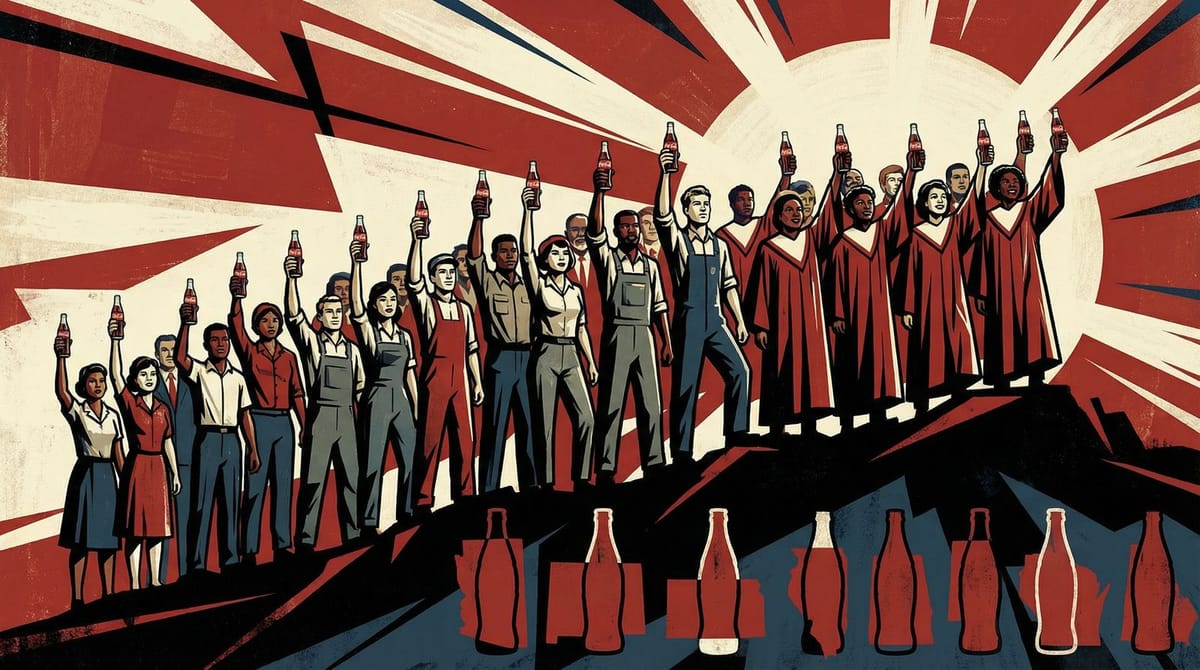
Coca-Cola just announced "Drink in America," a campaign for the country's 250th birthday that does something almost no other major brand can credibly do in 2026: it leans on a 55-year-old jingle that everyone over 30 already remembers, and dares the reader to feel something about it.
The hook is a restaging of the 1971 "Hilltop" commercial. Ad Age reports that Ogilvy is the lead agency, with Burson, VML, Mayan Productions, Optimus Chicago, and VAST/Keith Harris in support, and that the new spot features 25 singers from across the United States re-recording "I'd Like to Buy the World a Coke" in Los Angeles. There are 50 state-themed bottles, plus designs for D.C. and Puerto Rico. There is a "Paint the Nation" mural program and a stated goal of 250,000 volunteer hours. The work will run through NASCAR's Coca-Cola 600, the PGA Tour Championship, and a long list of music festivals through the back half of 2026.
That is the press release. The interesting story is what this campaign quietly tells you about how big brands are starting to think about creative defensibility in an AI-saturated year.
The asset that nobody else can spin up in a weekend
The original Hilltop ad cost about $250,000 to produce in 1971, which works out to roughly $2 million in today's money, and at the time it was the most expensive commercial ever made. Bill Backer scrawled the line on a napkin in an Irish airport during a fogged-out flight to London. Director Roberto Malenotti shot it on a hill outside Manziana, Italy. McCann Erickson got 100,000 letters from viewers, and radio stations were jammed with requests for the song.
You cannot prompt that into existence. You cannot fine-tune your way to it. The cultural memory is the asset, and Coca-Cola has spent five decades quietly insuring it. Every Mad Men finale callback, every "Buy the World a Coke" jingle on a sports broadcast, every reference in a marketing class adds another deposit to the same account. The ad has been compounding since 1971.
That makes it a category of asset most brands do not have: a piece of IP that gets richer the older it gets, and that no generative model can synthesize without instantly being recognized as a copy.
Why this lands harder in 2026 than in any year before it
This is the part that does not show up in the press release. 2026 is the year almost every brand will at least experiment with AI-generated creative. Adweek has been tracking a wave of brands like Aerie, Equinox, and Almond Breeze positioning themselves explicitly against "AI slop," running campaigns that score points by being visibly handmade. Coca-Cola is doing a more expensive version of the same trick, but instead of leaning on irony, it is leaning on inheritance.
The signal is the casting. Twenty-five singers, recorded in a real room in Los Angeles, blending styles from across the country. State-specific packaging across 50 markets. Murals painted by named artists in named cities. None of those line items are about creative quality in the abstract. They are line items that an AI pipeline cannot replicate cleanly, because they all run through human bodies in real places. The volunteer-hour goal is in the same family of decisions. It is the kind of metric that requires actual people doing actual things, which makes it both PR-friendly and authentication-friendly.
From what I have seen in the last year of brand briefs, this is starting to become a quiet hedge in big-budget creative. The brief says "make it feel American," but the line items add up to "make it impossible to fake."
Coca-Cola has been here before, which is the whole point
The 1976 Bicentennial got its own special-edition Coke bottle, which is part of why the company announced this partnership almost a year early, in March 2025. Coca-Cola is now America250's largest corporate sponsor. The decision was made on a calendar before it was ever made on a creative brief. The brand built its reputation as the unofficial soundtrack of American holidays decades ago, and now it is collecting the dividend on that positioning at exactly the moment when "owns a piece of the holiday" has more value than it has had in a generation.
Compare it to a brand trying to muscle into the same moment cold. They can spend the same money, hire the same agency, write the same brief, and the work will still feel synthetic, because there is no archive to draw from. Coca-Cola is borrowing from its own past in a way that essentially every other brand would have to invent from scratch.
What a smaller brand actually does with this
I hear the obvious objection: most marketers reading this do not have a 1971 Hilltop in their archive. Fine. The transferable lesson is not "make a national anthem campaign." It is two narrower things that any brand can act on this quarter.
The first is to inventory your owned cultural IP, even if it feels small. Old taglines, retired mascots, original spokespeople, podcast catalog, customer story archives, founder myths, a discontinued product that customers still ask about. Almost every brand older than five years has at least one piece of equity sitting in a closet that nobody is monetizing because the current marketing team did not create it. Pringles did this with Pringlelina by reanimating a stunt that had already paid for itself. The cost of that audit is one afternoon and a Google Doc. Set a benchmark: by the end of the quarter, ship one piece of work that draws on something only your brand could draw on.
The second is to think about what gets harder to fake as AI gets better. Real people in real places doing real things. Specific named artists. Verified volunteer numbers. Physical objects with serialized provenance. A recent $92K creative test showed that AI-generated ads can hit performance benchmarks in some formats, but they tend to hit a ceiling on the things that signal authenticity. Build your campaign so that at least one major asset cannot be cloned by a model in a weekend. That single constraint is starting to act as a defensibility moat.
Where this could still go wrong
This being Coca-Cola, it is not all upside. The 250,000-volunteer-hour pledge is the kind of headline number that gets graded later by reporters with spreadsheets, and it is going to be a lot easier to announce than to verify. Limited-edition packaging across 50 states is a logistics problem that will absolutely produce regional shortages, eBay arbitrage, and at least one viral complaint about which states "got the better can." And re-recording a sacred jingle is the kind of move that wakes up everyone who has an opinion on whether the original should ever be touched at all. The Hilltop ad has its own Wikipedia entry. The new version will be measured against it within minutes of airing.
I think the bigger risk, though, is overcorrection from competitors. Watch how many other heritage brands try to pull a similar move in the next eight weeks. Some of them have the archive and some really do not, and the ones that do not are going to make work that feels like cosplay. The category that is about to get crowded fast is "we are also American, and we also have feelings about it." Coca-Cola got there first because it had to schedule against an actual deadline.
The line item worth borrowing
If you take one thing from this campaign into your next brief, make it this: pick at least one element of the work that is structurally hard to fake. Not because authenticity is a virtue in the abstract, but because in a year when half of your competitors will ship AI-generated creative, the things that obviously cost a human to make will read as the premium tier whether or not they actually performed better. Coca-Cola is making a $20-million-plus version of that bet. You can make a $5,000 version of it on Tuesday.
On the surface the Hilltop revival reads as straight nostalgia, and a lot of the trade press is going to write it up that way. The more useful read is that Coca-Cola is quietly cashing in five decades of cultural deposits at the exact moment that doing so is worth more than it has been in a long time. Most of us do not have that account. But almost all of us could open a smaller version of it this week, and that is probably the most useful thing to take away from a 25-singer choir on a hill in California.
Notice Me Senpai Editorial