HubSpot Put TikTok Inside the CRM and Nobody Is Talking About the Lock-In
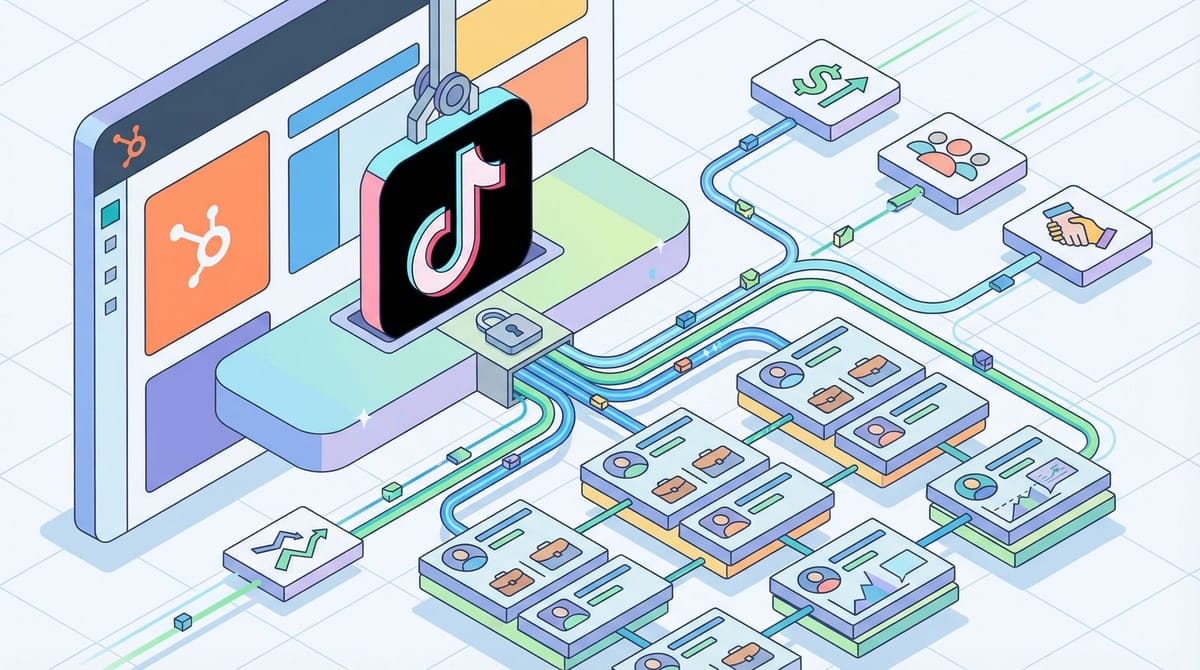
On April 3, HubSpot and TikTok announced a native integration that lets marketers sync contact segments, manage paid campaigns, publish organic content, and tie TikTok interactions back to closed revenue without leaving HubSpot. On paper, that sounds like a welcome upgrade for anyone tired of stitching TikTok Ads Manager to a scheduling tool to some half-working attribution workaround. And sometimes it is.
The part that is not getting enough attention is what it means structurally. HubSpot is now the easiest place for a small or mid-market team to measure TikTok, which means HubSpot is also becoming the hardest place to leave once TikTok turns into a meaningful spend line. The integration is technically free for Marketing Hub Professional and Enterprise customers. The switching cost is the part you are actually paying.
What the integration actually does
The announcement itself is not small. For the first time, HubSpot users can push CRM segments to TikTok for lifecycle-based targeting, build lookalikes from closed-won deals instead of raw pixel events, deploy and manage the TikTok Pixel inside HubSpot, schedule organic posts alongside every other channel, and see TikTok performance rolled up into unified campaign reports that connect an ad to a contact, a deal, and closed revenue. Breeze, HubSpot's AI layer, sits inside the publishing flow generating captions and hashtags, and TikTok comments land in the same social inbox as Instagram and LinkedIn, with AI-suggested replies already drafted for you.
The October 2023 version of this partnership was basically a lead capture connector. This one is bidirectional, covering both paid and organic, and it is the first time TikTok interaction data has flowed back into a major CRM with enough depth to trigger workflow automation based on what someone did on a video, not just after they filled out a form. That is a real upgrade. Don't let cynicism about martech announcements make you dismiss it.
Coverage from Search Engine Journal and CMSWire has framed this mostly as a B2B lead gen story, which is roughly half the point. The other half is that HubSpot is positioning itself as the measurement layer for an ad channel most of its SMB customers haven't figured out how to measure yet.
Why SMBs are going to take this deal
The honest reason marketing teams pick tools like this is almost never the depth of the feature set. It is friction. A mid-market marketer running TikTok paid, TikTok organic, and a HubSpot CRM today is logging into at least three places, exporting CSVs to prove revenue contribution, and arguing with their sales team about whether TikTok leads actually close. For most teams, attribution is a meeting, not a dashboard.
Putting all of that in one place removes the meeting. It is the same reason Meta's offline conversions API got adopted and why Google Customer Match spread faster than any documentation predicted. Friction, not data quality, decides what marketers measure. Remove enough friction and people will use a worse tool over a better one every time.
And the timing is not an accident. TikTok's projected 2026 ad revenue keeps climbing (forecasts vary, but most land somewhere in the mid-thirty to mid-forty billion dollar range depending on who you believe), and SMB adoption has been growing fast enough that TikTok needed a clean on-ramp into the segment of customers where it still has to prove business value. HubSpot had the same problem in reverse. Its core customer profile (SMB or mid-market, B2B-leaning, already sold on inbound) is finally ready to spend real money on a channel HubSpot previously couldn't credibly measure. Both sides win. The question is whether customers do.
The attribution upgrade is real. It is also a trap.
A widely-cited research study from Precis, analyzing TikTok performance across ten Nordic e-commerce brands, found that traditional last-click attribution undervalues TikTok by roughly 10.7x on average compared to an MMM-powered model. Ten times. The gap is that large because so much of TikTok's influence happens before a click ever shows up in any analytics platform.
HubSpot's integration does not fix last-click thinking. It just embeds it deeper. When a marketer sees "TikTok contributed $X in closed-won revenue" inside a HubSpot campaign report, the instinct is to trust the number because it came from the CRM. But the underlying model is still first-touch, last-touch, or linear attribution on HubSpot-recorded interactions. The pixel knows what HubSpot tells it to know. If your brand got discovered on TikTok three weeks before the person ever saw a HubSpot form, that journey is still largely invisible.
In most cases I've seen, this will not matter much for SMB marketers, because the alternative was no measurement at all. Something is better than nothing, and for that group the integration is a real step up. But for anyone thinking the HubSpot dashboard settles the "is TikTok working" debate, it really doesn't. It just gives you a cleaner version of the same flawed answer, with better design.
The quiet lock-in problem
Every SaaS integration has two phases. Phase one, the tool is helpful and gets adopted. Phase two, the tool becomes structurally load-bearing and the marketing team starts making budget decisions based on what the tool reports. Phase two is where switching costs get born.
For SMB marketers, this integration has a specific structural consequence the announcement glosses over. Once the TikTok Pixel lives inside HubSpot, once your lookalikes are built from HubSpot contact data, once your TikTok campaigns are tagged to HubSpot campaigns, and once your weekly revenue report shows TikTok performance alongside email and paid search, the cost of moving off HubSpot is no longer "export the contacts and call it a day." It is rebuilding your entire TikTok measurement model, retraining everyone who reads the revenue report, and starting your pixel history over on whatever platform you land on next.
From what I've seen, most SMB teams underestimate this cost by roughly an order of magnitude. When marketing tools consolidate, the bill doesn't arrive when you sign up. It arrives the first time you try to leave.
It is the same dynamic I wrote about in the Publicis and Trade Desk split, where the fight wasn't really about hidden fees. It was about who owned the pipe. HubSpot is quietly building its own version of that pipe for SMB social attribution, and it is smart enough to make the pipe feel free at the point of use. Marketing Hub Professional still starts around $1,200 a month for a modest contact tier, with an onboarding fee that tends to surprise people. That price is manageable when you can easily imagine an alternative. It feels different when the alternative involves ripping out your working attribution setup and rebuilding it from scratch.
A practical read before you turn it on
If you are running TikTok paid or organic on top of HubSpot today, turn the integration on. It is genuinely better than the workaround you had, and on balance the math almost certainly favors switching. The risk is not the turn-on. It is the blind spot you tend to adopt along with it.
Three specific things worth doing this month, before HubSpot's version of your TikTok story becomes the only story you can tell.
First, keep at least one source of TikTok performance outside HubSpot. TikTok's native Ads Manager reporting, GA4 with disciplined UTM tagging, or even a lightweight media mix spreadsheet updated monthly. The point is not redundancy for its own sake. It is so you can sanity-check HubSpot's numbers against a view HubSpot didn't generate. If the two diverge by more than about 20%, that's your signal to dig in.
Second, write down your current TikTok workflow in a document before you connect anything. Which segments, which creative categories, which pixel events, which audience definitions, which attribution windows. Call it your portability doc. When you eventually need it, you will be very glad past-you took the hour.
Third, audit your attribution window before Breeze starts suggesting creative. If your HubSpot campaign is set to a 7-day attribution window and TikTok's real influence window is closer to 28 or 30 days, you will undervalue TikTok even inside HubSpot. Then you will conclude the integration is underperforming, when really it is the settings doing the work.
Anyway. Those three things take maybe two hours combined. They are the cheapest insurance policy you will find against phase two.
What this really is
This integration is not really a marketing announcement. It is an infrastructure move. HubSpot is positioning itself as the default SMB operating system for a channel most of its customers haven't figured out how to measure, and TikTok is getting a clean path into the exact audience where it still needs to prove business value. The broader pattern of HubSpot updates in early 2026 makes it clear this is not a one-off integration. It is a direction.
I think most teams will stop treating the HubSpot view as one data source and start treating it as the truth within about six months. And when that happens, the question stops being "should we use TikTok" and becomes "what does our CRM think of TikTok this week." Those are very different questions, and only one of them is actually worth answering.
Notice Me Senpai Editorial