Why Lego Is Marketing the World Cup Like Nike Would
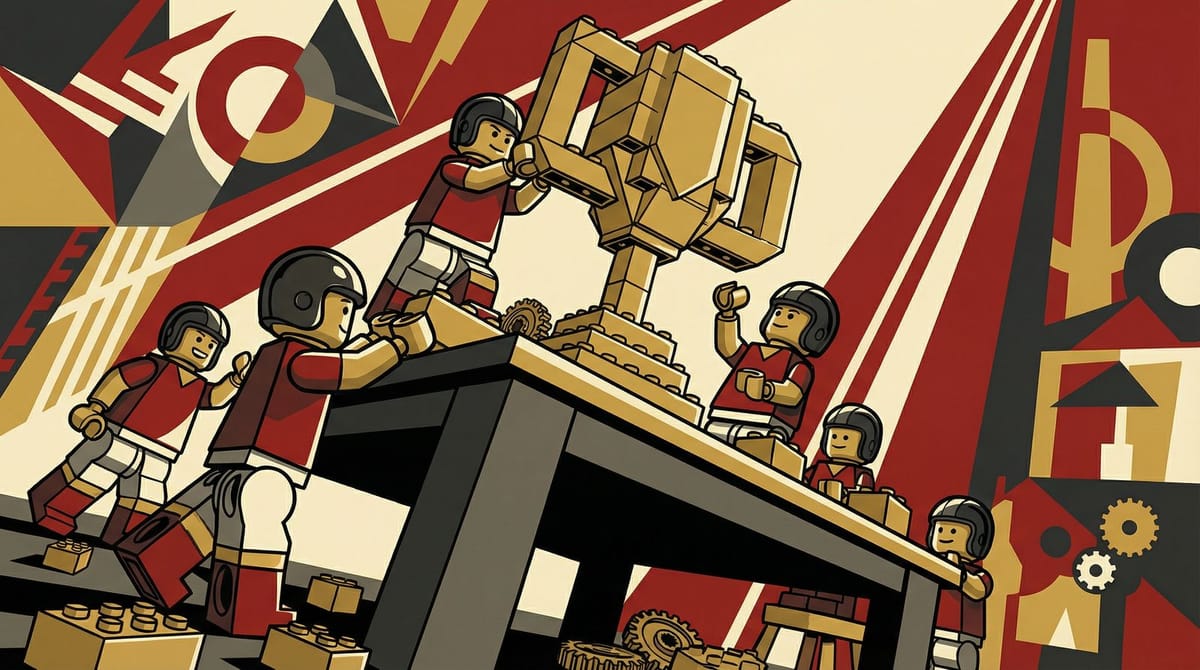
Lego dropped a World Cup ad this week featuring Messi, Ronaldo, Mbappe, and Vini Jr. building a brick trophy together. It hit 314 million Instagram views across the four players' accounts in the first wave. That is sportswear-brand territory. And that is the point.
The campaign, called "Everyone Wants a Piece," was developed by Wieden+Kennedy Amsterdam. If that name sounds familiar: they are the agency behind Nike's most iconic work. The choice of agency tells you more about Lego's ambitions here than any press release could.
The ad is not the product. The positioning is.
On paper, Lego is launching nine collectible football sets: four "Football Highlights" builds at $30, two "Football Legend" sets at $80, and a premium 1,427-piece Messi celebration set at $199. All hitting shelves May 1, with the Messi premium dropping June 1. The official Lego announcement goes into the easter eggs and letter-shaped bases and jersey numbers. Fine.
But the ad itself does not really talk about the product. It shows four of the most recognizable athletes on the planet sitting around a table, competing to build a trophy and place their minifigure on top. It reads like a Nike spot that happens to involve bricks. That was almost certainly the brief.
Lego's quiet pivot into sports IP
This did not come out of nowhere. Lego has been building (I am sorry, there is genuinely no other word for it) a sports-IP strategy for over a year now. The F1 partnership launched in 2025 with activations at more than twenty Grand Prix events. They signed on as an F1 Academy team sponsor for 2026. The Ferrari F2004 Michael Schumacher set targets adult collectors who would never walk down a toy aisle.
And the financial backdrop makes the strategy readable. Lego posted $13 billion in revenue in 2025, up 12% year over year. Consumer sales grew 16%, more than double the toy market's 7% growth. Adult self-purchasers have gone from roughly 5% to 25% of total sales in about five years. That is the number that explains everything Lego has done for the past two years.
When a quarter of your revenue comes from adults buying for themselves, you stop thinking of yourself as a toy company. You start thinking of yourself as a lifestyle brand. And lifestyle brands do not run toy commercials. They run World Cup campaigns with Messi and Ronaldo.
What 314 million views actually tells you (and what it does not)
Worth unpacking what 314 million Instagram views means in practice. The number comes from combining views across Messi's, Ronaldo's, Mbappe's, and Vini Jr.'s personal accounts. These are four of the most-followed people on earth. Ronaldo alone has north of 600 million followers. So the reach is partly a function of distribution, not just creative quality.
That said, distribution IS the creative quality in a campaign like this. Lego did not buy 314 million impressions. They made content that four global superstars were willing to post from their own accounts as something worth sharing, not as an ad obligation they were ticking off. From what I have seen with athlete endorsement campaigns, that distinction is where most brands lose the plot. They get the athlete, film a generic spot, and then wonder why it disappears into the feed.
The "Everyone Wants a Piece" film works because it shows the players actually doing something. There is a build-off. There is competition. Mbappe and Vini Jr. are jockeying against Messi and Ronaldo. It feels like a generational torch-passing moment dressed up as play. The Muse by Clio coverage described it as surpassing "the Wheaties box" level of sports endorsement, which is probably generous. But the ambition is clearly there.
The Wieden+Kennedy signal
Hiring Wieden+Kennedy Amsterdam for this campaign is a statement in itself. W+K built "Just Do It." They have been Nike's creative partner for decades. When a toy company hires the sportswear agency, they are telling you who they want to compete with for cultural attention.
And honestly, it is a smart read of where brand marketing is heading. The World Cup happens once every four years. The media rights and sponsorship costs are astronomical. But the cultural conversation around it starts months earlier and the competition for attention during tournament months is brutal. Lego is not trying to win shelf space at this point. They are trying to win Instagram feeds and living room coffee tables and the "what should I get him for Father's Day" conversation that happens right when these sets hit retail in June.
The portable insight for everyone without a nine-figure budget
The obvious lesson, "hire a big agency and sign four superstars," is not helpful unless you have Lego's marketing budget. But there is a more portable insight here.
Lego did not create a football campaign. They created a cultural moment that happens to involve football. The difference matters. A football campaign shows the product, explains the features, targets the obvious audience. A cultural moment creates content that the distribution channel (in this case, the athletes themselves) genuinely wants to share.
If you are working on any kind of licensing, partnership, or sponsorship deal, the question to ask is not "will this reach our target audience?" It is "would the partner post this from their personal account without being contractually required to?"
I think most partnership campaigns fail that test. They produce content that checks the brand guidelines box but does not give the partner anything they are proud of. Lego seems to have understood that the players' willingness to share is worth more than any media buy they could bolt on.
The Coca-Cola "And a Coke" campaign we covered last week operates on a similar principle. Different execution, same underlying bet: make the partner's participation feel like a flex rather than a transaction.
One number worth watching after May 1
Here is my prediction, for whatever it is worth. The $30 Football Highlights sets will sell fine. The $80 Legend sets will probably do better than Lego expects. But the $199 Messi Celebration set, the 1,427-piece premium build dropping June 1, a week before the World Cup starts on June 11? I would bet that sells out within the first 72 hours.
Adult collector Lego sets in the $150 to $250 range have been consistently supply-constrained for the past two years. The Botanicals and Icons lines drove a significant chunk of Lego's record 2025 growth. Add World Cup hype timing and Messi's name, and you have a resale market forming before the glue on the box has dried.
If your brand does anything adjacent to sports licensing or limited-edition drops, watch how Lego handles the scarcity narrative over the next eight weeks. The playbook they are running (cultural campaign creates demand, limited SKU captures it, timing syncs with a global event) is one of the cleaner examples I have seen of how a brand can manufacture urgency without resorting to fake countdown timers.
The FIFA World Cup runs June 11 to July 19. Lego timed every product drop, from the May 1 mass launch to the June 1 premium release, to ride that exact wave. Some brands sponsor tournaments. Lego is treating the entire World Cup calendar as a product launch window.
Notice Me Senpai Editorial