OkCupid's 12-Year Cover-Up Ended With Zero Fines and a 20-Year Leash
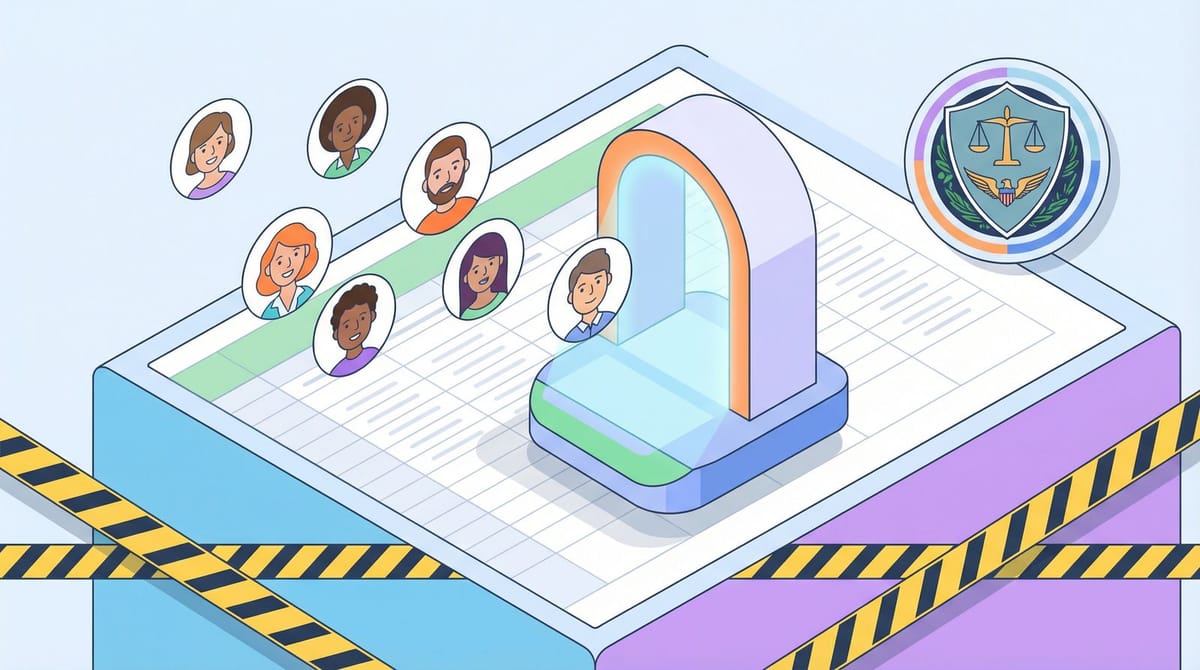
The FTC settled with Match Group and OkCupid on March 30 over a 2014 photo transfer the dating app spent twelve years trying to keep quiet. Nearly three million user photos went to Clarifai, a facial recognition startup. No money changed hands. No user was told. And the order the agency filed does not demand a single dollar in civil penalties. It demands twenty years of watching.
If you run a marketing team and you were about to skim this as a privacy story, don't. This is a brand risk story dressed up as an enforcement action, and your own organization probably has one of these buried somewhere.
The facts, briefly
In September 2014, Clarifai's CEO emailed one of OkCupid's founders asking for "access to large datasets of OkCupid photos." That founder was a personal investor in Clarifai through a VC fund called Corazon. The photos went over. No contract, no user notice, no money involved, no service provided in exchange. Clarifai got about three million images plus the demographic and location metadata that came bundled with them.
The 2019 New York Times story that first surfaced the arrangement got a denial from OkCupid. The FTC's version, filed March 30 in the Northern District of Texas, says the companies "engaged in extensive efforts to conceal and deny" the transfer for more than a decade. That includes, per the complaint, drafting misleading statements to the Times itself when the paper came asking.
Why a zero-dollar settlement is worse than a fine
There is no civil penalty. Match Group walks away without paying anything. What it gets instead is a twenty-year ban on misrepresenting its data practices, ten years of compliance reports to the FTC, five years of records retention, and an agency that can pull those records any time it wants.
On paper, that sounds like a soft outcome. Sometimes it is. But think about what a twenty-year leash actually means for a public company that depends on user trust and user data. Every product launch, every acquisition, every privacy policy update between now and 2046 has to route through a compliance process that did not exist on March 29. The legal team just became load-bearing in a way it was not a week ago.
A fine is a line item. The order restructures how the organization handles personal data for two decades, and the incremental compliance cost will almost certainly outrun whatever headline number the FTC could have extracted in a one-time penalty.
The part most marketers are missing
I think most teams reading this will file it under "Match Group problem" and move on. That is the wrong read. This is a them-today-you-tomorrow problem, and it starts with one question: what does your 2014 privacy policy actually say?
Now run through the data you collected under that policy and ask whether it is still being used in ways consistent with what you told users. If the answer involves any of the following, you have the same exposure Match Group had:
- Training data licensed to AI vendors for "research" or "product improvement"
- Photo or video assets reused for computer vision model training
- Customer email addresses enriched via third-party data brokers
- "Anonymized" behavioral data shared with a partner who then deanonymized it
- Any "mutually beneficial partnership" with a vendor that was really just a founder emailing a friend at a startup he had invested in
The FTC complaint explicitly flags the founder's personal stake in Clarifai as evidence of bad faith. They are treating conflict-of-interest-adjacent data handoffs as deceptive, not merely sloppy. That is a meaningfully lower bar than "you told users X and did Y," and it retroactively reclassifies a lot of Silicon Valley's 2012-to-2018 handshake-era partnership culture.
Where the exposure actually lives
From what I have seen of enterprise data audits, most marketing stacks carry two categories of legacy data risk. The first is known: customer records in legacy CRMs, email lists from acquired companies, old analytics integrations that still fire every night. Teams have at least some idea these exist, even if nobody has touched them in years.
The second category is worse because nobody remembers it. Data that left the building through a partnership, an integration, or a "pilot test" that nobody ever documented formally. A 2018 co-branded quiz whose photo uploads went to a third-party data scientist. A 2019 A/B testing platform trained on customer sessions before the vendor got acquired by someone you have never heard of. A 2020 "AI enrichment" pilot that quietly built a model on your user records and then quietly kept it.
This is how legacy data exposure really accumulates. Not through a formal contract and a procurement review. Through someone powerful sending someone they know a link to a shared drive.
The audit nobody wants to run tonight
Open a spreadsheet. Three columns: vendor, date of first data transfer, data still in their possession today. Start with anyone your marketing org has shared user-level data with in the last decade. If you cannot fill in column three for a given row, that is your first audit target.
Then check what happened to each vendor. This is where it gets bleak. When a company acquires another, the acquirer inherits the training data too. That OCR vendor your team abandoned in 2017 got acquired by a larger AI firm in 2022. The data you sent them is now part of a model that is being licensed to Fortune 500 companies, and you have no contract governing any of it because your original vendor does not exist as a legal entity anymore.
(If that last paragraph gave you a physical reaction, you are having the correct one.)
The quiet shift in how old law is being read
One more thing worth flagging. The FTC did not need a new law to pursue this case. They used Section 5 of the FTC Act, the same "unfair and deceptive acts" framework that has been on the books since 1914. What seems to have changed is their willingness to read "deceptive" more broadly around AI, biometric data, and old partnerships that never got formal consent.
The OkCupid order is a test of that appetite. The agency got essentially everything it asked for.
That should tell you where the enforcement curve is heading, at least from what I can see. Not toward fresh privacy laws that give compliance teams years to prepare. Toward aggressive reinterpretation of existing statutes against data practices that seemed fine a decade ago. The same pattern is visible in adjacent cases like LinkedIn's browser-scanning exposure and the way Reddit is being repriced as a privacy-first alternative to the rest of the ad ecosystem.
Survivable for Match Group, terminal for a Series B
Match Group will survive this. They will book legal costs, file compliance reports, and keep running the largest dating portfolio on the internet. The twenty-year leash will sting in ways that do not show up in the 10-K.
The smaller brands that get paraded through FTC orders for similar missteps rarely get the same luxury. A twenty-year order is survivable for a ten-billion-dollar public company. For a Series B direct-to-consumer brand, it is a death sentence that just has not had the funeral yet. The compliance overhead alone will make the next funding round a lot harder to close.
I do not know which brand is sitting on a 2014 partnership that will make the news in 2028. Most of their CMOs probably do not know either. That is the uncomfortable thing this settlement clarifies. You usually do not find out about the exposure until somebody else does.
Notice Me Senpai Editorial