Five Welcome Emails Earn 40x What a Broadcast Does
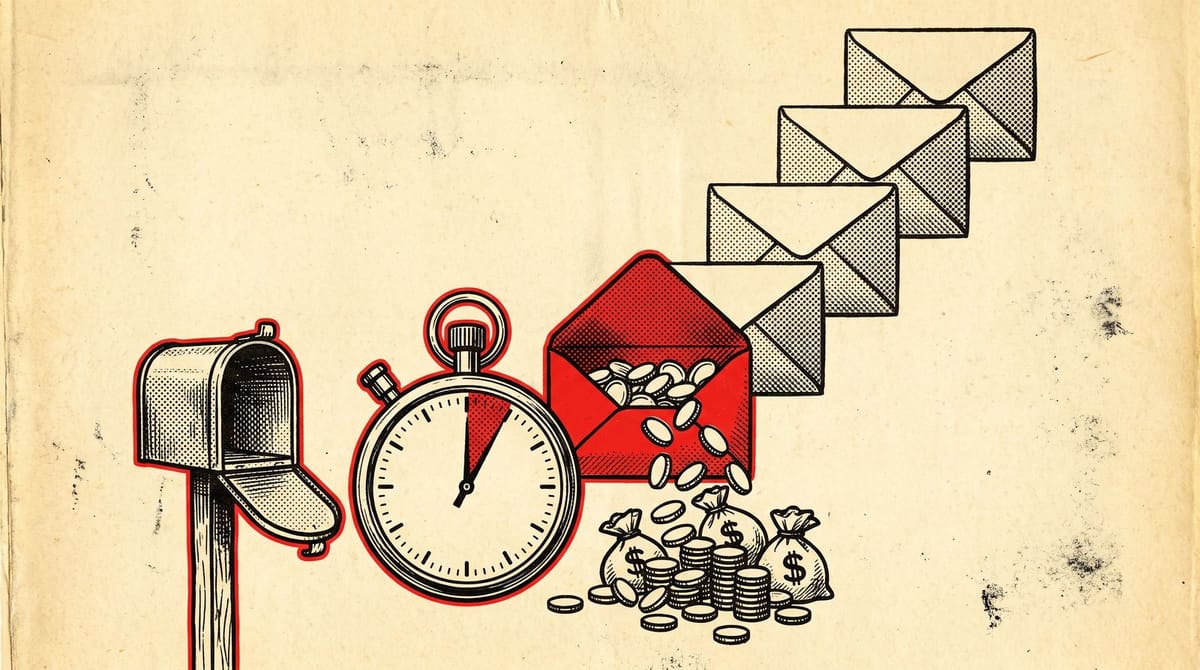
A welcome email earns $6.16 per send in Omnisend's 2025 benchmark dataset, against roughly 15 cents for a one-off campaign blast. That gap is not a rounding error. It exists because the sequence fires while a new subscriber's intent is still warm, and even a three-email version produces about 90% more orders than a single welcome note. The work is to build five emails across two weeks, give each one a job, and hold each to a benchmark you can actually check.
Welcome emails earn while intent is still warm
Most of email's revenue hides in automation, and almost nobody staffs for it. Omnisend put automated sends at about 2% of all volume in 2025 and roughly 30% of revenue. Per email, automated flows pulled $3.41 against $0.155 for scheduled campaigns. That is a 22x spread, and the welcome flow sits right at the top of it: $6.16 per email is close to 40 times what a broadcast earns.
The reason is timing, not cleverness. Someone hands you their address the moment they care most. An hour later they have moved on to whatever pulled them away. The team at InboxArmy frames it bluntly: miss that window and your subscriber's mind is already on the next thing. So the single highest-leverage change most teams can make is not better copy. It is firing email one inside five minutes instead of "tomorrow morning when the batch goes out."
I think a lot of brands underrate this because the welcome flow feels like plumbing. You set it up once, it runs, you stop looking. But automated emails converted at 1.49% in 2025 versus 0.08% for campaigns. When something converts roughly 19x better than your daily work and you check it twice a year, that is the textbook definition of a neglected asset.
The five emails, and the single job each one owns
You can run a welcome sequence in three emails and still beat a single note by about 90% on orders. Five is the version I would build, mapped across a 14-day window, because it gives you room to sell without making the offer the entire relationship. Here is the shape, drawn from the 2026 onboarding framework DigitalApplied published, with the benchmark each email should clear.
Email one, day zero. Confirm the relationship, deliver whatever you promised at signup, and set frequency expectations. Fire it within five minutes. Target a 50% open rate and 10% clicks. If this email opens below 40%, your problem is deliverability or the subject line, and nothing downstream will save it.
Email two, days two to three. Brand story and proof. This is where you earn the right to sell in email three: the founding story, the mission, a credibility signal or two. Send a fresh-subject variant to anyone who did not open. Target 35% opens, 5% clicks.
Email three, days five to seven. The primary offer. Core product, one testimonial, light urgency. Suppress anyone who already bought, because nothing reads more robotic than getting sold something you purchased yesterday. Target 30% opens, 7% clicks, and at least a 2% conversion rate.
Email four, days eight to ten. Education and use-case. Shift from what the product is to what it does for someone. Tutorials, a short case study, the use case that fits their acquisition source. Fork the content by where they came from (content, paid, or referral) if your tooling allows it.
Email five, days twelve to fourteen. The re-engagement check. Anyone who has not opened a thing by now gets one clear prompt and then routes to a dedicated win-back flow instead of dribbling into your main list. This is the email most teams skip, and it is the one that quietly protects everything else.
The discount belongs in email one, not email three
This is where a lot of sequences leak money. If you offer a welcome discount, do not bury it. InboxArmy's read, and mine, is that the offer should be stated clearly in the first email and reiterated through the series, not saved as a reveal in email three. The subscriber who came for "10% off your first order" already knows the deal exists. Hiding it just adds friction to the one action they were already ready to take.
The harder question is whether to discount at all. Welcome emails carrying a 10 to 15% offer tend to convert two to three times higher than those without, which is a real lift and tempting to treat as settled. It is not. A discount also trains a slice of your list to wait for the next one, and for high-margin or considered purchases that habit costs more than the incremental first order. From what I have seen, the discount is close to mandatory in commodity ecommerce and genuinely optional in software, services, and anything with a long consideration cycle. Test it as a fork in email three rather than assuming.
One messy caveat, because real life is messy: if your margins are thin, a 15% welcome discount on a first order that was going to happen anyway is not acquisition spend. It is a giveaway. Model the people who would have bought at full price before you go celebrating the lift.
How to know the flow is actually earning
Open and click rates tell you the sequence is healthy. They do not tell you it is earning. The metric I would put on the dashboard is revenue per new subscriber across the 14-day window, because it folds timing, offer, and deliverability into one number you can move. Omnisend's welcome benchmark lands at $6.16 per email and an 11.19% click-to-open rate, which is a useful gut check. If your welcome emails open fine but click-to-open sits in the low single digits, the content is the leak, not the list. If opens are the problem, look upstream at deliverability and subject lines before you touch anything else.
Watch the unsubscribe rate too, which runs near 0.87% on welcome sends. A spike there usually means you set frequency expectations you are not honoring, or the discount over-promised against what the rest of the program delivers. Track the cohort, not the calendar. The welcome flow is the rare email asset where you can attribute revenue cleanly to a single sequence, so actually use that.
Your welcome flow doubles as a deliverability warm-up engine
This is the part almost nobody counts, and it might be the most valuable. New subscribers are, by definition, your most engaged audience. They opted in seconds ago. That makes the welcome flow the cleanest signal you can send inbox providers: real people, opening, clicking, not complaining.
Domain warm-up advice usually reads like a chore. Start at five to ten sends a day, add five to ten a week, send to your most-engaged people first, and expect four to eight weeks. The welcome sequence does most of that work for free, because it only ever hits people at their engagement peak. You are building sender reputation and earning revenue with the same emails.
This only holds if the foundation is in place. SPF, DKIM, and DMARC are table stakes now, and you can configure all three correctly and still land in spam if your engagement signals are weak, which is exactly why we walked through the authentication setup most teams get half-right. The welcome flow is the engagement half of that same equation.
It also quietly fights list decay. Lists shed roughly 23% of their addresses a year to job changes, abandoned inboxes, and slow disengagement, a problem we dug into in how fast lists rot and what slows it down. A welcome sequence that ends in a real re-engagement check is your first line of defense, catching the people who never truly activated before they curdle into dead weight that drags your whole sender score down. Double opt-in is the other lever. It costs you a sliver of signups, but confirmed addresses open at higher rates and complain far less, which is why Customer.io and most deliverability teams still push it. For a new sending domain especially, I would take the cleaner list almost every time.
Questions people actually search before building this
How many emails should a welcome sequence have? Three at minimum, because a three-email series beats a single welcome by about 90% on orders. Five is the better target once you have the content, since it separates the offer from the relationship and leaves room for a re-engagement check at the end.
Should the first welcome email include the discount? Yes, if you are offering one. State it in email one and repeat it through the series. Saving it for later just delays the action the subscriber was already primed to take.
How long should the sequence run? Around 14 days is the standard window, with sends spaced roughly two to three days apart and the gap widening toward the end. Fire email one within five minutes of signup. That one timing detail moves welcome conversion more than almost anything else you can change.
If your welcome flow is one email, start here
If your welcome flow is a single email, or worse, a campaign you forgot to automate, the cheapest growth available to you this quarter is sitting right there untouched. You do not need five perfect emails by Monday. You need email one firing in under five minutes, the offer stated up front, and a re-engagement check at the end so the sequence cleans up after itself.
The brands winning here are not the ones with the cleverest copy. From what I have seen, they are mostly the ones who treated the welcome flow as a revenue engine instead of a setup task they finished once and never reopened. Go open yours. I would bet it has not been touched since launch, and I would bet the timing is the first thing wrong with it.
Notice Me Senpai Editorial