Beehiiv Added Webinars, Trials, and Paywalls While Substack Still Takes 10%
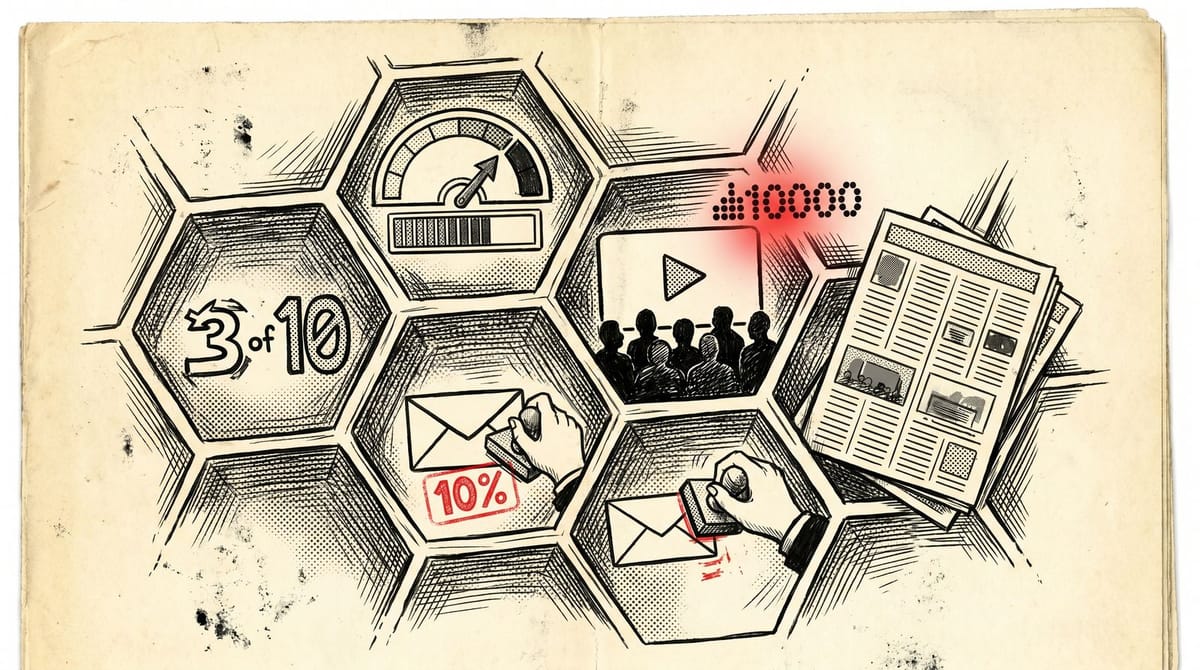
Beehiiv announced webinars for up to 10,000 attendees, metered paywalls, paid trials, and AI podcast analytics on April 23, 2026. The platform still takes 0% of paid subscription revenue while Substack charges 10% plus Stripe fees on every paid sub. For a creator launching paid this week, the gap between the two platforms is now four monetization surfaces and roughly $1 of every $8 earned.
The Substack flank, finally attacked
The new stack covers webinars, metered paywalls, paid trials, podcast hosting with AI analytics, email, and an ad network. Substack still covers email, a bit of audio, a bit of video, and Notes. Per TechCrunch, Beehiiv hit 400 million unique readers, crossed 50,000 active users, sent 10 billion emails, and passed $28 million in annual recurring revenue. Q1 2026 was the company's best quarter on record, adding $4.5 million in ARR. They also told Digiday that 50% of existing users migrated podcasts to the platform and 25% launched a brand new show after the audio features shipped.
Every one of those adds maps to a revenue surface Substack doesn't currently price in. Webinars monetize live without leaving the platform. Metered paywalls unblock the mid-tier reader who won't subscribe but will pay for access a few times a month. Paid trials solve the "I don't know if this is worth $10" objection that keeps lists from converting. On paper, that sounds like a Substack equivalent with better economics. In practice, the math shifts further than most creators realize.
The 10% is not the only number
CEO Tyler Denk's pitch has been consistent: creators keep 100% minus Stripe's standard 2.9% + $0.30 per transaction. Substack's published pricing is 10% platform plus the same Stripe cut on top. For anyone upgrading inside the Substack iOS app, Apple takes up to 30% of that transaction on top of both.
A $10 monthly subscription on Substack via iOS nets the creator roughly $5.80 after all three middlemen finish collecting. Same sub on Beehiiv's Scale plan ($43/month flat) nets roughly $9.41 after Stripe. At 50 paid subs, a creator on Beehiiv recovers the platform fee three times over every month. At 500 paid subs, the difference runs about $18,000 a year in pure platform take that simply stops leaving the account.
That 10% was always defensible when Substack was the only platform with recommendations, Notes, and a credible chat product. It's harder to defend when the platform on the other side of the comparison ships metered paywalls, paid trials, webinars, and MCP-powered podcast analytics in a single release cycle.
Why the 78.4% case study probably understates the delta
Digiday reported that writer Frankie de la Cretaz saw a 78.4% jump in net newsletter income (about $21,325 annually) after moving from Substack to Beehiiv. That number isn't really about fees alone. The ad network, recommendations, and paid-trial conversion rates compound with the zero take rate. Fee savings probably explain about half. The rest is extra monetization surfaces that Substack doesn't currently offer.
This part surprised me a little. I'd expect most platform migrations to underperform their headline claims once you account for list decay during the switch. A 78.4% lift implies the monetization infrastructure was doing more work than the fee delta was, which is a different kind of case study than "we saved 10%." It's closer to "we had the wrong product wrapper around the same audience."
The webinar add isn't what most people think
Webinars for up to 10,000 people with video, screen share, chat, and multi-currency billing sounds like a Zoom or Riverside replacement. For most newsletters, it's not. It's a paywall upgrade.
Instead of asking 5,000 readers to pay $10 a month for text they might not open, you sell them a $29 one-off workshop on the exact topic they've opened three emails about in the last two weeks. From what I've seen, one-off workshop pricing converts 3 to 5 times better than recurring subscription pitches for non-daily newsletters, because the buyer only has to decide once. Recurring asks have to clear a mental check every 30 days.
If you're running a weekly newsletter with 5,000 engaged subs, hosting a quarterly paid workshop at $49 probably outperforms trying to convert 10% of the list to $8 a month. And that math runs in Beehiiv's favor now because the webinar is baked into the same paid subscriber back-end.
Metered paywalls solve the middle tier
The metered paywall is the quieter shift. Creators now decide how many posts a reader can access (one to ten or more) before a subscription prompt appears, and they set the reset period: daily, weekly, monthly, yearly, or never. Paid trials get their own controls too, including $1 for 30 days or $5 a month for three months.
Most newsletter readers aren't "never pay" or "pay every month." They're in between. They'd pay sometimes, for specific posts, for specific workshops, at specific moments. Substack's model forces a binary. The metered paywall stops forcing it. Publishers who've tried soft meter + hard meter splits in display media for the last decade will recognize the setup, because it's the same one that kept a lot of local news sites alive through the worst of the 2017 to 2022 traffic drought.
What to actually check before Friday
If you're on Substack and making under $50,000 a year in paid subs, the migration math almost always favors Beehiiv now. If you're above $100,000 a year, the $10,000-plus annual fee savings still matters, but you need to stress-test audience retention during the list transfer. Some portion of your list is subscribed to you through Notes and Substack's recommendation engine, not to you personally. Losing 5 to 8% during migration is realistic, and if your gross margin on that chunk is above the 10% Substack take, staying might be cheaper for another quarter.
For creators launching paid for the first time this week, Beehiiv is probably the default now. The 0% fee was already the pitch. The metered paywall + paid trial + webinar bundle closes the last real argument for picking Substack over them, which was that Substack's stack was more complete out of the box. It isn't anymore. Beehiiv has also been quietly building out podcast hosting tied to an ad network, which means the audio monetization surface is now part of the same contract as email.
Where Substack still has the moat
Discovery. Notes, the "subscribe to three related newsletters" prompt, the algorithmic surfaces inside Substack's app. Beehiiv's ad network and recommendation engine help, but they're not the same thing. For creators who built their subscriber base organically on Substack's recommendation engine, switching means rebuilding an acquisition channel from scratch, and that's not free.
Denk told Digiday: "If you didn't like Beehiiv, you could export your emails and move it to MailChimp the next day…you own that relationship with Stripe, not us." Fine. Portability isn't the constraint. Re-acquisition is. If 30% of your weekly sign-ups come from Substack recommendations, moving platforms cuts that funnel to zero on day one, and it takes months to rebuild with ad spend, cross-promo, and recommendations on Beehiiv's side.
Deliverability is also worth thinking about during any move. Gmail's inbox algorithm has been shifting hard toward on-platform engagement signals (see our note on why deliverability rate is basically meaningless now), and migrating a paid list across ESPs introduces a warm-up period where open rates look worse than they are. Plan for a two to four week dip on the new platform even if everything else goes right.
The honest version of the decision
The gap between the two platforms is no longer primarily financial. It's operational. Substack gives you discovery you didn't build. Beehiiv gives you more surfaces to monetize the audience you already have. Most creators I'd talk to this month fall into the second bucket, and the math favors leaving. But if your top-of-funnel still runs on Substack recommendations, eating the 10% for another quarter or two might be the cheaper option. It depends which side of your funnel is actually broken, and that's a question creators should be able to answer with their own data by the end of this week.
Notice Me Senpai Editorial