Creator TV Is a $2M Budget Problem Stuck in a $50K Line Item
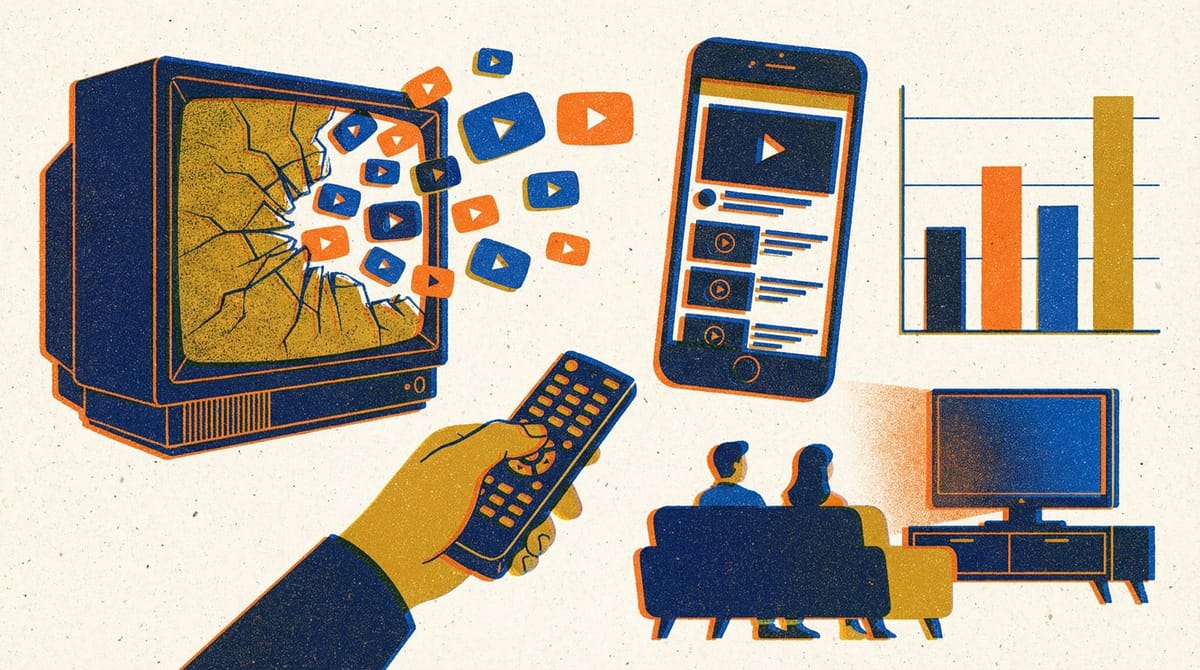
If you manage media budgets, there is a classification error quietly costing your brand real reach. Spotter's "Rise of Creator TV" report puts hard numbers on something a lot of buyers have felt but could not quantify: a growing tier of YouTube creators now delivers audiences that match or beat prime-time television. And brands are paying for it out of the wrong budget line.
The report identifies 6,600 YouTube channels that meet what Spotter calls "Creator TV" criteria: episodes over 22 minutes, 100K+ views per upload, connected TV as the primary viewing device, and a predictable publishing schedule. That is less than 0.02% of all social video channels. Together, they pulled 136 billion annual U.S. views and 26 billion hours watched in 2025. More than half of that viewing, 52%, happened on connected TV screens.
Those are television numbers measured by television methodology. But most brands still classify this inventory as "influencer" or "social media" spending, which means it gets a $50K to $200K allocation instead of the $2M to $5M that the same audience size would command from a TV or video budget. The measurement infrastructure caught up. The org chart has not.
The Comscore data makes this harder to ignore
Spotter partnered with Comscore to apply the same panel-based measurement used for linear TV and streaming to creator content. The comparisons are pretty striking. Comscore's data shows Jordan Matter generated 60% more time watched than Abbott Elementary on Hulu CTV. Dude Perfect pulled 82% more time watched than ESPN First Take. One family-focused creator ranked as the 8th most-streamed show across all U.S. streaming services.
I want to be careful here, because Spotter has deployed over $900 million in creator content licensing deals, so they have an obvious interest in making this case. But the Comscore methodology is the same third-party standard the rest of the TV industry uses. You can question Spotter's framing while still accepting the underlying measurement. And the measurement says these audiences are real, they are watching on the big screen, and they are watching for a long time.
YouTube itself backs this up from a different angle. Nielsen data from December 2025 shows YouTube at 12.7% of all U.S. TV viewing. The platform generated $40.4 billion in ad revenue last year, surpassing Disney, NBCUniversal, Paramount, and Warner Bros. Discovery individually. This is not a niche anymore. It probably has not been for a while.
The attention arbitrage nobody is pricing correctly
There is a second angle here that I think gets overlooked in the "creators vs. TV" conversation. The ad load difference is enormous. Creator TV content carries roughly 2.4 minutes of ads per half-hour. Linear TV runs about 8 minutes. That is 70% less clutter around your spot.
And the completion rates reflect it. Fifteen-second skippable ads on long-form creator content hit 70% completion, compared to 57% on shorter videos. Thirty-second skippable ads complete at 60% versus 39%. When you combine lower ad load with higher completion, the attention-per-dollar math gets lopsided fast.
There is also a trust gap working in creators' favor. A Magid study from January 2026 found 66% of viewers trust creator ads versus 33% who trust streaming ads. Branded search lift averages 138%. eCommerce visitation lift averages 220%. These are the kinds of downstream metrics that media planners building for performance should be looking at, and in most cases they are sitting in a spreadsheet that the influencer team maintains separately from the media plan.
(On paper, you would think the performance numbers alone would force a reclassification. But organizational inertia is a real thing, and honestly, a lot of media planning teams have built their entire workflow around the assumption that "creator" means short-form, low-reach, high-frequency. Updating that mental model takes more than a report.)
Why the budget bucket matters more than you would think
This is not just a labeling problem. Which budget a buy comes from determines the buying process, the measurement framework, the approval chain, and the negotiation leverage. When creator inventory sits in the influencer budget, it gets evaluated against influencer KPIs: engagement rate, cost per view, maybe brand lift if someone bothers. When it sits in the video or TV budget, it gets evaluated against reach, frequency, attention, and incremental reach over linear.
Digiday reported on this exact tension: long-form creators chasing bigger brand budgets but hitting the classification wall. The buyers who manage TV dollars often do not have creator buying in their mandate. The influencer team has the relationships but not the budget authority to write checks at TV scale.
The IAB's 2026 creator economy report projects $43.9 billion in creator economy spending, with 48% of buyers calling creators a "must buy." But "must buy" at what price? And from whose budget? Those are the questions that separate a $150K sponsorship from a $3M upfront commitment.
I think the brands that figure this out first get a genuine pricing advantage. Right now you can buy Creator TV inventory at influencer rates because that is how the market classifies it. Once the upfront buying process absorbs these Comscore comparisons (and YouTube's Brandcast on May 13 will push hard on exactly this), the pricing will adjust upward. The window where you are getting TV-equivalent reach at social-budget prices is probably not going to stay open much longer.
What this looks like in practice
If you are a paid social manager or media planner, here is where I would start. Pull your current creator spending and map it against the Comscore-verified Creator TV criteria: long-form, CTV-primary, 100K+ views, predictable schedule. Separate those buys from your short-form influencer partnerships. They are fundamentally different inventory types and should be measured differently.
Then run the comparison internally. Take your top three Creator TV placements and stack their reach, completion rate, and cost against your last linear TV or streaming buy. If the creator placements are delivering comparable or better attention metrics at a fraction of the CPM, you have a case for moving that budget line, or at least for getting the video buying team in the room.
YouTube has been automating parts of the creator partnership process, which makes it easier to execute these buys at scale. And the platform's expanding affiliate infrastructure adds another performance layer. The tools exist. The measurement exists. What is missing in most organizations is the internal conversation about where creator TV spending actually belongs.
And to be fair, some of this is not entirely the brands' fault. The creator ecosystem grew up inside social teams because that is where it started. Nobody planned for a world where individual creators would outperform network television shows in time watched. But that is the world we are in now, and treating it like an influencer line item is leaving reach and efficiency on the table.
The upfront season will force the conversation
YouTube's Brandcast is six weeks away, on May 13. It falls right in the middle of upfront season, when TV and streaming budgets get committed for the year. Spotter timed this report deliberately. The pitch is straightforward: if you are committing millions to streaming inventory measured by Comscore, you should be looking at creator inventory measured by the same Comscore methodology.
Markiplier's self-financed film Iron Lung pulling $17.8 million in domestic box office is the kind of proof point that makes this argument visceral for executives who still think of creators as people doing brand deals from their bedrooms. That is feature-film revenue from a YouTube creator's IP, without a studio.
I do not think every brand needs to reclassify creator spending tomorrow. But if you are heading into upfront planning without at least running the Comscore comparisons on your top creator buys, you are probably leaving the best pricing window you will get. The gap between what Creator TV inventory costs and what it delivers, measured by the TV industry's own standards, seems too wide to stay open through another upfront cycle.
The brands that move budget authority before the market reprices will get 12 to 18 months of arbitrage. Everyone else will pay TV rates for what they could have locked in at social rates. That is not a prediction about creators "winning." It is just how pricing works when measurement catches up to attention.
By Notice Me Senpai Editorial