Cutting Search to Fund Demand Gen Fails for the Same Reason Every Time
A thread on r/PPC this week drew 61 comments in under 24 hours. The post: "We pivoted our entire Q1 budget away from search to demand gen and the performance team is screaming." The comments are a mix of "what did you expect" and increasingly specific war stories from teams that tried the same thing. The pattern is so consistent it probably deserves a name.
The failure isn't that demand gen doesn't work. It does. The failure is a sequencing problem that shows up roughly 60 to 90 days after you flip the switch, and by then the damage to your pipeline is already done.
The Pond Gets Smaller Before the Ocean Gets Bigger
The mental model that keeps getting teams in trouble goes like this. Search advertising captures existing demand. Someone types "best project management software for remote teams" and your ad shows up. That person was already looking. You just intercepted them.
Demand gen does something completely different. It builds awareness and consideration among people who aren't actively shopping. Podcast sponsorships, LinkedIn thought leadership, conference booths, content syndication. The goal is to get into someone's head so that when they eventually do need project management software, your name is one of two or three they remember.
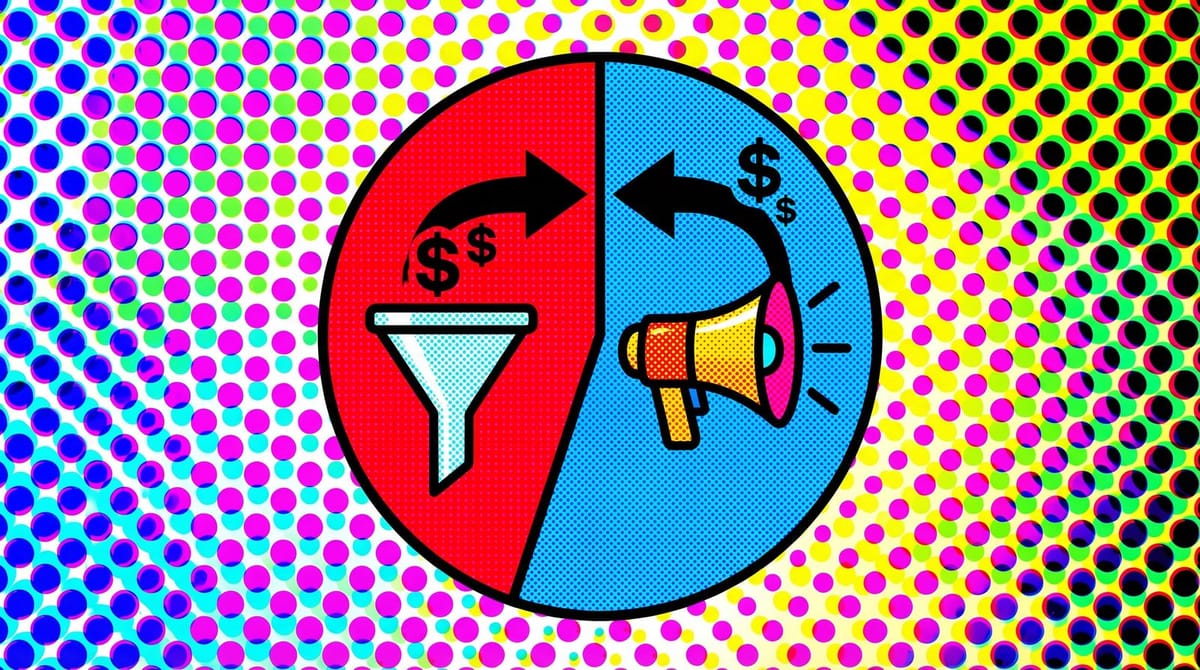
Both of these are real. Both generate revenue. But they operate on totally different timelines. Search delivers this quarter. Demand gen delivers in three to six months, sometimes longer. When you move budget from one to the other, you're borrowing from a system that pays out weekly to fund one that pays out quarterly. The math doesn't work unless you can survive the gap.
And most teams can't, which is exactly what happened in the thread.
Why 95% of Your Market Doesn't Care About Your Ad Right Now
Professor John Dawes at the Ehrenberg-Bass Institute published research on what he calls the 95:5 rule. At any given time, roughly 5% of potential buyers are actively in market for your category. The other 95% are doing their jobs, not thinking about your product, and will not respond to a bottom-funnel ad no matter how good your creative is.
Search captures that 5%. It's very good at it. That's why search has the highest intent signal of any paid channel. It's also why search budgets tend to be efficient: you're fishing in a stocked pond.
Demand gen reaches the 95%. The value is real, but it's deferred. You're planting recognition so that when someone in that 95% eventually enters the market (maybe six months from now, maybe eighteen), they already know your name. As Dawes puts it, if potential buyers basically know nothing about you, they have almost zero chance of buying from you.
The mistake isn't investing in demand gen. The mistake is defunding the channel that captures the 5% who are ready to buy right now, before the demand gen work has had time to move anyone from the 95% into the 5%.
The Budget Split Most Teams Get Backwards
According to eMarketer data, roughly 70% of advertising budgets go to capture channels (search, social retargeting, retail media) and only 30% to channels that create demand (CTV, audio, brand content). That ratio is too capture-heavy for long-term growth, and it's part of why budget allocation keeps lagging behind where the attention actually is.
But the fix isn't to invert it overnight.
The B2B Playbook recommends starting early-stage companies at 80% capture and 20% creation, then gradually shifting toward 60% creation and 40% capture as the brand matures. The key word is gradually. If your CPL is low but your pipeline isn't growing, you're overfunding capture. That's the signal to shift dollars upstream. But you shift incrementally, maybe 10% per quarter, while watching pipeline velocity at each step.
What you don't do is take a team that's been running 100% search and flip to 100% demand gen in a single quarter. The performance team screams because, well, they should. You just turned off the thing that was generating their leads without giving the replacement time to fill the gap.
Google Quietly Agrees With This, by the Way
It's sort of interesting that Google's own recommendation for Demand Gen campaigns (which are different from demand gen the strategy, confusingly) explicitly says to use them on top of maxed-out Search and Performance Max, not instead of those campaigns. The guidance from Google is that Demand Gen extends reach by starting earlier in the journey, catching people before intent has fully formed.
Even the platform selling you Demand Gen campaigns is telling you not to pull search budget to fund them. That's worth noticing.
The Uncomfortable Sequencing Reality
The actual move, from what I've seen work across the r/PPC threads and the broader industry conversation, looks more like this:
First, max out your search campaigns. If search is still converting profitably at the margins, there's no reason to cap it. Demand gen makes sense when search can't scale further, or when CPAs start climbing because you've exhausted the in-market pool.
Second, layer demand gen on with new budget, even if it's small. 10 to 15% of total spend is enough to start learning. Run it for 90 days before judging results, because the whole point is that returns are delayed.
Third, measure differently. Search gets measured on CPA and ROAS. Demand gen gets measured on pipeline velocity and branded search volume. If you hold demand gen to search-style metrics, it will always look like a failure. That doesn't mean it is. (PPC measurement is already complicated enough without applying the wrong framework to the wrong channel.)
Fourth, only reduce search allocation after demand gen is generating measurable branded lift. This typically takes two to three quarters. If you're still waiting for lift data and you've already cut search, you've skipped a step.
The r/PPC thread is a live case study of what happens when you skip steps two through four and jump straight to "move everything." The performance team isn't wrong to scream. They just lost their only source of qualified leads while the replacement is still warming up.
Harvesting and Planting Are Not the Same Job
The framing that gets teams into this mess is thinking about search and demand gen as two strategies competing for the same budget. They're not. They serve completely different functions at completely different points in the buyer journey.
Search is harvesting. Demand gen is planting. You can't stop harvesting to plant more seeds and expect to eat this quarter. You need to keep harvesting while the new crop grows.
I'd bet this same r/PPC thread shows up again in six months with a different poster and the same lesson. The pattern is that reliable. If you're the one making the budget case for demand gen right now, the strongest version of that case isn't "let's replace search." It's "search is maxed, and here's how we grow the total pool of people who eventually search for us."
That framing keeps the performance team fed while giving demand gen the runway it needs. It's less dramatic than a full pivot, and quite a bit less likely to end up as a cautionary tale on Reddit.