Dell Ranks Fifth in AI Commerce and Still Can't Convert the Traffic
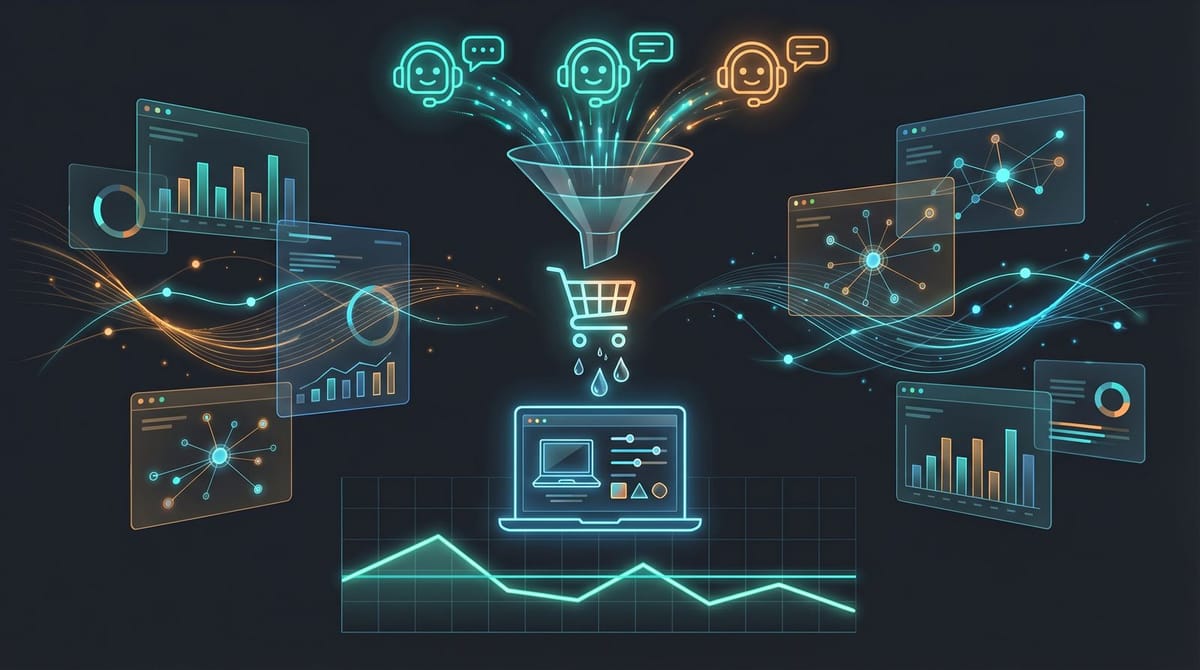
Dell is the fifth most visible ecommerce brand in AI-driven discovery, according to Digital Commerce 360’s new AI Commerce rankings. Traffic from ChatGPT, Perplexity, and Claude is growing. And Dell’s head of global consumer revenue programs, Breanna Fowler, is publicly unimpressed.
“Nothing to the point that is earth-shaking or completely shattering for me just yet,” she told interviewers. “I’m still one of those people that’s unimpressed by what agentic shopping is actually doing.”
That’s a notable admission from someone whose company is better positioned than most to benefit from AI-driven shopping. Dell ranks sixteenth in traditional ecommerce but jumps to fifth when AI surfaces are doing the recommending. The algorithms like Dell. Dell’s conversion data doesn’t like them back.
The Traffic Arrives. Then It Leaves.
The pattern Fowler described is one that any media buyer would recognize from early-stage channels. AI agents are excellent at narrowing down options. They can parse specifications, compare prices, surface reviews, and deliver a recommendation in seconds. What they can’t seem to do, at least not yet, is close the deal.
Fowler compared AI agent behavior to an aggregation layer, something closer to DoorDash or Instacart for electronics. Users arrive, explore configurations, learn about options. Then they leave. The sessions don’t translate into “anything that’s behaviorally consistent,” she said. “I’m a bit of a skeptic there.”
This tracks with broader data. A University of Hamburg and Frankfurt School study analyzed 50,000 ChatGPT-referred transactions across 973 ecommerce sites generating $20 billion in annual revenue. The findings were blunt: affiliate links converted 86% better than ChatGPT referrals. Organic search outperformed ChatGPT by roughly 13%. ChatGPT underperformed every traditional channel except paid social.
Researcher Christian Schulze put it plainly: “People don’t use ChatGPT as the last thing before purchase, but instead, check out other sources and then buy.”
The Per-Session Numbers Tell a Different (Partial) Story
The conversion picture isn’t entirely one-sided. Depending on what you measure and how, some of the data looks more encouraging.
Metricus’s 2026 Shopify data shows ChatGPT referrals converting at 1.9% to 2.4% for consumer electronics, compared to 1.2% to 1.8% for Google organic. That’s a meaningful per-session lift. But consumer electronics is the outlier. Apparel referrals from ChatGPT underperform organic by about 15%. And across all categories, ChatGPT sessions still represent roughly 0.2% of total ecommerce traffic.
So you have a channel that sometimes converts better on a per-session basis, but the session volume is functionally tiny, and the behavior is, as Fowler described it, inconsistent.
Adobe’s holiday 2025 data showed AI referrals surging 752% year over year. I think the mistake a lot of teams are making right now is conflating that growth percentage with actual revenue impact. Going from 0.02% to roughly 0.17% of sessions is technically a 752% increase. It’s also still irrelevant to your quarterly targets.
Dell’s Real Investment Isn’t in Agentic Commerce
The part of the Digital Commerce 360 piece that stuck with me was where Fowler redirected the entire conversation. She didn’t want to talk about agentic shopping. She wanted to talk about search.
“If I can’t find your products easily and effortlessly, no amount of content and configurator capabilities... nobody really gives a crap about that stuff.”
Dell’s actual bet is on on-site search quality. Not because they think AI agents are irrelevant, but because the bottleneck is the same regardless of how someone arrives. A customer from Google, from ChatGPT, from a link in someone’s Slack channel: they all hit the same search box. If the search experience is poor, it doesn’t matter which AI agent recommended them.
This is a quietly contrarian position. Most of the ecommerce industry is pouring resources into AI-optimized product feeds, structured data for LLMs, and agentic checkout integration. Dell is saying something simpler: fix your search. The rest sorts itself out.
Why Configurable Products Expose the Agent’s Limits
There’s a structural reason Dell’s AI traffic doesn’t convert well, and it has more to do with product complexity than agent sophistication.
Buying a Dell laptop isn’t an impulse decision. You’re choosing a processor, RAM, storage, display size, maybe a graphics card. That’s a configurator workflow that involves, as Fowler described it, “a fair amount of shipping and exploration and learning.” AI agents can recommend a product category, but they can’t walk someone through a 12-option configuration screen. Not well, anyway. Not yet.
This matters beyond Dell. Any product with meaningful customization (B2B software, build-to-order hardware, subscription services with multiple tiers) is a category where AI agent referrals will probably underperform for a while. The agent gets you to the parking lot. You still have to walk through the store yourself.
Standardized, commoditized products tell a different story. The Metricus data showing consumer electronics outperforming likely skews toward simple purchase decisions: right product, right price, buy. An AI agent handles that calculus fine. Configuring a $2,400 workstation is a different kind of problem entirely, and one that most agents aren’t built to solve.
Fix the Search Bar Before You Build the Agent Strategy
If I were running ecommerce right now, there are three things I’d prioritize based on what Dell’s data and the Hamburg study suggest.
First: set up proper attribution. Most analytics platforms lump AI referrals under “direct” or “other.” If you’re on GA4, create custom channel groupings that capture chat.openai.com, perplexity.ai, and claude.ai as distinct referral sources. You can’t evaluate a channel you aren’t measuring.
Second: compare per-session, not absolute volume. AI referral sessions sometimes convert at equal or better rates for certain product types. The volume is still negligible for most sites, but the per-session signal tells you whether the channel has potential or is just noise.
Third, and this is Fowler’s point that I think matters most: invest in your on-site search before you invest in agentic commerce features. Whatever traffic AI agents eventually send you, those visitors are going to search your site. If your search returns irrelevant results, you’ve wasted whatever trust the AI agent built for you. On-site search has been a conversion bottleneck for years. AI agents just made the gap more obvious.
We covered a related angle on this earlier this week. AI search queries require fundamentally different CTAs than traditional shopping behavior. Dell’s data reinforces that from the conversion side. Getting the traffic was never the hard part. Converting visitors who arrive with a researcher’s mindset, not a buyer’s, is the problem most ecommerce teams haven’t started solving yet.
Notice Me Senpai Editorial