Sponsored Stores Hit Google AI Mode (and Organic Links Landed on Top)
Search analyst Glenn Gabe flagged it on X last Wednesday afternoon: a "Sponsored Stores" unit sitting inside a Google AI Mode product detail panel, right above the organic "All stores" block. A day later, Search Engine Roundtable wrote it up. Google, as of this morning, has said nothing.
If you run paid search for a retailer, this is the update you were half-expecting and half-dreading, in that order. AI Mode is being positioned as the new shape of search. Roughly 75 million people use it daily. The whole time, advertisers have been waiting to find out whether ad inventory in there would look like standard Shopping, something new, or nothing at all.
Turns out it is all three, at once, in different places.
What Gabe actually saw
Two things surfaced inside the same session, both triggered by a query for "Gap men's chinos."
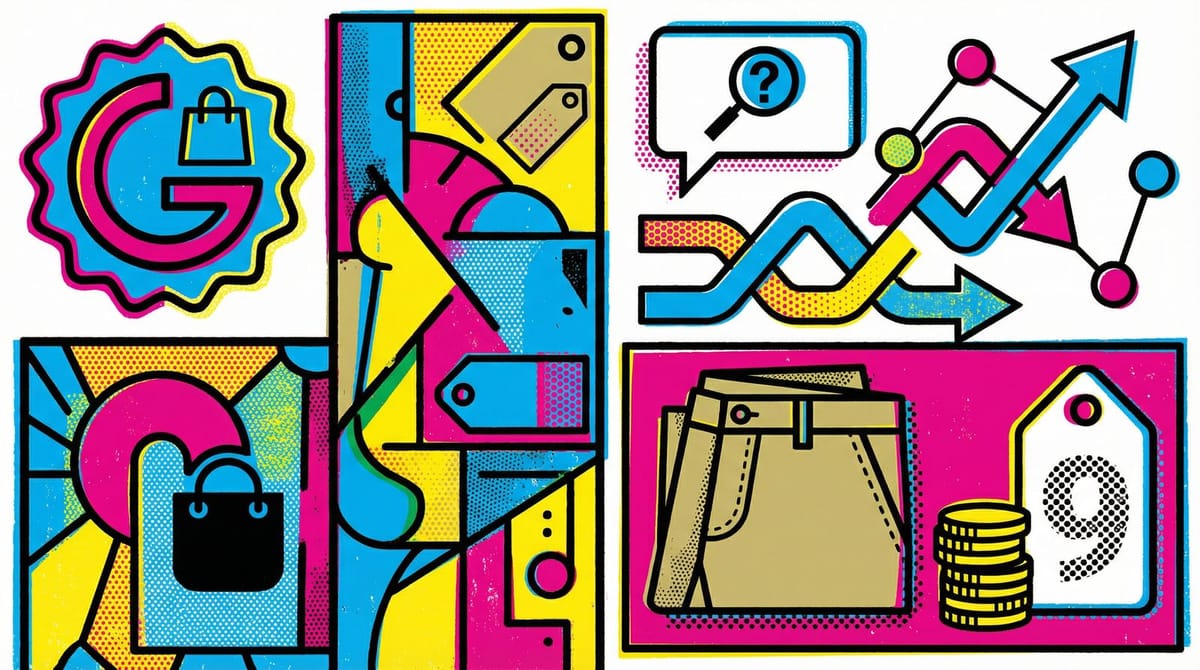
The first was the sponsored stores unit. Inside the product detail panel (the right-hand card that opens when you click a product AI Mode has surfaced), Gap appeared as a paid merchant listing at $29.00, marked down from $59.95. Directly below it, the organic "All stores" section ran a near-identical Gap listing at the same price, with a $5 delivery fee, an April 3-7 delivery window, and a 4.7/5 rating from 1,413 reviews. Same retailer, two placements, one of them paid. That is new inventory, not a format tweak. PPC Land walked through the details the next morning.
The second one, and the one I keep coming back to, was the "Quick results from the web" block. Before the AI answer even finished generating, two organic gap.com links appeared at the top of the response. Not links embedded in the answer. Links shown above it, while the model was still composing. Search Engine Roundtable documented the same behavior the following day.
On paper, that is organic SEO getting a better spot than it had a week ago. In practice, I would be careful about assuming this is a permanent gift.
Why this is a bigger deal than the coverage suggests
Most of the writeups so far have led with the sponsored stores piece, which makes sense. It is the first confirmed ad unit inside AI Mode outside of the expected Shopping feed. But the monetization pressure itself is not really the news. Google already told advertisers back in January that AI surfaces were getting ad inventory in 2026. The open question was what it would look like and where it would sit.
What matters is the placement pattern, not the placement itself. Google is running two experiments in the same response:
- Sponsored stores on top of the product detail panel, where intent is highest and organic retailers are losing premium positioning.
- Organic quick links on top of the AI answer, where impatient users bounce before the model finishes.
Taken together, they hint at Google's actual monetization thesis for AI Mode. The generative answer itself is not the ad slot. The pre-answer and post-click moments are. Those are where people actually decide what to click.
Adthena's tracking has been the only reliable read on ad frequency across AI surfaces. In November 2025 they picked up ads inside AI Overviews at 0.052%, which was 13 instances across 25,000 monitored SERPs. By early April 2026, their reporting puts that closer to 0.12% in the US and 0.05% in Australia. Still niche. But more than doubling in under five months. Year-over-year growth in auction competition on AI surfaces sits around 35%. That is not a test. That is a ramp.
The number that is probably going to get worse
Seer Interactive ran an analysis of 25 million organic impressions and 1.1 million paid impressions across queries with and without AI Overviews. On the queries where AI Overviews appeared, organic CTR fell 61% (from 1.76% to 0.61%) and paid CTR fell 68% (from 19.7% to 6.34%). Search Engine Land has the full breakdown. Those numbers come from AI Overviews, not AI Mode, so I would hedge on how directly they transfer. The direction is pretty clear regardless. When Google puts a generative answer layer on top of a results page, everything below it gets demoted.
AI Mode is more aggressive than AI Overviews in this sense. The whole page is the answer. You do not scroll past it to blue links. What sponsored stores and quick results are doing is rebuilding the parts of a SERP that click-happy users actually use, just moving them inside the AI Mode container.
Three moves before Google ships official docs
If I were running paid search for a retailer right now, three moves, in order.
First, pull the product listings feed in Google Merchant Center and run a full audit. GTINs, price match with landing page, MPN, brand field, shipping data, returns policy. Every previous time Google has opened new Shopping inventory, the feeds with the cleanest, most complete data got the first impressions. Sponsored stores looks like it pulls directly from Merchant Center data, so the lever here is feed quality, not bids. Messy feed, no impressions. I have seen this enough times to say it with some confidence.
Second, go into Ads Manager and segment your existing Shopping and PMax performance by "Search Network" placement over the last 30 days. You are looking for the first hints of AI Mode traffic showing up as a distinct segment or appearing in the top search terms report. Google will be slow to officially label it. The impressions are already flowing somewhere.
Third, and this one is the cheapest: brand-term coverage. On a query like "Gap men's chinos," Gap holding the sponsored stores slot keeps a competitor from buying against their brand term inside the AI Mode panel. Your brand defense budget (yes, the one your CFO asks you to cut every quarter) is now covering surface area you did not know existed. Do not cut it this month. Probably not next month either.
One thing I do not have a clean answer for
What is less clear is the optimization lever for sponsored stores itself. We do not know if it is bid-based, feed-quality based, or some mix of the two. We do not know if there is a separate reporting segment coming or whether it will get rolled into existing Shopping metrics. We do not know how frequently it triggers outside the narrow retail verticals Gabe tested against. Those are real questions for anyone booking time with their Google reps next week.
If your account executive has not been briefed yet, they have not been briefed. That is normal for Google. The features appear, the docs come later, and the teams who test earliest build the case studies the rest of the industry reads six months later.
For more context on how AI search is reshaping shopping intent, NMS dug into the 29 million AI query dataset last week. One of the takeaways: traditional ecommerce CTAs break when the user is not on a product page yet. Sponsored stores is Google's first real attempt at reinserting product-page intent back into a conversational search flow. Whether it works depends on whether retailers actually show up to test it this month.
Test it before the reports catch up
The gap between "this feature exists" and "Google has a reporting view for it" usually runs eight to twelve weeks. That is the stretch where anyone paying attention can learn how it behaves without competing against the whole market for the same impressions. I would not wait for the official announcement. It may never come in the form you are expecting.
By Notice Me Senpai Editorial