Google Shopping CTR Rose to 1.55% Because AI Overviews Ate the Bad Queries
Smarter Ecommerce analyzed 175 billion Google Shopping ad impressions from mid-2025 to mid-2026 and found median impressions fell from about 1.85 million to 1.4 million while median click-through rate rose from 1.20% to roughly 1.55%. The CTR gain is mostly a shrinking-denominator effect: Google appears to route low-click-probability queries into AI Overviews and keep Shopping ads on high-intent ones. Every Shopping CTR benchmark set in 2025 needs a rebaseline.
If your Shopping campaigns showed a CTR lift over the past year and someone on the team took credit for it, I have mildly bad news. The lift is probably real in the arithmetic sense and fake in every sense that matters for planning. Mike Ryan at Smarter Ecommerce posted the data on LinkedIn, and Barry Schwartz picked it up at Search Engine Roundtable this morning under the name "reverse crocodile effect," which is a slightly silly label for a fairly serious accounting problem.
The crocodile, and why it runs backwards for Shopping
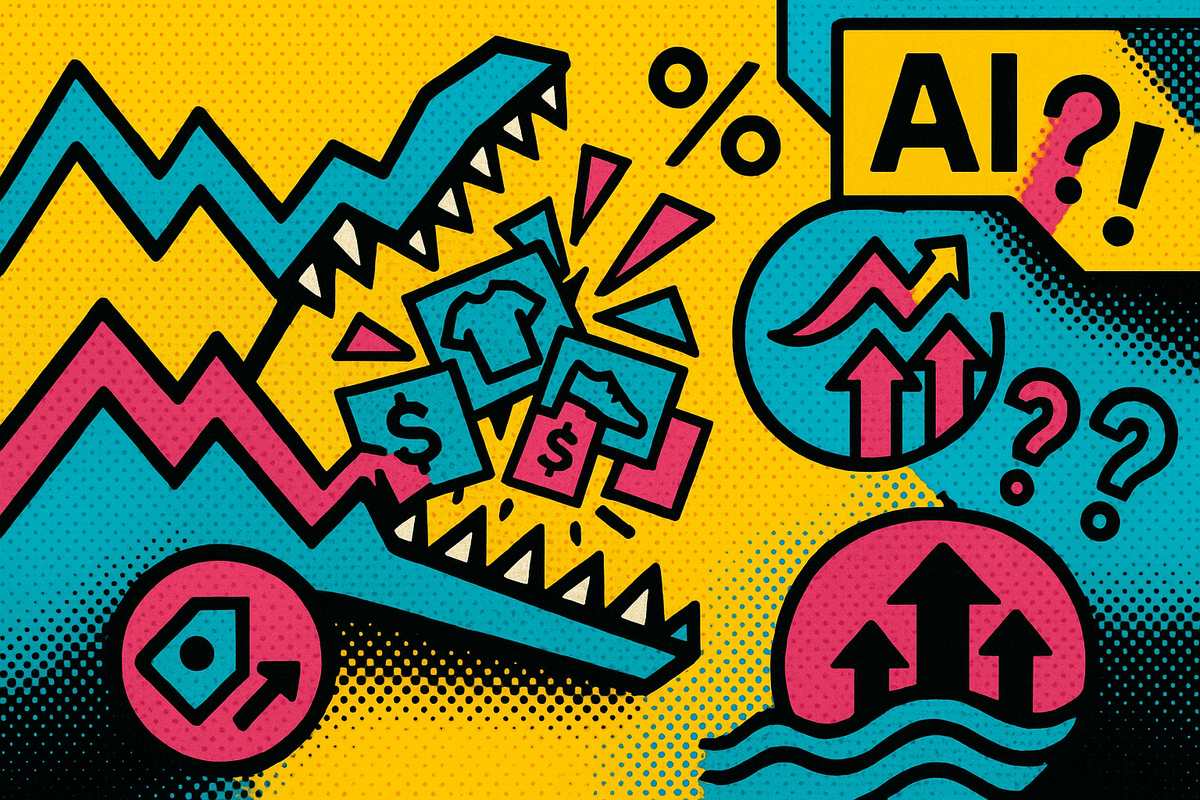
The original crocodile effect is the publisher-side chart everyone has seen by now. Since AI Overviews rolled out, organic impressions in Search Console went up and clicks went down, and the two lines opened like a jaw. Google shows your page in more places, including as a citation under an AI answer, but fewer people bother to click through because the answer already ate the query.
Shopping ads are doing the opposite. Impressions are falling, CTR is rising, and the jaw opens the other way. On the surface that looks like Google got better at picking which auctions to show your products in. Ryan's read is less flattering, and I think it's right. His hypothesis, quoted directly: "Google checks the predicted CTR of a given query and serves AIOs preferentially for lower-probability queries in order to preserve revenue."
Walk through what that does to your numbers. Say last year you served on 100 queries, and 40 of them were the mushy research-phase ones where nobody clicked a product tile anyway. Google now answers those 40 with an AI Overview and keeps Shopping on the 60 where people actually buy. Your impressions drop 40%. Your click count barely moves. Your CTR jumps because the denominator got pruned of exactly the queries you were worst at. One commenter on Ryan's post, Pablo Alvarez, put it more bluntly than I would have: the rising CTR "isn't performance, it's survivorship."
It's a bit like a restaurant chain closing its ten worst locations and then announcing record revenue per store. Technically true. Nobody at those ten locations learned to cook.
Google has more or less said this out loud
None of this requires a conspiracy theory. On the Q3 2025 earnings call, Google's chief business officer Philipp Schindler told analysts that with ads above, below, and within AI Overviews, "overall, we see the monetization at approximately the same rate," per the transcript at The Motley Fool. For a feature that removes the classic results page from a large share of searches, flat monetization is a remarkable outcome. Something has to be steering the AI answers toward the queries that were never going to pay.
The Semrush data points the same direction. Their commercial-intent AI Overviews study, published in July and covering more than 600,000 keywords from November 2025 through April 2026, found the share of commercial SERPs carrying an AI Overview grew 71% in six months. Transactional queries, the ones closest to a purchase, actually declined 5% over the same window. Ads and AI Overviews now appear together roughly twice as often as a year earlier. So AI Overviews are expanding hard into "which laptop should I get" territory and retreating from "buy macbook air m4 13 inch," which is precisely the split you'd expect if predicted click value were deciding where the AI answer goes.
In fairness to Google, some of this is just sensible product design. Nobody wants an eight-paragraph AI essay when they've typed a SKU. But the effect on your reporting is identical whether the motive is user experience or revenue protection, and honestly, the motive doesn't change what you should do about it.
Why your 2025 benchmarks are quietly lying to you
Three metrics broke at once, and they broke in a direction that flatters everyone, which is why nobody flagged it.
CTR first. If your Shopping CTR target was set against a 2025 baseline, whether from your own history or from published benchmarks, that target now sits on a different query mix. A campaign holding at 1.2% today might be underperforming badly, because the median account climbed to 1.55% just by standing still. From what I've seen, most agency reporting decks still treat CTR as a creative or feed-quality signal. It has become, at least partly, a Google-query-selection signal.
Impression share second. Impression share is your impressions divided by the impressions you were eligible for. When Google removes queries from the Shopping-eligible pool, your eligible impressions shrink and your share can rise with zero change in spend or rank. A rising impression share number over the last twelve months does not mean you won more auctions. It may mean fewer auctions happened.
Reporting third, and this one is the most annoying. Google's own help page on ads in AI Overviews says Shopping ads from Search, Shopping, and Performance Max campaigns are eligible to show inside the AI Overview, that you cannot opt out, and that these placements are reported as Top Ads with no separate breakdown yet. Ryan's earlier write-up on AI surface placements makes the same point: the only proxy you have is watching Top Ads volume and performance for unexplained shifts. So the impressions you lost to AI Overviews and the impressions you gained inside AI Overviews land in the same undifferentiated bucket. Good luck reconciling that.
Paid search more broadly seems to hold up better than organic, which is the small consolation here. Seer Interactive's 2026 CTR update, covering 53 brands and about 5.5 million tracked queries, put paid CTR at 16.21% on queries where an AI Overview appeared versus 21.85% where it didn't, as of February 2026. Text ads take a hit when the AI answer shows up, but it's a haircut rather than a collapse. Shopping tiles, being visual and sitting above or inside the answer, may be insulated even further. Which again explains why Google would rather keep them on the high-intent queries.
A CTR that rises while clicks stay flat is a chart of what Google removed, not of what you improved.
The 20-minute rebaseline I'd run before the next reporting cycle
You don't need a new dashboard for this, just an uncomfortable comparison. Open Google Ads, filter to Shopping and Performance Max campaigns, and pull June through August 2025 against June through August 2026. Put four columns side by side: impressions, clicks, CTR, and conversions.
Then apply a simple rule. If CTR is up more than 15% and impressions are down more than 15%, treat the CTR movement as a query-mix artifact and stop citing it. The number that tells you whether anything improved is the click count. Clicks flat within plus or minus 10% while CTR climbed 20%: nothing got better, the denominator got smaller. Clicks up alongside CTR: fine, you may actually have improved feed quality or bids, and you can say so with a straight face.
Second pass, ten more minutes. Run the search terms report for both periods and sort by terms that had impressions in 2025 and none in 2026. That list is, in effect, Google's opinion of your least monetizable queries. In most cases I've seen described, it will be dominated by generic and comparison phrasing. You have two options with it. Either accept that Google is now handling the research-phase traffic with an AI answer and shift your product-page and content strategy to try to get cited there, or bid on those terms explicitly through Search with broad match, which Ryan's write-up notes can also serve Shopping ads into AI surfaces. I lean toward the first, mostly because paying to force your way back into queries Google's own model thinks won't click is a strange use of budget.
Third, and this is a quick one: any automated rule or script in your account that triggers on CTR thresholds, whether it pauses products, shifts budget, or flags "winners," needs its thresholds raised by roughly the size of the median shift, so about 25 to 30%. Otherwise you'll be rewarding products for surviving Google's pruning instead of for selling.
Related: if you run Shopping and haven't looked at the new automated promotions feature, we covered how Google will now pull discounts off your landing page and run them as ads. Same theme, really. Google keeps taking over more of the decisions inside the Shopping surface, and your reporting keeps pretending the decisions are yours.
Where this goes next, and a number to hold me to
The "reverse crocodile" is probably transitional. Ryan frames it as a both/and phase, where Google shuffles queries between the AI answer and the ad unit until it can put Shopping ads inside the AI answer at scale. That's already happening in AI Mode: PPC Land reported Google formally announced Shopping ads inside AI Mode conversations in February, when that surface had already passed 75 million daily active users. Daily, not monthly, which for once is the flattering number. Once Shopping tiles are native to the AI answer, the impressions Google is currently holding back could come roaring back, except now inside a format where your CTR history means nothing at all.
My guess, and I'd put maybe 60% on it: by the end of 2027, median Shopping impressions in this same dataset drop another 20% and median CTR pushes past 1.8%, and then the line snaps back as in-AIO Shopping placements get reported separately and dilute the pool again. If that plays out, anyone who spent 2026 tightening targets against the inflated CTR will spend 2028 explaining why performance "fell" the moment reporting got honest.
I keep going back and forth on whether the pruning is actually bad for advertisers. Losing the queries you were worst at, at no cost, is kind of a gift. The problem was never the pruning. The problem is that every dashboard in the industry reads it as a win you earned, and budgets get set on that story.
So maybe the honest version of the advice is smaller than it sounds. Stop reporting Shopping CTR as a performance metric for a while. Report clicks and conversions, note the impression decline as a Google-side change, and wait for the reporting to catch up to the placements. It's less impressive in a deck. It's also true, which has to count for something.
Notice Me Senpai Editorial