Harley-Davidson Launched a Brand Reset Before Anyone Knows the Plan
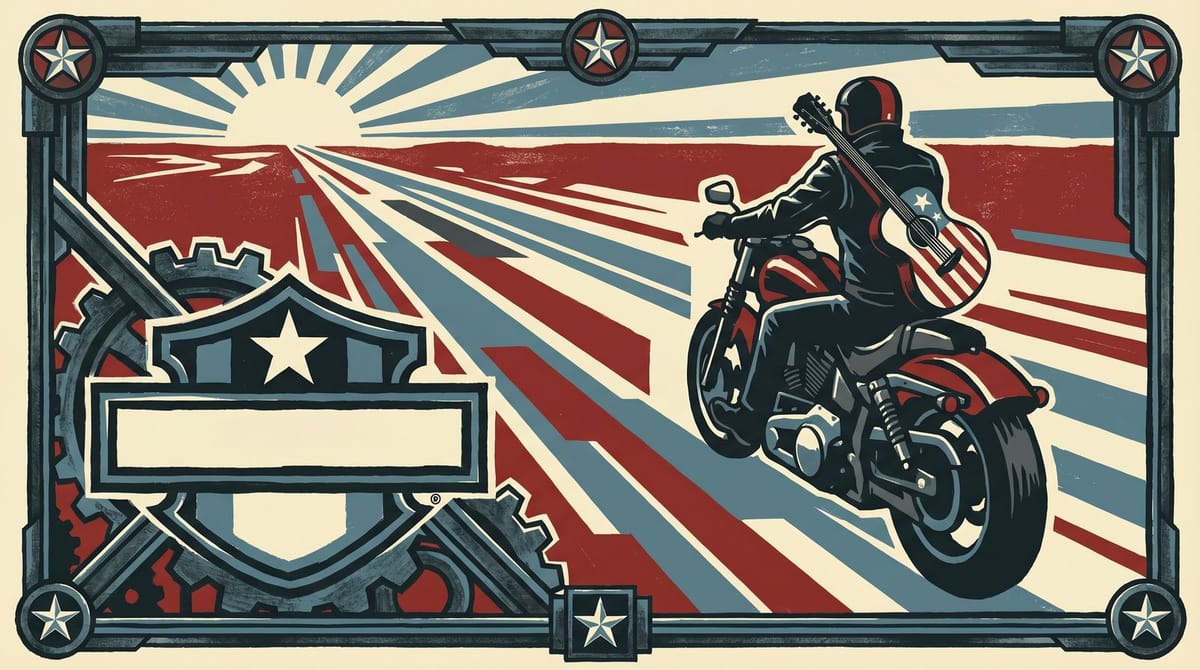
Harley-Davidson just launched RIDE, a new global brand platform set to Willie Nelson's "On the Road Again," complete with the classic bar and shield logo front and center and footage of real riders on open roads. It looks and sounds exactly like what you'd want a Harley-Davidson campaign to look and sound like.
The part that makes it interesting for anyone who thinks about brand strategy: the company lost $279 million in Q4 2025. Revenue dropped 14% to $4.47 billion for the full year. Global retail sales fell 12% to 132,535 motorcycles. And the actual strategy for fixing any of that, something called WireForward, won't be announced until May.
So Harley is running the brand play before the product play. That sequencing choice is probably the most revealing marketing decision they've made in years.
The Campaign Looks Great. The Timing Is the Real Story.
CEO Artie Starrs called RIDE a "full reset of the brand" ahead of the company's strategy rollout next month. The campaign itself is solid, if predictable: authentic rider footage, Willie Nelson, heritage logo restoration, national broadcast and streaming placement. The tagline is "More riders. More rides. More freedom. More stories to be told."
None of that is surprising on its own. Heritage brands in trouble almost always reach for nostalgia first. What IS surprising is that Starrs explicitly framed this as preceding the strategy, not supporting it. Most brand platforms launch alongside a product roadmap or at least a strategic narrative. Harley launched theirs a month before one exists publicly.
The read I keep coming back to: they think the brand perception problem is more urgent than the product problem. For a company selling 12% fewer motorcycles per year, that's a genuinely bold call to make.
Five Years of Going Premium Left Nobody at the Door
To understand why RIDE matters, you need the context of what it's replacing. From 2021 to 2025, Harley ran a strategy called "The Hardwire" under former CEO Jochen Zeitz. The idea was intentionally narrow: fewer models, higher margins, focus exclusively on heavyweight Touring and Custom bikes. Premium everything.
On paper, it worked for a while. Margins improved. Average selling prices went up. But the consequences compounded quietly. New riders had no entry point into the brand. The average Harley buyer kept getting older. The dealer network, squeezed between lower volume and higher margin expectations, started losing confidence in the whole direction.
By Q4 2025, the full picture was hard to ignore. A $279 million quarterly net loss. EMEA retail sales down 24% in Q4 alone. Asia Pacific off 15% for the full year. The motor company division flipped to a $29 million operating loss after posting $278 million in operating income just the year before. Tariffs added another $67 million in costs on top of everything.
Starrs, who took over from Zeitz, put it plainly in February: the company is taking "deliberate actions to stabilize the business, restore dealer confidence, and align wholesale activity with retail demand." That's CEO-speak for admitting the previous strategy broke the distribution channel.
The 2026 outlook reflects that uncertainty. Harley is guiding for somewhere between a $40 million operating loss and a $10 million profit at the motor company level. That's a range wide enough to include both "getting worse" and "barely stabilizing." Global retail projections sit at 130,000 to 135,000 units, essentially flat with 2025 at best.
The Sprint Is the Part Worth Watching
While the RIDE campaign gets the press attention, the product move that will actually decide whether this reset works is the Sprint. It's an entry-level motorcycle priced under $6,000, confirmed for 2026. The name is a callback to Harley's Aermacchi-era Sprint models from the 1960s and 70s.
This matters because Harley's previous attempts at entry-level have all failed for roughly the same reason. The Street 500 and Street 750 were affordable but felt like compromise products. LiveWire went electric and premium simultaneously, a combination that essentially marketed itself to nobody. (It eventually got spun off into its own publicly traded entity, which tells you roughly how well that went.)
The Sprint seems to be trying something different. Sub-$6K pricing puts it in direct competition with Honda and Yamaha for first-time riders, not just people trading down within the Harley ecosystem. That's a completely different customer acquisition strategy than anything Harley has run in decades.
From what I've seen watching brand extension attempts across industries, the product alone almost never solves the access problem. You can build a cheaper motorcycle, but if the brand screams "expensive lifestyle for 55-year-old men," the 28-year-olds aren't walking into the dealership to find out.
A cheap Harley is not aspirational. A Harley that reconnects people with the joy of riding, then offers a $6K way to try it, is a different proposition entirely.
That, I think, is why RIDE had to come first.
The Sequencing Problem Every Heritage Brand Eventually Hits
There's a pattern here that's worth pulling apart. We wrote recently about Nike optimizing Converse into a 15-year revenue low. The mechanism was similar: a heritage brand with deep cultural equity tried to modernize through product and distribution decisions, lost the thing that made people care, and watched revenue decline while the spreadsheet metrics said everything was fine.
Harley did the inverse. Where Converse went too broad (too many SKUs, too many channels), Harley went too narrow (only premium, only heavyweight). Both ended up in the same place: declining revenue and a brand story that no longer matched the business reality.
Coca-Cola's Hilltop restage for America250 is probably the better comparison for what Harley is attempting with RIDE. Coke leaned into owned cultural IP at a moment when the brand needed emotional re-anchoring, not product innovation. It worked because Coca-Cola doesn't have a customer acquisition problem. Everyone already drinks Coke. They just needed people to feel something about it again.
Harley's situation is harder. They need the emotional re-anchoring AND the customer acquisition fix. RIDE is supposed to handle the first part. Sprint has to handle the second. And the sequencing seems deliberate: if Sprint launched first, without the brand reset, it would just look like desperation. A budget motorcycle from a brand that's bleeding money is not a story anyone forwards to a friend.
Four Months to Make a $6K Harley Feel Like It Belongs
Harley has roughly a four-month window between the RIDE launch and whenever the Sprint hits dealer floors. In that window, they need to shift brand perception enough that a first-time rider can walk into a Harley dealership and feel like the place was made for them, not just for their dad.
If you're running a heritage brand that needs younger customers, the order of operations matters more than most marketers give it credit for. Product changes without emotional permission feel like desperation. Brand campaigns without product changes feel like stalling. Harley is betting they can thread the needle by doing both, in the right sequence, fast enough that the financials don't force a different conversation in the boardroom first.
The stock jumped over 6% on the RIDE announcement, which suggests investors liked the narrative. But stock price is not the same thing as dealership foot traffic. Retail demand is the metric that actually matters here, and it has been heading in one direction for five consecutive quarters.
I'm genuinely not sure whether this works. RIDE itself is a well-executed campaign. Sprint looks like a real product, not a token gesture. And the sequencing makes strategic sense on paper. But four months is either enough time to reset a 123-year-old brand's cultural positioning, or it's not nearly enough. Retail numbers in Q3 will be the first real signal either way.
Notice Me Senpai Editorial