Nike Optimized Converse Into a 15-Year Revenue Low
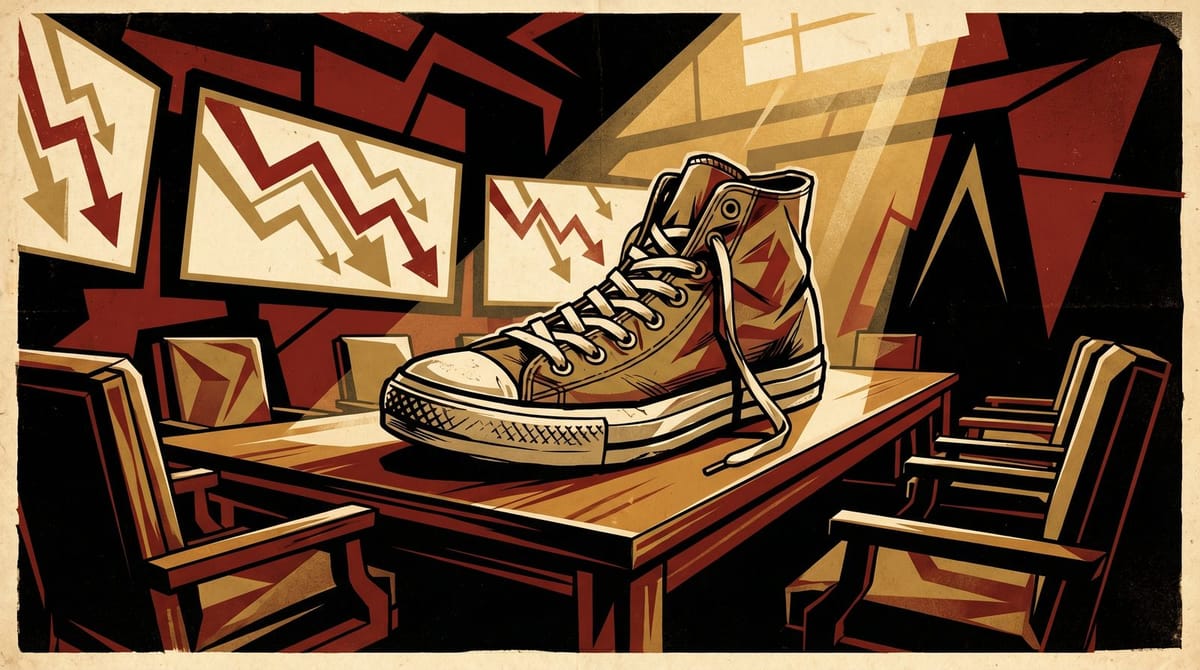
Converse just posted $264 million in quarterly revenue. That's a 35% drop year over year, the steepest decline in 15 years, and the third consecutive quarter of accelerating losses. The trajectory: down 27%, then 30%, then 35%.
The coverage has mostly framed this as "heritage brand struggles in competitive market." Which is a polite way of saying nothing. Converse's problem isn't competition. New Balance and Asics are heritage brands too, and they've been having the best stretch either company has seen in decades. The difference is what happened to Converse while it was inside Nike.
The Chuck Taylor Didn't Fail. The Management Layer Around It Did.
Nike bought Converse in 2003 for $309 million. For roughly a decade, it mostly left the brand alone. Converse had its own identity, its own distribution, its own cultural positioning. Then Nike started applying the same operational playbook it uses for everything: centralized decision making, DTC channel prioritization, and the assumption that scale efficiencies work on cultural products the same way they work on performance footwear.
They don't.
The DTC push that Nike ran across its entire portfolio hit Converse especially hard. When Nike pulled back from wholesale partners to drive more sales through its own digital channels, Converse lost shelf space at the retailers where it actually mattered. The brand wasn't showing up in the places where its customers casually discovered it. Instead, Nike funneled Converse into the same digital infrastructure built for $180 running shoes, where the Chuck Taylor's $60 price point and slower purchase cadence made it look like a bad performer by Nike's own internal metrics.
Yates Jarvis, who runs brand consultancy 2 Visions, told Digiday that Converse's core issue is it's "iconic and it has not been able to shift" consumer perception enough to expand the product line. That's fair as far as it goes. But I think it misses something bigger. Converse didn't need to expand. It needed to be curated. And curation is the one thing Nike's management system, built for volume and velocity, is structurally incapable of doing well.
The Numbers Tell a Story Nike Won't Say Out Loud
Annual revenue fell 19% to $1.7 billion in fiscal 2025, down from $2.1 billion the year prior (which itself was already a 14% decline). The Q3 2026 result of $264 million, down 37% on a currency-neutral basis, hit every geography simultaneously. Not a regional soft patch. The brand is losing ground everywhere.
In February, Converse started laying people off. In March, Nike filed regulatory paperwork revealing roughly $300 million in restructuring charges. CEO Elliott Hill's public line has been that Converse "will remain an important part of the Nike, Inc. family." If you've spent any time around corporate communications, you recognize that sentence. It usually shows up about 18 months before the opposite happens.
Nike's own problems haven't exactly helped. The company's aggressive DTC pivot under former CEO John Donahoe produced a 20% single-day stock drop, roughly $28 billion in market cap evaporating, when quarterly results revealed the strategy wasn't working. Digital sales fell for the first time since 2015. Nike is now scrambling to rebuild wholesale relationships it spent years deliberately dismantling.
Converse got caught in that blast radius. The brand was never going to thrive inside a system optimized for moving 50 million pairs of Air Force 1s per year. But nobody at Nike seems to have asked that question until the revenue chart started pointing straight down.
ABG Is Watching (and Their Reebok Playbook Works)
Authentic Brands Group, the firm that bought Reebok from Adidas in 2022 for $2.5 billion and turned it around, is reportedly monitoring Converse for a potential acquisition. ABG CEO Jamie Salter has said publicly that he expects Reebok to reach $10 billion in revenue, roughly doubling from where the brand sat at acquisition. ABG's full portfolio now does $38 billion in annual retail sales globally.
Their playbook is consistent: find brands with residual cultural equity that are being mismanaged by larger corporate parents, buy them at a discount, and run them through a licensing model that prioritizes brand health over quarterly revenue targets. The key with Reebok was reducing corporate overhead while expanding through licensing partners who actually understood the brand's specific customer. Less centralized infrastructure, more distributed expertise. Close to the opposite of what Nike did with Converse.
Converse, with its 100-plus year history and a silhouette that still shows up at every major fashion week, fits ABG's acquisition profile almost perfectly. ABG recently picked up a 51% stake in Guess, following the same pattern. My guess is we see some kind of resolution on the Converse ownership question within the next 12 months. When a subsidiary posts three consecutive quarters of accelerating declines, the board conversation tends to move faster than the press releases let on.
A Collaboration Blitz That Reads Like a Pitch Deck
In recent weeks, Converse has announced releases with Tyler, the Creator, a collaboration with Noah, and a signature shoe for NBA player Shai Gilgeous-Alexander. They're also getting product placement in "Project: Hail Mary." On paper, that's exactly the kind of cultural programming the brand needed.
The timing makes it hard to read as purely organic, though. When you're posting 35% revenue declines and simultaneously ramping up splashy cultural partnerships, the signal to the market is fairly transparent. You're demonstrating that the brand still has a pulse before someone makes an offer.
I don't think the collaborations themselves are bad. The Tyler partnership in particular has consistently produced shoes people genuinely want. But a handful of collaborations can't undo what a decade of operational mismanagement broke. The bottleneck was never the shoes.
The Heritage Brand Pattern That Keeps Repeating
If you're managing a brand with genuine cultural history inside a larger corporate portfolio, Converse might be the most instructive case study of the year. Because this pattern keeps showing up, and the ending is always roughly the same.
We saw a version of it with Allbirds, which optimized for DTC metrics until the brand hollowed out and eventually sold for $39 million after peaking at a $4 billion valuation. We saw it with Reebok under Adidas, where years of corporate indifference slowly bled what used to be a genuine cultural force. Now we're watching it happen to Converse in real time.
The mechanism is always the same. A cultural brand gets absorbed into an operational system built for a fundamentally different kind of product. The parent company applies its standard playbook (centralize, digitize, optimize for margin) and the brand slowly loses the thing that made it worth buying in the first place: the slightly irrational, hard-to-measure cultural credibility that makes someone pick a Chuck Taylor over a functionally identical canvas shoe from any other company.
From what I've seen, the brands that survive this cycle tend to be the ones that fight for operational independence early. Separate distribution strategy. Separate marketing budget that doesn't get benchmarked against the parent's performance products. Creative leadership that can push back on scale efficiencies when they conflict with brand positioning.
If you're sitting in a meeting where someone proposes running your heritage brand through the same optimization framework as the parent's core product line, Converse's last three earnings reports are probably all the ammunition you need.
Notice Me Senpai Editorial