The Paleontologists Say VML’s Dinosaur Leather Is Fake. That’s Exactly Why the Campaign Works.
By Notice Me Senpai Editorial
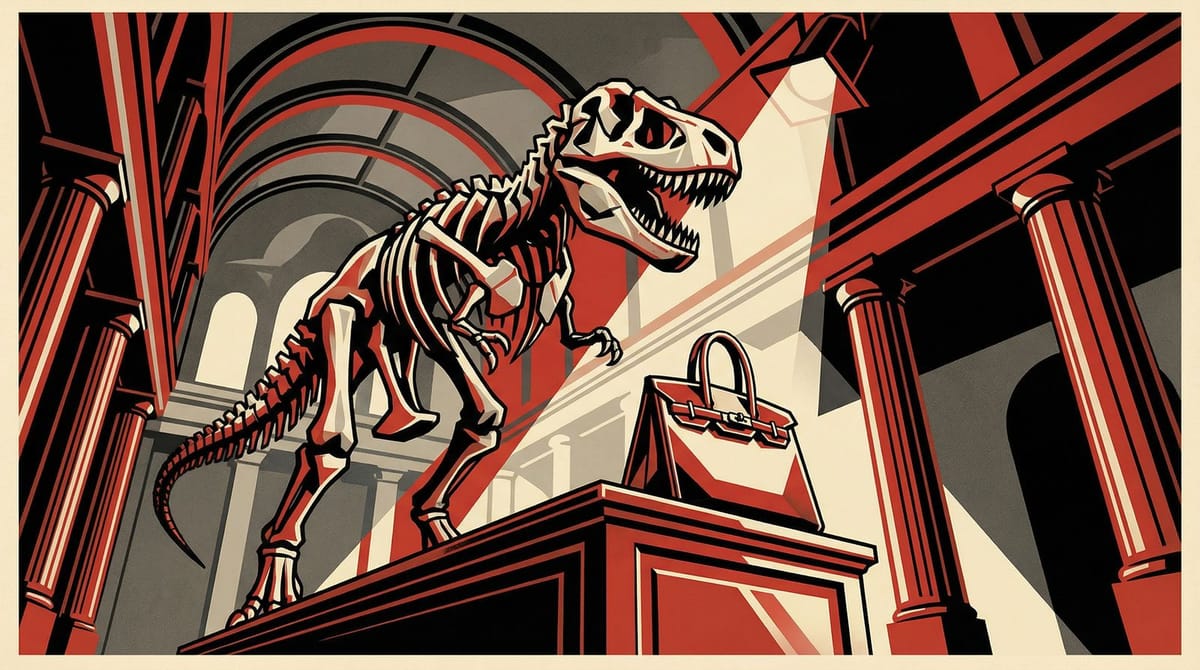
VML unveiled a handbag made from lab-grown T. rex leather at Art Zoo Museum in Amsterdam this week. Paleontologists immediately called the science misleading. And somewhere in a WPP office, Bas Korsten probably smiled, because the debate is the campaign.
This is the third time VML’s global chief creative officer for innovation has run the same play. And it keeps working because most brands still don’t understand why.
The Pattern Hiding Inside the Stunt
The sequence matters. In 2016, Korsten’s team created The Next Rembrandt, a new “painting” by the 17th-century Dutch master, generated entirely by AI analyzing his existing works. Art critics debated whether it counted as art. That debate was the distribution.
In 2023, they made the Mammoth Meatball. Lab-grown meat engineered from woolly mammoth DNA, unveiled at a science museum in Amsterdam (yes, always Amsterdam). Food safety regulators said nobody could eat it. Korsten’s own summary of that limitation was characteristically blunt: “You couldn’t eat the damn thing because of food safety regulations.” Media coverage hit 13 billion impressions within days of launch. The equivalent advertising value was roughly $120 million, according to the campaign’s own measurement. On zero paid media spend.
Now in 2026, it’s T-Rex Leather. A luxury handbag designed by Enfin Levé, using what VML and partners Lab-Grown Leather Ltd. and The Organoid Company describe as collagen sequences extracted from fossilized T. rex bones, reconstructed via AI modeling, and grown using cell engineering. The bag is sitting next to a life-sized T. rex skeleton at Art Zoo Museum. It’ll be auctioned after a six-week exhibition.
The pattern: take an extinct creature, apply a real but boundary-pushing technology, build one physical artifact, put it somewhere visually dramatic, and wait for the controversy to do the marketing.
Why the Scientific Criticism Is the Best Part
From a media buying perspective, the scientific criticism might be the most valuable part of this whole operation. ScienceAlert and Live Science both ran pieces questioning whether T. rex DNA could even exist. The oldest recovered DNA on record is about 1.6 million years old, from Siberian mammoth molars. T. rex went extinct 66 million years ago. The original 2007 study claiming to find T. rex collagen fragments faced accusations that researchers had actually sequenced ostrich and alligator collagen contaminating the equipment. At best, one analysis suggested, the resulting leather contains “some tiny snippets of collagen fibrils that may bear a passing resemblance” to what a T. rex might have had.
Does that kill the campaign? The opposite. Every debunking article links back to the original story. Every paleontologist quoted generates a new headline. The controversy creates a second and third wave of earned media that a purely positive announcement never would.
I think this is the part most brand teams miss when they look at stunts like this. They see the weird object and think the object is the point. It’s not. The object is a conversation starter with built-in disagreement, and disagreement is what drives sharing. A straightforward announcement about lab-grown leather would have landed in two trade publications and died there quietly. A dinosaur handbag that scientists are arguing about lands everywhere.
The Uncomfortable Math on Earned Media Arbitrage
The Mammoth Meatball’s $120 million in equivalent ad value on zero paid spend is a number worth sitting with. Even if you discount earned media equivalence by 80% (and plenty of people argue you should), that’s still $24 million worth of attention for the cost of producing one meatball and renting a museum space.
A CPM of $0.009 makes any Meta or Google campaign look expensive by comparison.
And the coverage quality is different too. Wall Street Journal front page. The Late Show with Stephen Colbert. Reuters camera crews at the launch. You cannot buy that placement at any price. The Mammoth Meatball also hit 98.4% positive or neutral sentiment across its coverage, which is a number most paid campaigns would struggle to match even with total creative control.
Of course, not every brand can genetically engineer a prehistoric handbag. But the underlying template is more transferable than it looks. You need three things: a genuine (if provocative) technical innovation, an absurd framing that begs to be debated, and one physical artifact good enough to photograph. The Mammoth Meatball was one object in one museum. The T-Rex bag is one object in one museum. We wrote recently about how KitKat’s stolen chocolate stunt generated outsized earned media from a relatively simple concept. The scale of production is tiny. The scale of conversation is enormous.
What Makes This Harder to Copy Than It Looks
I’d be lying if I said any brand could pull this off next quarter. The VML pattern works partly because Korsten has spent a decade building credibility at the intersection of science and creativity. The Organoid Company and Lab-Grown Leather Ltd. are real biotech firms doing real research. Lab-Grown Leather Ltd. is even publicly traded on the London Stock Exchange. The science underneath may be questioned, but it’s not entirely fabricated. There’s enough genuine innovation to make the conversation substantive rather than just a gimmick.
The brands that try to replicate this usually fail at one of two points. Either they go weird without substance (a stunt that’s just a stunt, forgotten in 48 hours) or they go substantive without weirdness (a genuine innovation that nobody covers because the framing is boring). The sweet spot, from what I’ve seen, sits right in between: real enough to defend in a serious interview, strange enough that someone at a news desk sees the headline and says “wait, what?”
And to be fair, this isn’t entirely new as a concept. Red Bull has been running the “real physics, absurd framing” version of this playbook since the Stratos jump in 2012. The difference is that Korsten’s version doesn’t require throwing a human being out of a space capsule. One handbag and a rented museum does it. The commercial angle is also sharper than it looks. Lab-Grown Leather Ltd. is using the stunt to pitch luxury brands on real material supply contracts. The handbag gets the headlines. The B2B sales deck gets the meetings.
One Handbag, Three Campaigns, Same Museum
The thing I keep coming back to is how little has changed between 2016, 2023, and 2026. Same city. Same museum format. Same “take something extinct, make it new” concept. And it works every single time because the news cycle has a short memory and the underlying mechanic (controversy generates distribution) is structural, not trendy.
If VML runs this play again in 2029 with, I don’t know, lab-grown dodo feather couture or a perfume synthesized from ancient Roman DNA, I’d bet it generates another billion-plus impressions. The formula isn’t wearing out because nobody else is running it at this level.
Most marketing teams are still spending 90% of their creative budget making the thing and 10% making people care about the thing. Korsten’s ratio is inverted. And honestly, the numbers suggest he might be right.