20 Publishers Backed Amazon's Perplexity Case Because They Can't Sue Alone
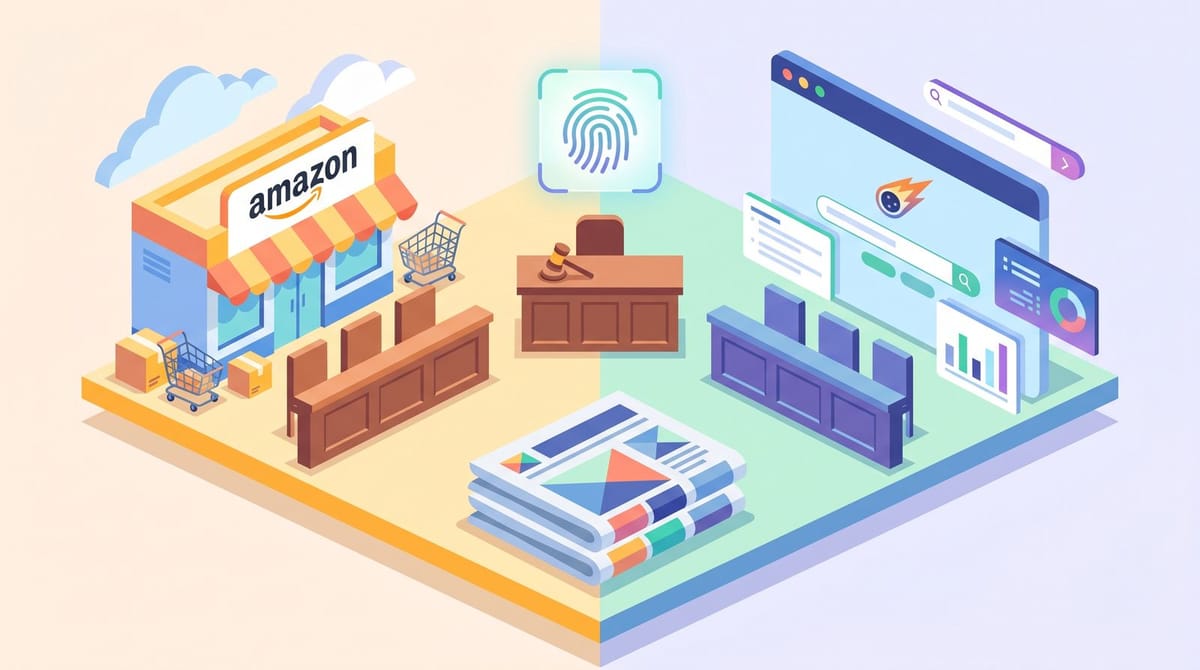
Digital Content Next filed an amicus brief on April 29, 2026 asking the Ninth Circuit to uphold an injunction that blocks Perplexity's Comet browser from accessing Amazon's logged-in pages while spoofing Chrome. The brief carries 20-plus publishers covering 259 million unique visitors. It is the closest proxy publishers have to a CFAA ruling against AI agent impersonation, and the outcome will reset which AI traffic counts as authorized.
The standing problem publishers couldn't solve themselves
Computer Fraud and Abuse Act cases are notoriously hard for content publishers. The statute is built around unauthorized access to a "protected computer," and to win a preliminary injunction you usually need to show concrete, irreparable harm tied to the access itself. Publishers can show traffic anomalies and revenue dips, but courts have generally treated those as too diffuse for a federal computer-crime statute.
Amazon does not have that problem. Comet was logging into Amazon accounts, executing purchases on behalf of users, and doing it while presenting a Chrome user-agent string. That is a precise, demonstrable trespass on a password-protected system, exactly the fact pattern CFAA was written for. Judge Maxine Chesney issued the preliminary injunction on March 9, 2026, and on April 1 Perplexity took it to the Ninth Circuit, raising what the IAPP called the first major liability test for autonomous AI agents in a US appellate court.
The DCN brief, filed April 29, leans on Amazon's win to ask the appeals court to draw a line publishers can later cite. If the Ninth Circuit affirms the injunction, every publisher with a paywall, login wall, or member-only area gets a precedent that AI agents accessing those areas without disclosure is a CFAA violation. From what I have seen of how amicus strategy works, that is the actual game here. Amazon is the lead plaintiff because Amazon has standing nobody else does.
What user-agent spoofing breaks for advertisers
The technical claim is small. Perplexity's Comet browser, on launch, transmitted a Google Chrome user-agent string while behaving as an autonomous shopper. Servers receiving that traffic logged it as a human Chrome session because that is what user-agent headers are supposed to mean.
The marketing consequence is not small. Comet, at any meaningful volume, becomes invisible to bot filters, ad verification vendors, and analytics platforms, all of which gate decisions on user-agent strings. DCN's brief makes the consequence explicit: "Advertisers pay for their ads to be seen by humans, not AI agents. If publishers cannot distinguish between an AI agent and a human subscriber, they will not be able to measure audiences accurately."
Translate that into something operational. If you bought 10 million impressions on a Tier-1 publisher last quarter, somewhere in that pile is a number you cannot back out: how many were rendered to a Comet session that no human ever looked at. The publisher gets paid. The verification vendor sees Chrome. Your post-buy audit shows clean delivery. The only number that moves is the one that should not, your conversion rate, and you spend the next month blaming creative.
DCN cites one named anecdote: Salon lost a mid-sized advertiser specifically over non-human-traffic concerns. That is the canary. The brief argues a ruling against Amazon would force publishers into an "arms race" with increasingly sophisticated agents, and most publishers are not staffed to win that fight. Marketing Brew has been tracking the same dynamic on the retail-media side, where one Gartner analyst called agentic shopping "an existential threat" to the ad model retailers spent the last five years building.
The numbers DCN put into the record
The brief enters specific stats into the appellate record, which matters because once they are cited at the Ninth Circuit they become the data points other courts will reach for in the next AI agent case:
- $63 billion lost annually to invalid traffic across media channels
- 86% year-over-year increase in general invalid traffic in the second half of 2024
- 16% of known-bot invalid traffic now associated with AI scrapers (2024 data)
- 259 million unique visitors covered by the brief, or roughly 95% of US online users
The 16% figure is the one to flag. In late 2023, AI scrapers were a footnote inside the bot category. A year later they were a sixth of all known-bot traffic, and that was before Comet shipped at all. The DCN line that resonated most was the contract framing: "An AI agent that commercialises publisher content for AI products without authorization effectively commandeers a perpetual license of unlimited scope without paying a cent."
I think that framing wins at the Ninth Circuit. It collapses a complicated technical question into a contract question. Did the agent identify itself? No? Then the access was not authorized. Whatever the agent did with the content after that is unpaid commercial use. The brief sidesteps the harder fight (what counts as a "use" under copyright) and reframes the whole thing as plain trespass.
The wider ecosystem context matters for marketers planning 2026 AI strategies. ChatGPT, Claude, Gemini, and a handful of agentic shopping tools currently default to either generic bot user-agents (which most paywalls already block) or to undisclosed Chrome strings (which is the Perplexity pattern). An affirmation would push the entire category toward the former. That sounds like a small protocol detail, but it determines whether AI-driven traffic to your site shows up in your analytics under "ChatGPT-User" (where you can model it) or "Chrome 124" (where you cannot tell it from organic). Brands building AI citation playbooks on the second assumption are about to find out the assumption was load-bearing.
Three audits to run before the appeal lands
A few things worth moving on this week, regardless of which way the ruling goes:
- Audit your publisher buys for any line items where post-bid verification is the only check between you and your CPM. Vendors that depend on user-agent strings to flag bots are the ones with the largest blind spot, and their dashboards will not show the gap until the Ninth Circuit forces the disclosure question. Pull a sample of 90 days of impression-level logs from each major publisher partner and ask the verification vendor to break it out by user-agent fingerprint, not just IVT-rate aggregate.
- If you run a paywall or login wall, log user-agent and behavior pairs for the next 30 days. Agents that present Chrome but hit logged-in pages in patterns no human would (like a 2-second average dwell on a checkout flow, or no mouse-movement events) are worth flagging now. Cloudflare has been moving in this direction with its paid AI agent infrastructure, and that approach (declared agent identity, verified payment rails) is roughly where the case is pushing the industry anyway.
- If you depend on AI citation traffic for top-of-funnel, do not assume Perplexity's appeal will succeed. The Ninth Circuit has been notably skeptical of CFAA defenses that hinge on "we used valid credentials." A loss for Perplexity reshapes how every consumer-facing AI tool will need to identify itself, and Comet is not the only product that ships with a default Chrome user-agent.
The ruling is unlikely before late Q3, given typical Ninth Circuit timelines. That window is enough to run the measurement work you will wish you had done if the affirmation lands the way the publisher coalition is betting it will. Most marketing teams I have watched react to legal precedents react about three months too late. The audits cost nothing. The blind spot they catch is the part that gets expensive.
Notice Me Senpai Editorial