29 Million AI Search Queries Later, "Shop Now" Is the Wrong Button
Adthena just published what might be the most useful dataset in paid search this year, and the headline finding isn't about budgets or bidding. It's about your call-to-action button.
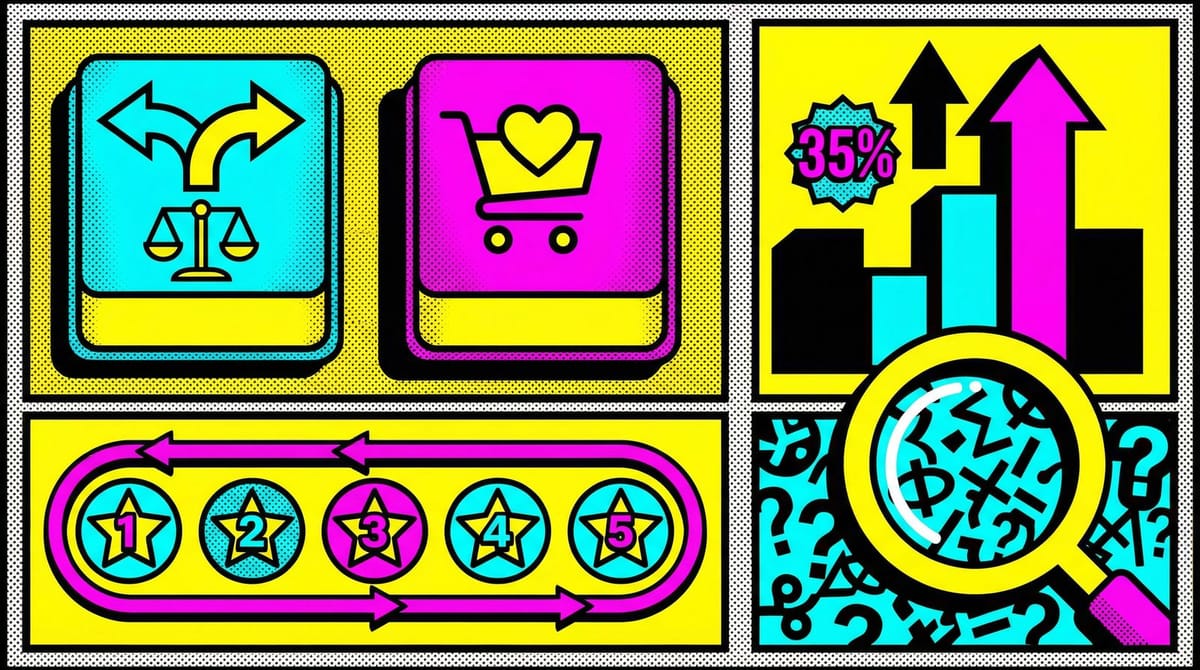
Across 29.1 million queries in 10+ industries and three markets, the "Compare" CTA outperformed "Shop Now" by 35% on click-through rate. "Get a Quote" beat it by 22%. And "Find a Store" didn't just underperform. It dragged CTR down 20-40%.
If your AI search ads are still running the same CTAs you use in standard search campaigns, you're probably leaving the biggest easy win on the table. The data on this one is unusually clear.
The Query Length Surprise
The part of the report that caught me off guard: over 60% of AI Overview ad appearances are concentrated on 3-4 word searches. Not long-tail conversational queries. Not the kind of natural-language prompts everyone keeps talking about. Short, commercial queries. The ones most PPC teams have been running for years without giving them a second thought.
Three-word queries generated 16,381 total AI ad appearances in the dataset. Four-word queries hit 12,404. By the time you reach 9-10 word searches, you're in double digits.
That runs counter to most of the AI search conversation. The discourse has been almost entirely focused on long, conversational queries because that's how people use ChatGPT. But Google's AI Overviews operate differently. The short commercial queries are where ads actually show up and this distinction matters more than most teams realize.
The exception is vertical-specific. In retail, 84% of AI ad visibility comes on 9+ word queries. Travel hits 87.5% on 9-word searches. If you're running campaigns in those verticals, long-tail is still the play. For everyone else, the action is in the mid-funnel, not the bottom.
Cox Communications Spent $400,000 Learning This the Hard Way
The most detailed case study in the report involves Cox Communications. Their "Cox Internet Plans" query went from triggering AI Overviews occasionally to showing them 84-94% of the time. What happened next was expensive.
CPC jumped from $2.45 to $4.82. A 97% increase. CTR dropped from 68% to 45%. The wasted spend added up to roughly $400,000 in additional cost before anyone changed course.
The fix wasn't a budget increase. It was structural.
Cox implemented a Portfolio Target CPA with a hard CPC cap at $3.75, introduced gradually over four weeks ($4.20 to $4.00 to $3.80 to $3.75). They also rewrote their headline from "Fast Home Internet Plans" to "Skip the Research: Order Your Plan Here." That second change is interesting because it's basically an anti-AI-Overview CTA. It tells the searcher they don't need to read the summary above.
Result: $117,000 in annualized spend recovered. CPC stabilized in the $3.50-$3.75 range. Conversion variance stayed under 10%. They kept about an 80% win rate on the auctions that were actually efficient.
I think the real lesson from the Cox case is that most teams, when they see CPCs spike, either throw more budget at it or pull back entirely. Both are wrong. The teams in this data that are doing well set hard CPC caps and change the creative. Spending more money on an inflated auction is like buying drinks at a nightclub that just doubled its prices because a celebrity walked in. You're overpaying for the same experience.
Position 1-2 Is the Entire Game
The carousel data puts a number on something that was probably true but lacked proof. Positions 1 and 2 in AI Overview ad carousels generate 91% more site visits than lower positions (US market data).
That's a much steeper drop-off than standard search. In regular Google results, position 3 or 4 still pulls meaningful traffic. In AI carousels, users seem to engage with the first two options and mostly ignore the rest. Makes sense if you think about it. The AI summary already did the comparison work. The user wants confirmation, not a full menu.
For teams with smaller budgets, this creates an uncomfortable choice. If you can't consistently bid into position 1-2, you might be paying for carousel space that generates almost no clicks. From what I've seen, it's probably smarter to focus spend on a narrower set of queries where you can win the top spot than to spread budget across everything and land in position 4.
Fewer Clicks, Better Clicks
Across the broader market, paid CTR on queries with AI Overviews dropped 68% between June 2024 and September 2025. From 19.7% down to 6.34%.
But the conversion story tells a different version. About 65% of industries actually saw improved conversion rates despite the volume decline. Education saw a 43.87% year-over-year lift. Sports and recreation hit 42.43%.
The explanation seems to be journey compression. The AI Overview does part of the research for the user. By the time they click an ad, they're further along in the decision process. Fewer clicks, but each one is more qualified. One analysis modeled it like this: a campaign goes from 1,000 clicks at $2.00 CPC with 5% conversion to 700 clicks at $2.90 CPC with 7% conversion. Nearly identical conversions, only 3.6% higher CPA.
The math still works. But it only works if you stop optimizing for click volume and start optimizing for conversion quality. A lot of PPC teams are still reporting click volume as a primary KPI, and honestly, that's going to look worse and worse every quarter as AI Overviews expand.
The Citation Multiplier Nobody Budgeted For
One more finding worth highlighting: brands cited in AI Overviews see a 91% paid CTR lift. If Google's AI summary mentions your brand by name, your ads perform nearly twice as well.
This is where paid search and SEO teams need to start having actual conversations. The citation isn't earned through ad spend. It comes from content authority, structured data, and being the source the AI model trusts. Your SEO team's work now directly impacts your paid team's performance, and most org charts haven't caught up to that.
We've written about how AI creative is reshaping paid performance. The citation connection makes the case more concrete. If you're running paid and organic as separate operations with separate KPIs, this data makes a decent argument for bridging that gap.
Four Changes Before Your Next Reporting Cycle
If I were running paid search right now, the Adthena data would push me to do four things:
Audit your CTAs. If "Shop Now" or "Find a Store" is your default, test "Compare" and "Get a Quote" on your top 20 campaigns by spend. A 35% CTR uplift on the CTA alone is the single easiest win in this entire dataset.
Set a CPC ceiling. Pull your last 90 days on queries where AI Overviews appear. If CPC has jumped more than 30%, implement a Portfolio Target CPA with a hard CPC cap. Step it down gradually over 3-4 weeks. Don't let the algorithm bid you into expensive auctions.
Check your carousel position. If you're consistently landing in position 3+ on AI carousel placements, you're probably paying for nothing. Either increase bids on those specific queries to win position 1-2, or reallocate that spend to queries where you can actually compete for the top spot.
Talk to your SEO team. Ask them where your brand appears in AI Overviews as a cited source. Those are the queries where your paid ads will perform best. Prioritize budget there.
I'd guess that by Q3, the CPC inflation on AI Overview queries will settle around 40-50% above pre-AIO baselines for most verticals. That's the new normal, not a glitch to wait out. The data covers 29 million queries across five months. At some point, arguing with the sample size starts to look like the more expensive bet.
Notice Me Senpai Editorial