Ad Budgets Are Freezing. The Ones That Stay Liquid Will Buy the Discount.
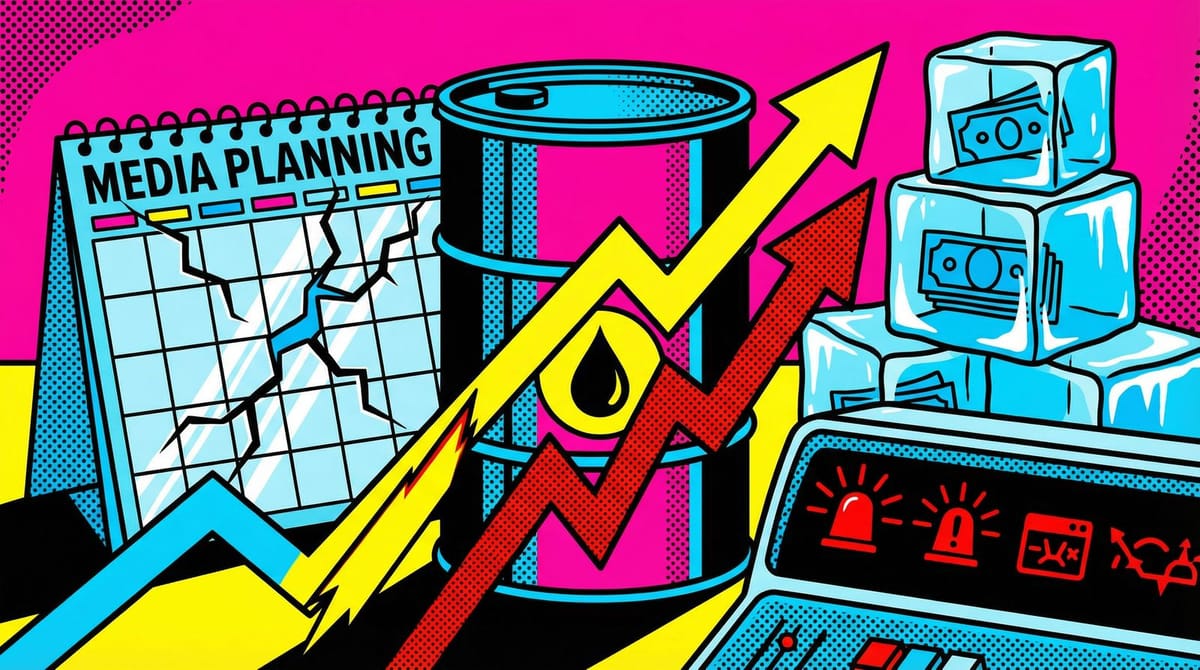
Oil is above $106. The White House is modeling scenarios where it hits $200. And somewhere in a conference room right now, a CMO is staring at a Q2 media plan that was approved when crude was at $70 and pretending the numbers still work. They don't.
The $94 Billion Question Nobody Wants to Answer
WARC's latest forecast projects global ad spend will hit $1.32 trillion this year, a 10.4% jump that would look impressive if it weren't built on assumptions from before the Iran conflict escalated. The problem: the World Advertising Research Center now estimates that a sustained crisis could wipe out nearly $50 billion in ad spend this year, with another $44 billion at risk in 2027.
In a more moderate scenario, 2026 ad growth would decline by 1.6 percentage points, roughly $19 billion. That is the optimistic number.
The mechanism is straightforward, and it is the reason this matters to anyone buying media right now: oil crises are stagflationary. GDP falls while inflation rises. Unlike a normal recession where central banks can cut rates and stimulate spending, stagflation traps you. Ebiquity puts the ad spend multiplier at 1.7x, meaning for every 1% hit to GDP, ad budgets take a 1.7% knock. That is not linear. It compounds fast.
"Predictability has become a luxury," as Thomas Bailly at Readpeak put it. "And when it runs out, precision is what's left."
We Have Seen This Movie Before. The 2022 Version Was Shorter.
When Russia invaded Ukraine in February 2022, the ad market reaction was swift and messy. eCPMs on Android dropped 75% within weeks. iOS was not far behind at 71%. July 2022 was the lowest month for ad spending since COVID, with a 12.7% year-over-year decline. Magna cut its growth forecast from 12.6% to 11.5% essentially overnight.
But here is the part most people forget: the dip was temporary. Oil surged 150% peak-to-trough during the Gulf War in 1990, then normalized within six months. The Ukraine advertising pullback followed a similar arc. Brands that paused came back. CPMs recovered. And the advertisers who stayed in market during the low point bought the same eyeballs at a significant discount.
That is the pattern. It feels uncomfortable to talk about because it sounds callous, like you are treating a war as an arbitrage opportunity. I get that. But the reality is that your competitors pulling budget creates lower auction prices, and someone is going to benefit from those prices. The question is whether it is you or someone else.
What Is Different This Time (And Why It Matters More)
The Iran conflict introduces a variable that Ukraine did not: direct oil supply disruption to global markets at a scale the Gulf War parallels more closely than 2022. The 1990 analogy is useful. Oil surged 150% and then normalized, but the six months in between were chaos for advertisers trying to plan anything beyond 30 days out.
Chris Mele at Siberia agency captured what most people in the industry are feeling: "We've noticed hesitation with larger investments in innovations... between AI disruption, volatility in markets and general instability." S4 Capital's Martin Sorrell is already flagging Q1 revenue declines.
The other difference: ad-GDP decoupling. Since 2020, performance marketing has increasingly operated on its own cycle, somewhat insulated from broader economic swings. Brand spending, though? That is where the vulnerability sits. The brands pulling back right now are not cutting their Google Shopping campaigns. They are freezing awareness budgets, pausing TV commitments, and shelving the brand campaigns that were supposed to build long-term equity.
If you are running mostly performance media, your Q2 probably looks fine. If you are running a mix, the brand half of your budget is the part under pressure.
The Uncomfortable Math on Travel and Transportation
Travel and transportation advertisers face the sharpest edge. WARC projects this category will reduce spending by 3.5% compared to 2025, roughly $1.3 billion in cuts. That is a sector-specific number, but the ripple effects hit everyone: fewer travel ads mean more available inventory across premium placements, which means CPMs soften across the board.
This is where it gets interesting for practitioners. On paper, softer CPMs sound like good news. And sometimes they are. But softer CPMs often come packaged with softer consumer intent. People browsing during economic anxiety convert differently than people browsing during confidence. Your ROAS might look flat even though your media costs dropped, because the denominator moved too.
From what I have seen in past cycles, the teams that navigate this well are the ones who separate their efficiency metrics from their absolute volume metrics. A 15% cheaper CPM means nothing if your conversion rate drops 20%. You need to track both.
What to Do With Your Q2 Plan This Week
I am not going to pretend there is a clean playbook for this. There is not. But there are a few specific moves that worked during previous uncertainty windows, and they are worth considering now.
First: shift budget toward media without cancellation fees or long advance booking requirements. This is what the Digiday report found agencies doing already, and it makes sense. Preserving optionality costs you almost nothing when auction prices are falling. Locking into fixed commitments when the market is repricing daily is how you end up overpaying.
Second: if you are running brand campaigns, consider shifting 20-30% of that allocation into flexible performance channels for the quarter. Not permanently. Just while the market figures out where oil prices settle. You can move it back when things stabilize. The goal is maintaining total spend while reducing exposure to the uncertainty premium that brand media carries right now.
Third: watch the CPM trends weekly, not monthly. During the Ukraine pullback, the cheapest weeks were roughly 4-6 weeks after the initial shock, when the panicked pullbacks created the biggest gaps in auction competition. If this follows a similar pattern, late April through May could be an unusually good window for awareness campaigns at discounted rates.
And to be fair, I might be wrong about the timing. Every geopolitical crisis has its own dynamics and this one involves oil supply in ways Ukraine did not. But the underlying mechanics of auction-based media buying do not change: when fewer advertisers bid, prices drop. That part is physics, not prediction.
The Brands That Keep Spending During Chaos Tend to Come Out Ahead
There is a well-known IPA study from the 2008 recession showing that brands maintaining share of voice during a downturn gained market share at roughly twice the rate of brands that cut. The mechanism is simple: when competitors go quiet, your message gets louder even at the same spend level. The data on this is remarkably consistent across multiple downturns.
I do not think the right move for most brands is to increase spend into uncertainty. That requires a risk tolerance most organizations do not have, and honestly should not have. But maintaining spend while competitors freeze? That is the more practical version of the same advantage. You do not need to be brave. You just need to not panic.
The teams that will struggle most are the ones who make decisions based on headlines rather than their own data. Your campaigns have their own conversion rates, their own CPM trends, their own ROAS curves. If your numbers are holding, keep going. If they are deteriorating, adjust. The macro environment is context, not instruction.
Alex Brownsell at WARC Media summed it up: "With every week that passes there's this nagging sense that this actually will be a problem." The nagging sense is probably right. Whether you respond to it with a plan or with a freeze is the only decision that is actually yours to make.