AI Beat the PC and Internet to 53% Adoption (and Marketing Is Still Pacing Late)

Stanford's 2026 AI Index Report shows generative AI reached 53% global population adoption within three years of ChatGPT's November 2022 launch, faster than either the personal computer or the internet hit the same milestone. McKinsey's parallel survey shows marketing and sales overtook supply chain as the top AI-deployment function for the first time since the survey began in 2018, with enterprise marketing teams now reporting 94% adoption. The implication for any team still running pilot programs: median is no longer early.
The curve is steeper than anything marketers have run before
The personal computer took roughly six years to hit 50% adoption. The commercial internet took about seven. Generative AI did it in three, per Stanford's 2026 AI Index. The Stanford team is honest about the asterisk. AI didn't have to lay infrastructure. It rode existing PCs and broadband. So the three-year sprint is partly pre-built rails. Even with the asterisk, it's the steepest adoption slope ever tracked for a general-purpose technology.
Worth labeling the metric, because the headline number hides a lot of variance. The 53% counts anyone in the global population who has used generative AI at all. That includes one-time free signups along with daily power users. Stanford pegs US adoption at 28.3%, ranking the country 24th globally with a stricter methodology. The St. Louis Fed's tracker put it at 54% in August 2025. Both can be right depending on how you define "user." Singapore reported 61%. The UAE 54%. Country variance correlates strongly with GDP per capita, which is one of those findings that becomes uninteresting the second you hear it.
What actually matters for marketing planning is the slope, because slope sets a competitive timeline.
Marketing finally became the headline AI function
McKinsey's 2025 State of AI survey shows marketing and sales overtook supply chain as the most commonly cited function for AI deployment. First time since the survey started in 2018. Marketing also led every function in spending growth: a 64% year-over-year increase in AI budget, with sales close behind at 61%.
Adoption inside the marketing org is stratified by team size. Per the same data set, 87% of marketers use generative AI in at least one recurring workflow as of Q1 2026, up from 51% in Q1 2024. Enterprise teams (250-plus marketers) sit at 94%. Mid-market teams (50 to 249) at 91%. The "haven't started yet" cohort is now measured in single digits.
This part is a quiet shift. Two years ago, having an AI workflow inside your team was a differentiator you could bring up in a quarterly review. Now the absence of one is the noticeable thing. If you've been treating ChatGPT in your stack as a personal productivity hack rather than a team-level system with documented prompts, retrieval, and quality gates, the median competitor has lapped you. That's not flattering to admit, but it's where the data lands.
Why the late-arrival cost compounds differently this time
Adoption curves matter for marketers because they set the window where being early actually pays.
On the PC curve, a marketing team that adopted spreadsheets two years late lost some efficiency but caught up inside a quarter. The tools were finite. Excel in 1990 was Excel in 1993. The gap closed almost on its own.
The AI stack doesn't sit still long enough for that. From what I've seen, teams that started building structured prompts and retrieval workflows in early 2024 now have eighteen months of usage data, prompt-version histories, and an internal vocabulary for what good output looks like. A team picking it up clean in April 2026 is not catching up to where those teams were in early 2024. They're catching up to where those teams are now, plus another twelve months of compounding.
That's not nothing on the PC curve either. But on a curve this steep, the practical gap between a 24-month-late team and a current team is closer to what a 60-month gap looked like on the PC curve. I'd want to see more rigorous studies on that, honestly. Anecdotally it tracks.
One concrete thing to do this quarter if you're behind
The fastest action that closes part of the gap: pick the single most repeatable copy task on your team, write three competing prompt versions for it, run them blind against last month's outputs, and pick the winner as the team standard. Document it. Date it. That's a Tuesday afternoon, and it converts a personal hack into a team-level asset you can iterate on.
The benchmark to beat: most teams I see in this stage skip the blind comparison and pick whichever prompt they wrote first. Don't. The reason the comparison matters is that the prompt you instinctively wrote in February is almost never the prompt that wins in April once you see the alternatives next to it. The exercise itself, repeated three or four times, is also how a team builds a shared vocabulary for what "better" actually means in your category. That vocabulary is the part you can't shortcut.
The transparency curve is going the other way
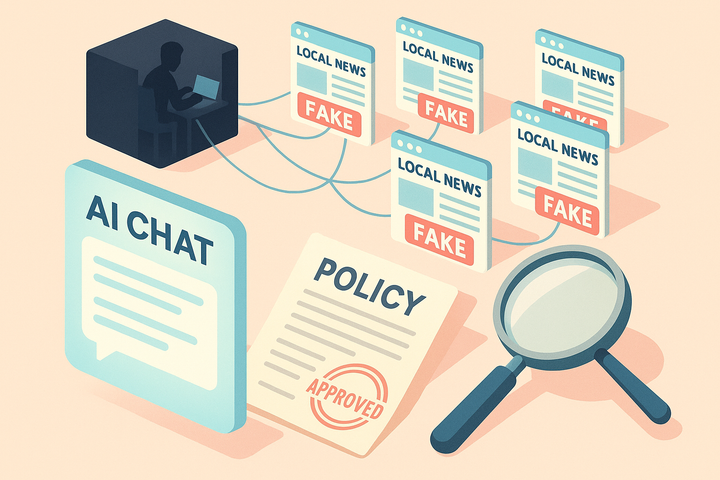
One Stanford finding that's getting less air time than it deserves: the Foundation Model Transparency Index dropped from 58 to 40 in a single year. 80 of the 95 most notable 2025 model releases shipped without training code. IEEE Spectrum's coverage walks through the methodology if you want the deeper read.
For a marketing team, this matters specifically because the workflow you build today is increasingly resting on a substrate you can't audit. If your client asks you why an AI-generated landing page used a specific phrasing, the honest answer is closer to "we don't know" than it was twelve months ago. That's a small thing right now. It will become a procurement-conversation thing inside a year, especially in any industry that's already nervous about AI-generated claims.
I don't have a clean fix for this one. The realistic move is documenting your own usage tightly enough that you can defend the workflow even when the model can't explain itself. Logged prompts. Versioned outputs. Human review notes attached to anything that goes external. Annoying, but the audit trail is on you, not on OpenAI or Anthropic. (Related: ChatGPT mines 16 million Reddit URLs and cites 1.93% of them, which is the distribution side of the same opacity problem.)
The investment data sets the urgency
Global corporate AI investment hit $581 billion in 2025, a 130% year-over-year jump. US private investment alone was $285 billion. The reason that number matters for your roadmap is that it tells you platform updates are going to keep coming faster than your team can absorb them. Budget for retraining. Budget for prompt rewrites every six months. The platforms shift underneath you whether you have time to repaper your workflow or not.
Workforce data is the other side of the same story. Stanford flagged a near-20% decline in software developer hiring for the 22-25 age bracket since 2024. Similar patterns showed up in entry-level customer service. Marketing's equivalent moment is probably the entry-level copywriter and the junior media buyer. Not gone. Just narrowing. Worth thinking about as a hiring manager before you post the next req.
Where to actually start reading
If you're going to read one source on this, the Stanford 2026 AI Index Report itself is the cleanest. Skim the Adoption chapter and the Public Opinion section. The 12 takeaways post is the shortest version if you have ten minutes. For the marketing-function slice, McKinsey's State of AI is the source for the 64% spending number and the supply-chain crossover. Pair it with the Stanford report and you have the macro and the marketing-org data on the same desk.
I don't think the takeaway here is that marketing teams need to panic-rebuild their stacks. From what I've seen, the teams that move best on this kind of data don't sprint. They pick one workflow, document it, and move to the next. The 53% number is just the reminder that the floor moved while you were busy.
Notice Me Senpai Editorial