The AI Ad Market Split Three Ways and Nobody Agrees What a Conversion Is
By Notice Me Senpai Editorial
There is a version of this article that treats "AI chatbot advertising" as one coherent thing. That version would be useless. Three months into the chatbot ad era, the three platforms that matter have picked three entirely different business models, and the gap between them is widening, not closing.
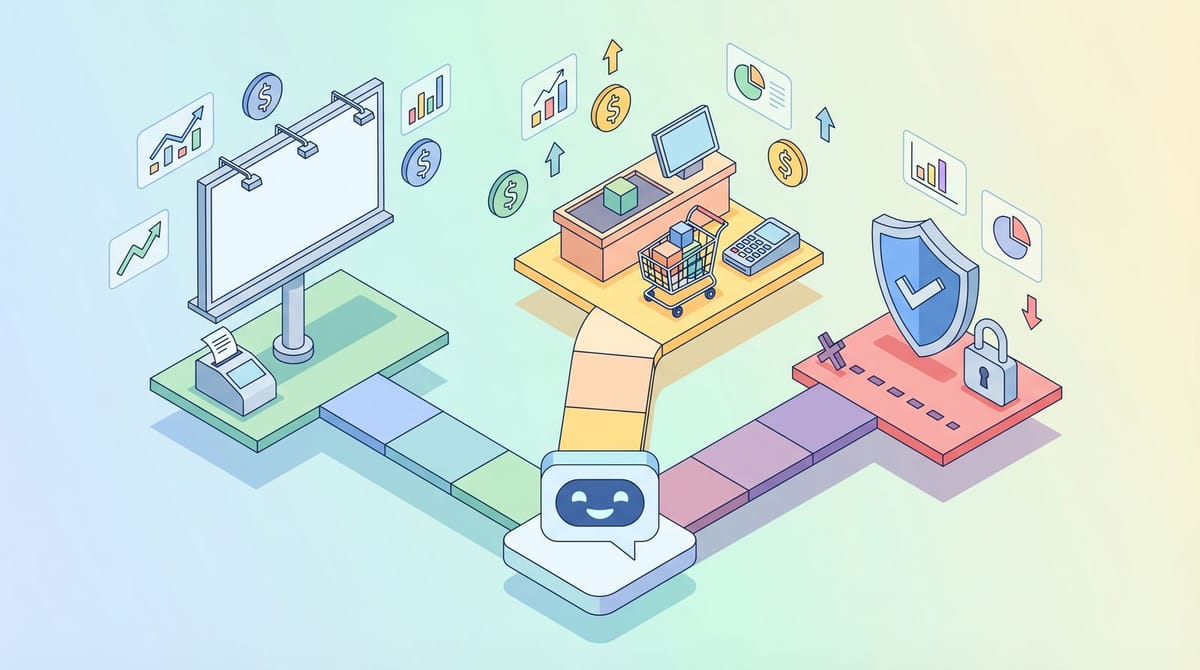
OpenAI is selling impressions with no conversion tracking. Google is building a checkout button inside AI Mode. Perplexity pulled the plug on ads entirely.
If your media plan has a single line item labeled "AI chatbot ads," it is already outdated. What each platform chose NOT to offer reveals more about where they are heading than any product announcement.
OpenAI's Gamble: Premium CPMs, No Receipts
ChatGPT's ad program launched in February with a $60 CPM and a $200,000 minimum commitment. That is roughly 3x what Meta charges and comparable to Netflix's launch pricing in late 2022. For that money, you get ads displayed as sponsored recommendations at the bottom of AI responses, but only for users on the Free and Go tiers.
The catch is a big one: you cannot see what happens after someone clicks. There is no purchase data, no signup tracking, no post-click attribution of any kind. OpenAI's official documentation confirms advertisers receive total impressions and total clicks. That is it.
The early click-through rate sits around 1.3%, which sounds acceptable until you run the math. At $60 CPM with 1.3% CTR, your effective cost per click lands at roughly $12. About 6x the average Google Search CPC. For a click where you have zero visibility into what happens next.
I think the honest read is that ChatGPT ads are not a performance channel yet. They are a brand awareness play priced like a premium placement, and that is fine if you evaluate them that way. The problem is most teams on Reddit and in paid media communities are trying to force performance frameworks onto what is essentially a billboard inside a chatbot. One advertiser on r/PPC put it bluntly: they burned through budget without any ability to tell their CMO whether it worked.
We covered OpenAI's $60 CPM strategy when it launched. The self-serve rollout is still underway, so the $200K minimum is the only door for most brands. That barrier is probably intentional.
Google Skipped the Ad Part and Built a Cash Register
Google took the opposite approach entirely. Instead of selling impressions inside AI responses, it built a full commerce layer that lets users browse products, see personalized deals, and complete purchases without leaving AI Mode.
Direct Offers, the ad format Google introduced at NRF 2026, surfaces exclusive promotions inside AI Mode when the system detects high purchase intent. These are not banner ads or sponsored recommendations. They are discount codes, loyalty perks, and product bundles pulled directly from Merchant Center feeds.
The bigger structural move is the Universal Commerce Protocol, launched in partnership with Shopify, Etsy, Wayfair, Target, and Walmart. UCP standardizes how AI agents discover products, check inventory, and process checkout across retailers. UCP-powered checkout is already live for Etsy and Wayfair purchases made directly within AI Mode and the Gemini app.
Google does not just want ad impressions inside a chatbot. It wants to own the transaction. The CPC model works through your existing Google Ads account with no minimum spend, which makes it far more accessible than ChatGPT's approach. But the real play is AI Mode as the place where the entire purchase funnel collapses into a single conversation. We wrote about Sponsored Stores arriving in AI Mode last week, and Direct Offers is the next step: from awareness to checkout, all inside one interface.
From what I have seen, the teams getting early results are the ones who already have strong Merchant Center feeds and active Shopping campaigns. If your product data is current and your promotions are loaded, Direct Offers seems to surface inventory more aggressively. If your feed is stale, you probably will not see much. Same pattern as Performance Max, honestly.
Perplexity Tried Ads, Then Did the Math on Trust
Perplexity's retreat is the most instructive move of the three. The company tested sponsored follow-up questions starting in November 2024, carefully labeled and positioned below organic responses. By February 2026, they killed the entire program.
The reasoning was blunt. One executive told the Financial Times that "a user needs to believe this is the best possible answer," and that once ads appear, users inevitably start questioning whether responses are compromised. Fewer than 0.5% of brands who applied were even accepted into the pilot before they shut it down.
Perplexity is now targeting $500 million in annualized subscription revenue with plans from $20 to $200 per month. With 100 million users and roughly $200 million in current revenue, the company bet that subscriptions scale better than ad trust erodes.
Call it principled if you want, but the competitive incentive is real. Anthropic ran a Super Bowl ad explicitly calling Claude ad-free. Perplexity made a similar play. And the user data backs it up: 63% of users say AI ads reduce their trust in results. When nearly two-thirds of your users start second-guessing the product because of ads, the subscription math gets a lot more attractive.
63% is not a number you can message around. It is a structural constraint.
What the Gaps Reveal About What Comes Next
The constraints on each platform are more telling than the features they shipped.
OpenAI's refusal to share conversion data is not a temporary limitation they will patch in Q3. It signals that they view user conversations as too sensitive to fully instrument, or they have not figured out how to do it without creeping people out. Either way, performance advertisers will keep hitting a wall. Albertsons already learned this the expensive way.
Google's checkout infrastructure tells you they see AI shopping as a transaction medium, not an awareness channel. If UCP expands to Target and Walmart as planned, Google's AI interface could process a meaningful slice of U.S. ecommerce within the year. EMARKETER projects AI platforms will handle $20.9 billion in retail ecommerce in 2026, nearly quadrupling the 2025 figure.
Perplexity's exit tells you the trust cost of chatbot ads is real and measurable, even when the revenue looks tempting from outside. The platforms that keep ads will have to prove they can maintain answer quality under commercial pressure. Honestly, nobody has demonstrated that convincingly yet.
Where to Point a Test Budget in April 2026
If you have budget earmarked for AI chatbot ads, here is how to think about allocating it based on what is actually available right now.
Google AI Mode: Check your Merchant Center feed. If your product data is current, your promotions are loaded, and you run Shopping campaigns, Direct Offers should surface without extra setup. Monitor performance in your Google Ads reporting under the placement breakdown. The benchmark: if your AI Mode CPC runs within 20% of your standard Shopping CPC with comparable conversion rates, scale it. If CPC is 2x or higher, your feed needs work first.
ChatGPT: Unless you have $200K and a clear brand awareness objective that does not require conversion measurement, wait. I realize that sounds conservative. But paying $12 per click for a placement you cannot attribute downstream is a tough sell to any CFO. When self-serve opens up and the minimum drops, revisit.
Perplexity: No paid option exists, which is actually fine. Perplexity cites sources prominently in every answer, which means organic visibility through quality content drives meaningful referral traffic. Focus on being the source Perplexity pulls from rather than trying to buy placement around it.
The Measurement Gap That Outlasts All Three Strategies
There is a bigger problem underneath all of this. Even Google, which has the most complete commerce integration, is measuring AI Mode performance through the same attribution models that everyone agrees are partially broken in traditional search. AI shopping conversations are longer, more comparative, and often span multiple sessions before a purchase. Last-click attribution will dramatically undercount their influence. Multi-touch attribution will probably overcredit them. Neither model was designed for a ten-message conversation that ends in a checkout.
The advertisers who get ahead of this probably will not be the ones with the largest budgets. They will be the ones who set up isolated measurement early, track AI Mode as a separate channel with its own benchmarks, and resist the urge to compare it to search or social until the data actually tells them what the conversion mechanics look like. That is a six-month instrumentation project, not a quarterly review line item. And from where I sit, almost nobody has started building it.