Amazon's Store Display Impressions Drop 63% on Jan 1 (Your Ads Didn't Change)
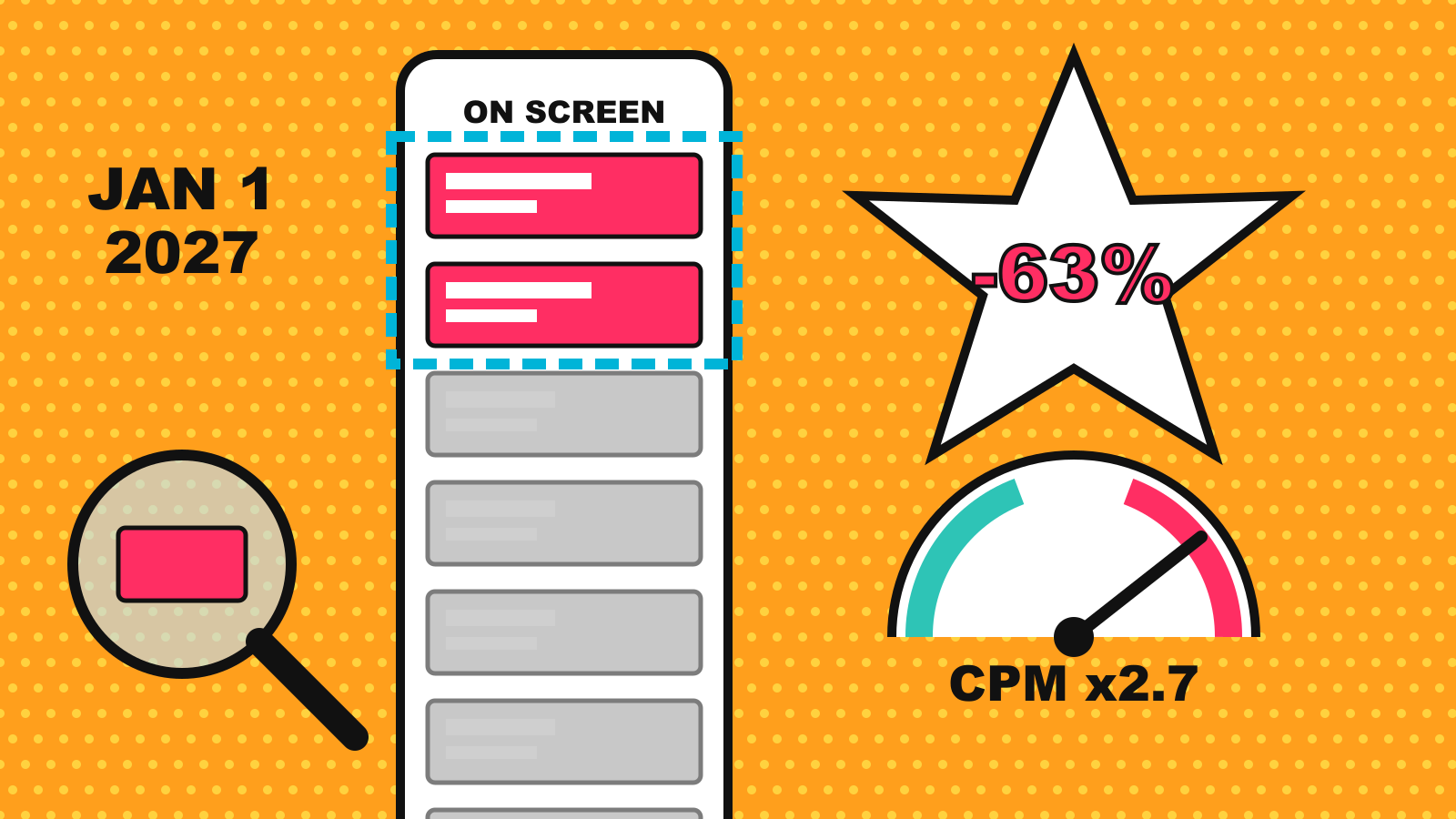
Starting January 1, 2027, Amazon will count a DVA display impression on the Amazon Store only once the ad actually appears on a shopper's screen, instead of when it downloads. Amazon expects reported impressions on those placements to fall about 63% on average, which makes CPM look roughly 2.7x higher and CTR jump even if nothing about delivery changes.
The change was flagged in an advertiser notice that PPC Land reported on November 3, after Elevate33 CMO Saul Jacobs shared it on LinkedIn. It covers DVA display on the homepage, product detail pages, search results and order pages. Video, audio, third-party inventory and sponsored ads aren't mentioned. Amazon's one line of explanation: "we will count an impression once the ad appears on the shopper's screen."
I think this is a good change. Honestly, it's overdue. But the next eight weeks are the only window you get to set up clean before-and-after numbers, and my guess is most Amazon teams are buried in Black Friday instead.
Nearly two out of three Store impressions were never on screen
Sit with the 63% for a second. If Amazon's own estimate is right, the majority of display impressions you've been reporting on Amazon Store pages were ads that loaded somewhere below the fold and never scrolled into view. Amazon says lower-page placements will drop the most, which is pretty much what you'd expect from a count-on-download system on long product pages.
Jacobs put it plainly in the LinkedIn thread: "I'm betting most advertisers weren't aware of the current impression methodology onsite." I'd take that bet too. Amazon's own viewability guide describes the IAB and MRC standard (50% of pixels on screen for one second for display) and says the metric "measures only the impressions that are actually seen." It's easy to read that and assume the base impression count works the same way. It didn't.
For reference, Google's Campaign Manager 360 documentation lists three counting methods: downloaded, begin to render, and displayed (one or more pixels on screen). Amazon is jumping from roughly the first to something that sounds like the third, skipping the middle step. The notice doesn't name a pixel threshold, so "appears on screen" could mean one pixel or could mean something stricter. That's question one for your rep.
The math your dashboard is about to do to you
PPC Land ran a simple illustration. Hold spend and clicks flat, cut impressions by 63%, and a $5.00 CPM becomes $13.51. A 0.10% CTR becomes 0.27%. Neither number means shoppers changed anything. It's just a smaller denominator.
Think of it like a restaurant that used to count everyone who walked past the window as a "guest." Starting in January it only counts people who sit down. Revenue per guest nearly triples overnight, and the chef didn't get any better.
Where this bites:
- Agency goals and client KPIs written in CPM or CTR. A CPM ceiling of $8 will look blown on January 2. A CTR target will look crushed, and someone will want credit for it.
- Year-over-year reporting. January 2027 Store display impressions will look about 63% lower than January 2026 with identical delivery. Any YoY deck built on impressions or reach is broken unless you annotate it.
- Cross-channel comparisons. If you benchmark Amazon CPM against Meta or programmatic CPM in a blended media plan, Amazon will suddenly look like the most expensive line on the sheet. It probably isn't, or at least not by 2.7x.
- Frequency. Reported frequency on Store display should drop too, so caps tuned against the old count may behave differently in practice. That part is a guess, since Amazon hasn't said how caps get evaluated.
Billing is the part nobody has answered
The notice talks about "your reports." It does not say whether invoices change. That's a big gap, and the comment thread on Jacobs' post mostly circled it.
There are two ways this can go. If Amazon keeps charging on the old download count while reporting the new on-screen count, your reported CPM jumps 2.7x and your actual cost per ad seen stays exactly what it always was (you were already paying for the invisible ones, you just didn't know it). If billing moves to the new count at unchanged bids, you pay for roughly a third as many units, and effective spend on Store display drops until auction dynamics adjust. Iqra Shakoor of Tacosology warned in the thread that if CPM billing uses the stricter count, advertisers could end up paying more per reported impression.
There's a hint in Amazon's own testing claim. The notice says advertisers in testing saw ROAS rise and CPA fall. PPC Land points out that only works if spend dropped relative to attributed sales, either because billing followed the smaller count or because budget moved toward placements people actually saw. Amazon didn't share a test size or time period, so treat that claim the way you'd treat any vendor test with no sample size.
One odd wrinkle: Amazon's advertising product terms already include sections (Class I placements, and Fire Tablet and Fire TV) where advertisers are "obligated to pay only for viewable impressions." So viewable billing exists on some Amazon inventory today. Which basis your Store display line items bill on is worth confirming in writing, not on a call.
And to be fair to Amazon, this isn't happening in a vacuum. Google is moving DV360 and CM360 billing to begin-to-render in February 2027, and AdSense and Ad Manager follow on February 17. Google says to expect "a slight decrease" in billed volume. Amazon is saying 63%. Same direction, very different size, and Amazon is grading its own pages here, since it's both the publisher and the seller.
This also lands a year after Amazon moved view-based attribution to a shopping-signal enhanced last-touch model on January 1, 2026, which already shifted ROAS for view-heavy campaigns. Two January methodology changes in a row means Q1 2026 and Q1 2027 are each measured differently from the year before. Fun.
If your Q1 report shows Amazon CPM up 170%, the first question should be "which count?" and not "who do we fire?"
A 30-minute snapshot before December gets away from you
None of this needs a big project. It needs a baseline you can point to in February.
- Export Q4 Store display data now, by placement. Impressions, viewable impressions, CPM, CTR, clicks, spend, DPV, purchases. Split by homepage, detail page, search and order pages if your reporting allows. Lower-page placements lose the most, so placement-level baselines matter more than the total.
- Compute your current viewable rate per placement. Viewable impressions divided by measured impressions. It won't map one-to-one to the new count (viewable means 50% for one second, while "on screen" may be looser), but it gives you a rough read on how far your own numbers will drop compared with Amazon's 63% average.
- Rewrite KPIs that use impressions as a denominator. Move Store display goals from CPM and CTR to cost per click, cost per detail page view, or ROAS for Q1. If a client contract has CPM language, flag it this month.
- Annotate every YoY dashboard with a January 1, 2027 methodology note. Looker, Sheets, whatever you use. Future-you will be grateful in about eight weeks.
- Ask your Amazon rep three questions, by email: Does billing move to the new count? What's the on-screen threshold? Do frequency caps and view-through attribution use the new count or the old one?
A rough benchmark to sanity-check against: if a placement currently shows a viewable rate well under 40%, I'd expect its reported impressions to fall by more than Amazon's 63% average. That's my inference from how the numbers line up, not something Amazon published, so check it against your own January data.
David Buckley raised a fair concern in the thread about view-through conversions. If fewer ads count as "seen," does view-through credit shrink with them, or does it somehow concentrate? Nobody knows yet. If you're running heavy view-through on DVA (and if you're testing the agent-led setup we covered when Amazon folded its DSP into an agent, you probably are), watch DPV and new-to-brand purchases more closely than reported ROAS in January.
My bet on how January actually plays out
I expect at least one large retail media agency to publish a "January Amazon CPM spike" analysis by mid-February, and I'd put better-than-even odds that reported Store display CPM across their book lands above 2x the December figure. The more interesting question is whether spend follows. If Amazon bills on the old count, spend stays flat and everyone shrugs. If it bills on the new count, Store display gets cheaper in real terms for a few weeks, and the advertisers who noticed will quietly push more budget into it before bids catch up.
There's a trust angle too. Amazon is already fighting an FTC and 22-state lawsuit over alleged hidden auction surcharges, which Amazon denies. Cleaning up impression counting is the kind of move that looks good in that context. It also means a lot of advertisers are going to learn, for the first time, how the old count worked. (Some of them are going to be annoyed about the last few years of reports, and I'm not sure that's unreasonable.)
Measurement changes like this rarely cost anyone budget on the day they happen. The damage usually shows up three weeks later, in a meeting where someone compares two numbers that were counted two different ways and nobody in the room catches it. If you take a baseline this month, you'll probably be the one who does.