ChatGPT's App Directory Has No Ad Auction. The First Apps Become Defaults.
ChatGPT quietly became a different product over the last six months, and the shift barely made it into most marketing briefings.
In September 2025, OpenAI launched Instant Checkout inside ChatGPT. The promise was simple. You could buy a scented candle from an Etsy seller without ever leaving the conversation. Stripe powered the payments. Etsy stock jumped 16 percent on the announcement. Shopify merchants were next in line. The whole thing felt like the obvious next step: ChatGPT as the new Amazon, minus the search bar.
Six months later, OpenAI pulled the emergency brake.
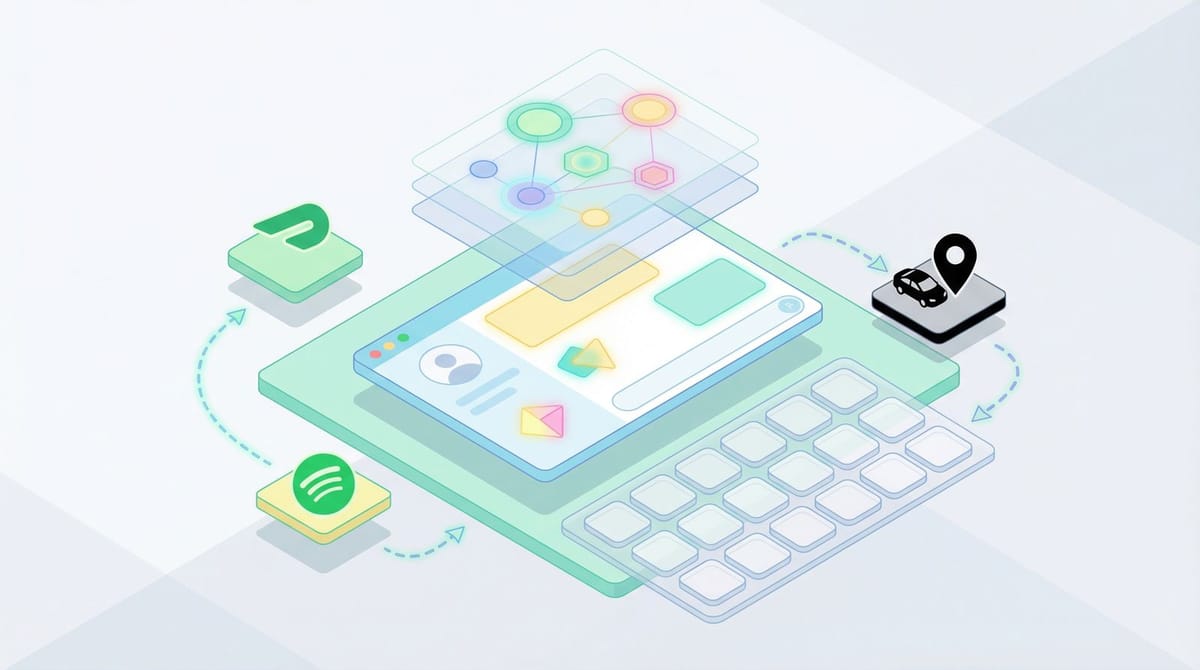
By March 2026, CNBC reported that OpenAI and its retail partners had "headed back to the drawing board," moving away from in-chat checkout and toward dedicated apps that route users back to the merchant's own site. The new model is already live. You can ask ChatGPT to order from DoorDash, build a Spotify playlist, or check Uber Eats menus. Each one opens a dedicated app surface inside the conversation that eventually hands control back to the merchant.
A strategy reversal in real time, and I think most marketers are still reading about the original Etsy launch like it's the real story.
OpenAI Blinked, and the Retailers Won That Round
Instant Checkout had one big promise. ChatGPT owns the transaction. Merchants lose the customer touchpoint. OpenAI takes a cut, probably comparable to app store fees, though the rate was never published.
The pivot to apps flips that entirely. When you order from DoorDash inside ChatGPT now, ChatGPT acts as the app switcher. It opens the DoorDash interface, lets you browse and select, then routes you back to DoorDash's own checkout flow. With the Uber Eats integration, you actually finish paying inside the Uber Eats app itself, not inside chat. The merchant keeps the conversion, the customer data, the payment relationship, and most importantly, the ability to remarket.
From what I can tell, retailers pushed back hard on the original setup. CNBC's reporting in March framed the change pretty bluntly: OpenAI is "giving those companies more control of the customer experience and the transaction process." Translation: the big retailers leaned on OpenAI, and OpenAI needed them more than they needed it.
This is the kind of concession that only happens when a platform realizes it does not have as much negotiating power as it thought. ChatGPT has 800 million weekly active users at last count. That is a lot of eyeballs. But eyeballs without retailer inventory is just a chatbot with a payment link, and the big retailers figured that out fast.
The Directory as It Exists Right Now
OpenAI announced the Apps SDK at DevDay 2025 in October. The initial launch partners were Booking.com, Canva, Coursera, Figma, Expedia, Spotify, and Zillow. Seven slots, seven categories, no competition inside each one.
The SDK is built on MCP, the Model Context Protocol that Anthropic originally open-sourced. That detail matters for exactly one reason. Apps built for ChatGPT can technically work in any MCP-compatible client, so the integration work is not locked to OpenAI. I suspect that made more brands willing to invest in building one.
Third-party submissions opened December 17, 2025. Apps that passed review started rolling out to users in early 2026. Since then, the list has grown to include DoorDash, Spotify, Uber, Uber Eats, Target, and Instacart. OpenAI has said OpenTable, PayPal, and Walmart are coming later this year.
Here is the part nobody is talking about loudly. There is no ad auction. There is no paid placement. There is currently no way to bid for better visibility when a user asks ChatGPT to "order dinner" or "book a hotel."
If your category has an app already, that app is the default. If your category has no app yet, there is an empty slot, and whoever ships a decent integration first probably owns that query for a long time. I have seen this dynamic before, and it tends to produce winners that stay winners well past the point where the platform opens up the slot to real competition.
The Shape of the App Surface Is Not the Shape of Search
Look, I might be wrong about how long this window stays open. OpenAI has already signaled that "intent-based monetization" is its direction, and intent-based almost always means auctions eventually. But right now, asking ChatGPT to "order groceries" effectively means Instacart wins the query, because Instacart built an integration and your brand did not.
That is a very different shape from SEO. In Google, there are ten organic links per results page. In the ChatGPT app surface, there is one recommendation per intent. Maybe two, on a good day. If the model picks Spotify for "make me a running playlist," it is not also picking Apple Music, and Apple Music is not getting a consolation click further down the page.
One category. One slot. One default.
For categories where one app already dominates (Spotify in music, Uber in rideshare), the new surface mostly concentrates the existing winner. For fragmented categories like local restaurant discovery, fitness tracking, small business tools, or weekend travel planning, there is a genuine opening.
The closest historical parallel, and I am hedging here because no analogy is perfect, is Facebook Pages in 2009. The pages were free, most brands shrugged, and a handful of companies built real audiences before the platform started charging for reach. By 2013 the real estate was expensive. By 2016 it was mostly closed off to organic distribution. The brands that showed up early got years of free reach. The brands that waited ended up paying by the impression.
Geographic Limits Are the Real Constraint
This part matters more than the monetization story and gets less coverage. ChatGPT's app integrations are only available in the United States and Canada. Europe and the UK are blocked because of regulatory friction, which is the polite way of saying OpenAI has not figured out how to make this legal under the Digital Services Act.
For US-focused brands that run most of their paid media in North America, this is fine. For anyone whose primary market is EU, UK, or APAC, your ChatGPT app strategy has an indefinite start date. That is a real planning problem. I would not ignore it, but I would not prioritize an EU integration either until OpenAI actually ships in your region.
The Fifteen-Minute Check Every Category Leader Should Run
A practical test, maybe fifteen minutes of work:
- Open ChatGPT in a US session. Ask it three queries that map to your category. For a food brand, try something like "suggest something for dinner tonight near me." For travel, try "plan me a weekend in Austin." For a consumer app, try "help me track my workouts this week."
- Note which app, if any, surfaces. If it surfaces a competitor, you are already losing that query. If it surfaces nothing, you have a window.
- Check if there is an existing app in your category by asking "what apps do you have for [your category]?" and reading the actual SDK-connected list, not a generic recommendation.
- If there is no app in your category yet, start scoping whether the SDK build is worth it. The Apps SDK is open source and built on MCP, so your engineering team probably has faster time-to-prototype than you think.
The benchmark I would watch: if your brand appears in even one of the three test queries, log that as a baseline and re-run the test weekly. The first week a competitor ships an integration and starts stealing the query, that is your signal to either build your own or accept that you are now paying for distribution you used to get for free.
This connects to something we covered recently about 29 million AI search queries and why "shop now" is the wrong button on these surfaces. The common thread is that AI interfaces do not work like Google results pages. The CTAs, ad units, and ranking signals that marketers are used to do not transfer. Every new AI surface creates a small window where the rules are not written yet. This is one of them.
What I Actually Think Happens Next
The apps surface probably gets an ad auction within twelve to eighteen months. It would be strange if it did not. OpenAI reshuffled its entire ad business leadership recently, which is not something you do if you plan to stay neutral on monetization forever.
But between now and that auction, there is a weird moment where the platform is handing out slot inventory that will eventually sell for money. The brands that figure this out now will have integration data, engagement metrics, and operating histories by the time the auction opens. The brands that wait will find themselves bidding against incumbents who have been collecting data on the same surface for a year. I have watched that pattern play out on Facebook Pages, on the App Store, on Amazon advertising, and on the Google Shopping feed. The early movers rarely lose their position, and the late movers almost always pay a premium for the scraps.
I do not think the ChatGPT app directory is going to replace search or ads or email as a primary channel. It is probably going to be a weirdly important distribution layer for a narrow set of categories, and a non-event for everyone else. For the narrow set where it matters, the brands taking it seriously in the next six months will look noticeably smarter in eighteen months than the ones dismissing it as another OpenAI press release.
Distribution is free exactly once. This is the free part for ChatGPT apps.
Notice Me Senpai Editorial