Claude Has No Paid Placements. Spotify Got One Anyway.
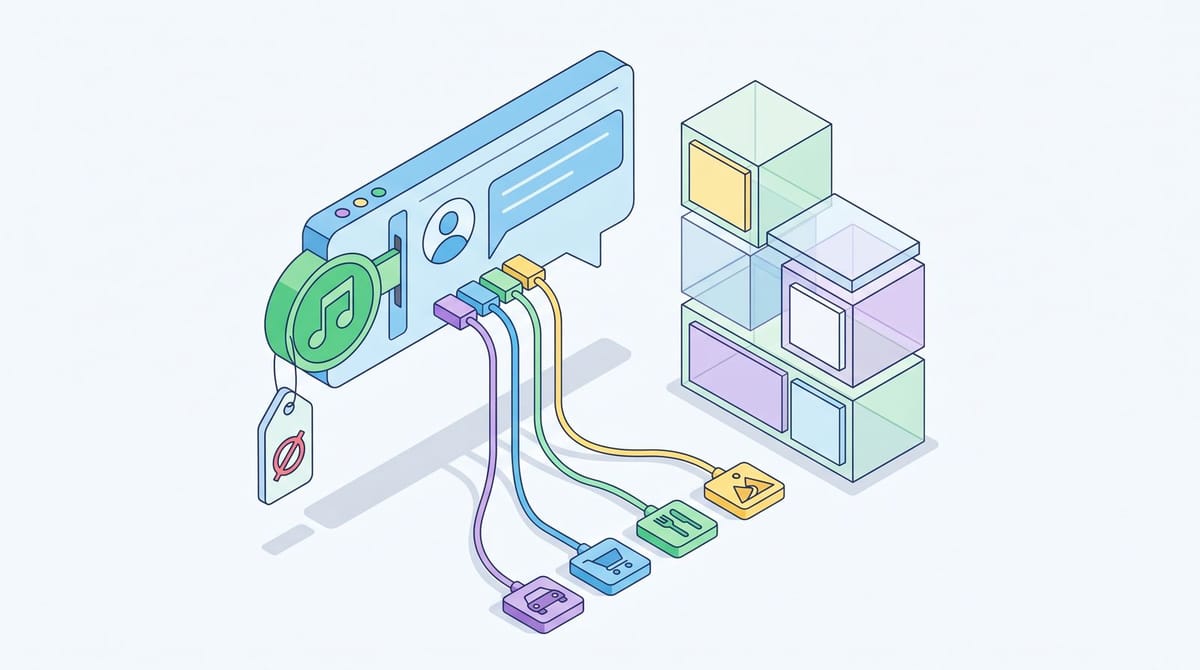
On April 23, 2026, Spotify became one of 15 consumer apps Anthropic added to Claude as built-in connectors. Claude's published policy says no paid placements and no sponsored answers anywhere in the product. Spotify, with 761 million monthly active users, is now the music recommender Claude reaches for before users type the word "music".
A brand placement without an invoice attached
That contradiction is the whole story. Anthropic's announcement post is explicit: "Claude is ad-free and will stay that way. There are no paid placements or sponsored answers in conversations with Claude."
The directory of 200-plus connectors does have a structure though. When you ask Claude for music, Spotify fires. Ask for a ride and Uber fires. Describe a hike and AllTrails fires. Anthropic frames this as connectors getting "ranked by what's most useful to you," which is the line that does the real work. Useful by what definition, ranked by which algorithm, with what data: none of that is documented anywhere.
What we do know is who is in and who is not. Spotify is in. Uber, Instacart, Booking.com, Resy, StubHub, TurboTax, Credit Karma, AllTrails, Audible, Taskrabbit, Thumbtack, Tripadvisor, and Viator are in. Apple Music is not. Tidal is not. Lyft is not. DoorDash is not. OpenTable is not. Expedia is not. Claude's default answer for music in early May is Spotify, and the default answer for restaurant reservations is Resy.
That is a brand placement. It just does not have an invoice attached.
Spotify spent the last six months writing the playbook
This integration did not appear in a vacuum. In February 2026, Spotify disclosed that its senior engineers had stopped manual coding in December 2025 and were running entirely through Claude Code via an internal system named Honk. Whatever that engagement looked like, it ran for at least four months before this consumer-facing connector landed.
What I think is more interesting is that nobody else has produced public reporting on a partner relationship that deep with Anthropic. Apple Music presumably uses LLM tooling somewhere internally. Tidal does too. None of them show up in the connector directory in this drop. Spotify worked the channel that mattered, and the channel paid off in a way standard B2B partnership work tends not to.
The takeaway for consumer brands: the AI assistant integration list is not a paid media buy you can bid on. It is a product partnership you have to negotiate directly with the model provider. The currency is engineering credibility, content rights, and API quality. The ROI is being the default answer in the interface tens of millions of people are starting to treat as their primary search layer. This pattern is similar to Meta letting ChatGPT and Claude into its ad API, except Spotify negotiated for the consumer-facing slot rather than the ad-buying one.
Why the "no ads" promise makes the slot more expensive, not less
Anthropic is making a positional statement here. ChatGPT runs rewarded UA experiments. Perplexity carries explicit ads. Microsoft Copilot links into Bing's sponsored grid. Claude is the holdout, and the company leans into it in marketing.
That position will not hold forever. When the connector directory grows from 200 to 2,000, the ranking layer becomes the entire economics of LLM-mediated commerce. Even without sponsored answers, Anthropic will need a tiebreaker between three competing reservation apps, four competing music services, and six competing ride providers. "Most useful to you" will eventually mean something operational, and what it ends up meaning will be one of the more important questions in performance marketing for the next five years.
For now, Spotify gets the slot for free. So does Uber. So does TurboTax. The brands inside the directory at the moment Anthropic flips the switch on monetization, if it ever flips, will have a structural advantage that is hard to dislodge. Default-status incumbency is sticky in every interface that has ever existed. Yahoo's default search deal with Mozilla was worth roughly a billion dollars a year when nobody else could buy it. Apple's default-engine slot for Google has paid out around $20 billion a year for the better part of a decade. The pattern is consistent. Whoever is in the box when the box becomes the front door wins.
The wrinkle in Claude's case is that the connector layer is more granular than search-engine defaults ever were. A search engine routes a query to an entire web of competing destinations. A connector routes a query to one product, one brand, one experience. From what I have seen, that compresses the price of being the default by a couple of orders of magnitude, because there is no second-place click for the user to fall through to. Either Spotify shows up or Apple Music does, and right now it is always Spotify.
What working marketers should do this week
Three things, in order of effort.
First, audit which of your competitors are in the connector directory. Spotify's own announcement and Anthropic's partner page list the current set. If your category already has a connector and your brand is not in it, log the gap as a real product-marketing problem, not a content problem. If your category does not have a connector yet, that is a temporary advantage that probably will not last past Q3.
Second, run a small manual test. Open Claude Pro, ask the question a customer would ask in your category, and see which brand surfaces. If you sell email software and Claude pulls Mailchimp without prompting, you have a problem that another G2 review will not solve. The fix lives upstream, in the connector layer or the training data, and probably both.
Third, and this is the one most teams will skip, figure out who at your company owns the relationship with the LLM platforms. For the last twenty years that role belonged to the SEO team for Google and the social team for everything else. For the AI assistant layer, there is no team yet. Make one. Even if it is one person at 25 percent capacity, name them, and start a working doc tracking which assistants surface your brand for which queries, who owns the partnership conversation with each provider, and what content or API access you have licensed to whom.
One concrete benchmark to track from the start: how often Claude defaults to your brand versus a competitor for your top five customer queries. Run the test monthly, log the result, and treat any month where the default flips against you as a P1 incident. That is the closest analog to a rank-tracking dashboard the AI-assistant era currently has, and it costs nothing to set up.
The signal to watch next
What I would watch over the next quarter is three things: how many connector slots get added, how often Claude defaults to a partner over an unpartnered competitor when both are technically eligible, and whether anyone outside the current partner list shows up in a future drop without a public announcement.
The first signal that the no-paid-placements rule is bending will probably be a surprise addition to the directory after a quiet partnership announcement somewhere else, ideally one nobody connects to a commercial agreement at first. That will be the moment to take the position seriously.
For now, the move is to assume Spotify just made the playbook public. The brands that copy it before the slot has a price on it are going to be very hard to compete with later.
Notice Me Senpai Editorial