Liquid Death Is Giving Away a House. The Stunt Isn't the Story.
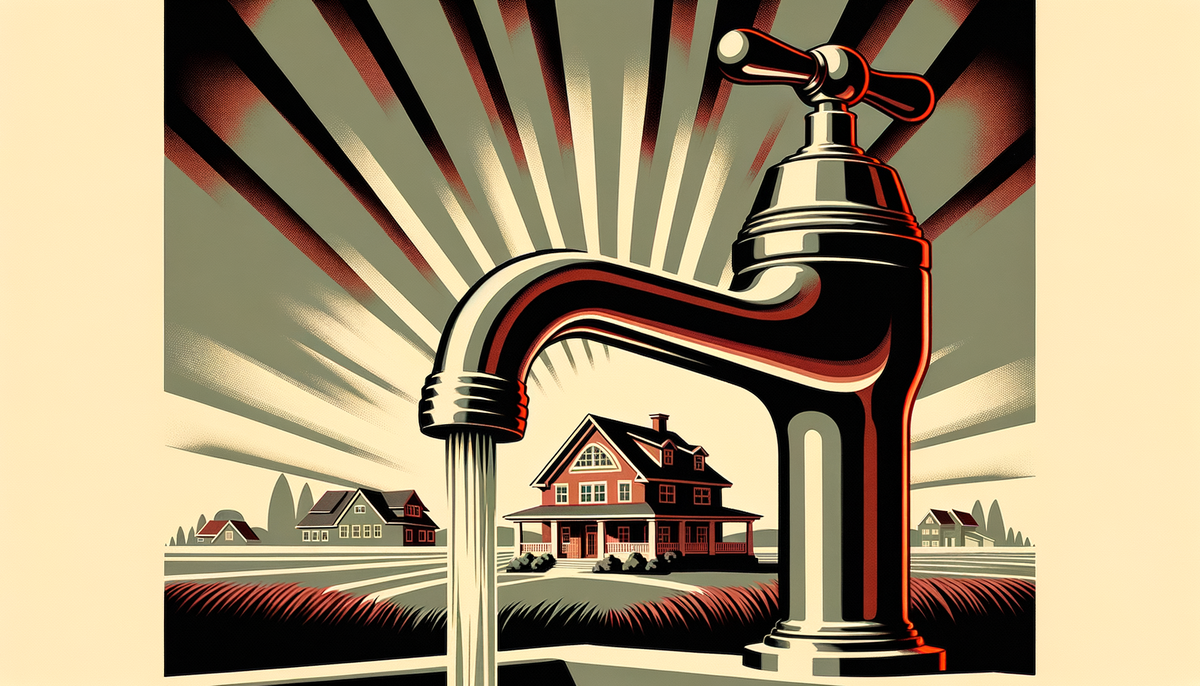
A publicly traded homebuilder and a canned water company with a death metal logo just partnered on a house where every faucet pours soda-flavored sparkling water. If your first instinct is to call this a gimmick, I'd slow down. The stunt is funny. The strategy behind it is worth more than the house.
Taylor Morrison, a Fortune 500 homebuilder with communities in Florida, Texas, and Indiana, teamed up with Liquid Death on a sweepstakes where the winner gets a home (or $250,000 cash) with a 1,000-gallon tank of Liquid Death connected to the plumbing. Every showerhead. Every garden hose. Every bathtub faucet. That's roughly three days of water for a family of four, which is a detail I keep thinking about from a purely logistical standpoint and honestly find kind of hilarious.
Entry works like this: buy Liquid Death, keep the receipt, each can equals one entry. Tour a Taylor Morrison model home and scan a QR code for five bonus entries. Entries close June 30, 2026. Standard sweepstakes mechanics with a physical retail and homebuilder foot traffic play baked in.
But the house isn't the interesting part. What's interesting is who's on the other side of the partnership.
A water brand and a homebuilder have no business being in the same room
That's the point. Liquid Death has been running this playbook for years, and I think it's one of the more underappreciated brand strategies in DTC right now.
Most brand collaborations stay neatly inside their category. Beverage brands partner with other food companies. Apparel brands partner with other fashion labels. It's comfortable, it makes sense on a slide deck, and it generates approximately zero cultural conversation. Nobody is screenshotting a press release about two sparkling water brands doing a limited-edition flavor together.
Liquid Death deliberately goes the other direction. Their collaboration history reads like someone shuffled a deck of brand names and drew at random. e.l.f. Cosmetics (a corpse paint makeup kit). Spotify (a $495 speaker shaped like a funeral urn). Van Leeuwen (ice cream flavors inspired by canned water, which sounds terrible and got enormous press). Cineverse for a Toxic Avenger partnership. And now Taylor Morrison, where the collaboration literally involves plumbing.
None of these partnerships make intuitive category sense. All of them generated media coverage that a same-category collab never would have. According to the Food Institute, more than 70 brands have approached Liquid Death about collaborations. Not the other way around. Seventy brands are trying to get into the Liquid Death orbit, which tells you something about the earned media math these partnerships produce.
The off-category arbitrage most brands won't touch
I think there's a real structural advantage to what Liquid Death is doing, and it's not just "be weird for attention." There's a logic underneath it.
When you partner within your category, you're fighting for the same audience's attention with the same media outlets covering the same industry. A beverage brand partnering with another beverage brand gets covered by food and beverage trade press. Maybe a lifestyle blog. The ceiling is low.
When Liquid Death partners with a homebuilder, the story hits Ad Age, real estate publications, marketing trade press, and mainstream entertainment outlets simultaneously. Each partner brings a completely different audience graph. The overlap between people who follow Taylor Morrison new-build communities and people who buy Liquid Death at a gas station is probably close to zero, and that's exactly the point. You're not splitting attention. You're multiplying it.
It reminds me a bit of what happens when a DTC brand does something structurally unexpected. When Allbirds sold for $39 million after being valued at over $4 billion, the conversation wasn't just about shoes. It was about what happens when a brand's identity and its business model stop reinforcing each other. Liquid Death seems to understand, at least from what I've seen, that brand identity needs to be fed constantly with things that feel slightly wrong. The dissonance is the distribution mechanism.
Why most marketing teams can't copy this (and what they can steal)
I should be honest: telling a mid-size B2B SaaS company to "just partner off-category like Liquid Death" is useless advice. Most brands don't have the cultural permission to do something this absurd. Liquid Death spent years earning that permission by being consistently weird in a way that felt intentional rather than desperate. There's a difference between "our brand is fun" and "our brand has a coffin-shaped casket cooler and a page where you can sell your soul." One is a positioning statement. The other is a commitment so deep it becomes credible.
But there are pieces of the playbook that scale down. The core principle is this: look for partners who share your audience's sensibility but not your product category. Your customer probably has interests, humor, and cultural touchpoints that have nothing to do with what you sell. The partnerships that break through tend to acknowledge that reality instead of pretending your customer's entire personality revolves around your product.
Practically speaking, if I were running partnerships for a brand right now, I'd build a list of 10 companies that my best customers also buy from but that have zero competitive overlap with me. Then I'd look for the two or three where a collaboration would make people do a double-take. Not confused. Intrigued. The Taylor Morrison partnership works because it's surprising but not random. Water comes from faucets. Liquid Death is water. A house has faucets. The logic is there, it just takes a second to land, and that second is where the earned media lives.
The $1.4 billion brand that still acts like an underdog
Liquid Death was valued at roughly $1.4 billion after its Series E round. It reportedly pulled in about $333 million in revenue in 2024, with projections around $340 million for 2026. Goldman Sachs has been hired to explore an IPO. This is not a scrappy startup anymore by any financial measure.
And yet the brand still operates with the energy of a company that has something to prove, which is probably the hardest thing to maintain at scale. Most brands at Liquid Death's size start playing it safe. They hire a new CMO who tones things down. The board gets nervous about a partnership that involves the phrase "killer house." Incrementally, the brand becomes indistinguishable from its competitors.
Liquid Death seems to be doing the opposite, at least for now. The Taylor Morrison partnership is arguably their most ambitious stunt to date, not because it's the weirdest (the e.l.f. corpse paint kit probably wins that title) but because it involves giving away actual real estate. That's a fundamentally different scale of commitment than a limited-edition product. And it still feels, somehow, like a joke that got out of hand in the best way.
My prediction: within the next 18 months, at least 15 major consumer brands outside the beverage category will attempt a Liquid Death-style off-category partnership strategy. Most of them will fail because they'll copy the weirdness without building the underlying brand permission first. The ones who succeed will be the ones who spent years establishing a clear enough identity that the off-category move feels like a natural extension rather than a desperate pivot.
The faucet thing is silly. The distribution model behind it is not.
I keep coming back to the sweepstakes entry mechanics. Buy a can, keep the receipt, get entries. Tour a Taylor Morrison home, scan a QR code, get bonus entries. It's a physical retail and foot traffic funnel disguised as a publicity stunt. Taylor Morrison gets potential homebuyers walking through model homes. Liquid Death gets point-of-sale lift from people buying cans specifically for sweepstakes entries. Both brands get a media cycle that neither could have manufactured alone.
That's what a lot of the "Liquid Death is just marketing" criticism misses, I think. It is just marketing. But the marketing is doing real commercial work. Every collaboration isn't just content. It's a distribution partnership with a media multiplier attached. The sparkling water flowing from faucets is the headline. The QR code scanning in a model home is the business model. And, to be fair, the fact that 70-plus brands are now lining up to be part of the next one means Liquid Death has turned its own brand into a platform that other companies pay to access.
Whether that holds up through an IPO process, where public market investors tend to want predictable revenue growth rather than viral moments, is a genuinely open question. But for right now, if you're building a brand and your partnerships all look like they came from the same industry conference networking event, it might be worth asking what your version of a sparkling water faucet house could look like. Probably something smaller. But the principle is the same.
By Notice Me Senpai Editorial