The Old Traffic Recovery Playbook Assumed Google Was the Problem. It Is Not Anymore.

Most SEO teams responding to traffic drops still run the same play they've been running since 2019. Audit technical issues, check for algorithmic penalties, refresh thin content, build more links. It's a reasonable response to a problem that increasingly doesn't exist.
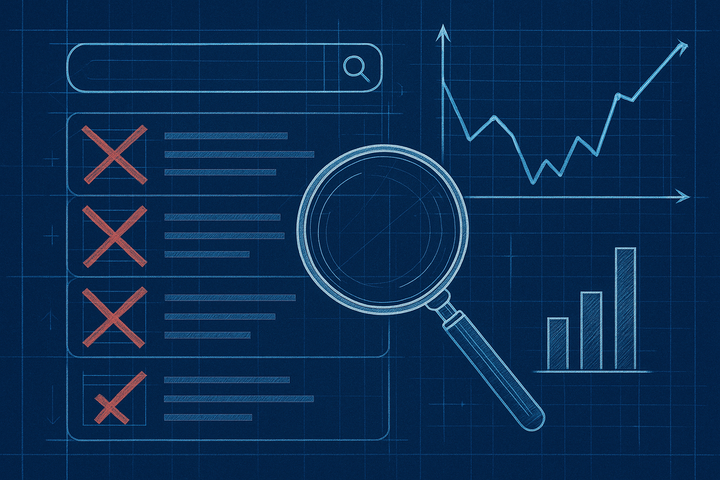
Traffic declines in 2026 are less likely to come from a Google algorithm update and more likely to come from queries being answered before anyone clicks anything. A Seer Interactive study tracking 3,119 queries across 42 organizations found that organic CTR dropped 61% on queries where AI Overviews appeared. Not a small decline you can optimize around. A structural shift in how answers get delivered.
And that's just the Google side. ChatGPT now processes roughly 1.6 billion daily search queries, about 12% of Google's total volume. But it sends 190 times less traffic back to websites.
Twelve percent of search volume. Almost none of the clicks.
Gartner predicted in early 2024 that traditional search volume would fall 25% by 2026 due to AI chatbots and virtual agents. We're roughly on pace for that. The question isn't whether traffic is declining. It's whether the strategies most teams are using to respond actually address the cause.
Applying the old playbook to the new problem is like optimizing your store layout after the highway moved
If you need a concrete example of what happens when a traditional content strategy meets the new reality, look at HubSpot. Their organic visits fell from around 13.5 million to under 7 million between late 2024 and early 2025, with some estimates putting the year-over-year decline at 80%.
HubSpot CEO Yamini Rangan acknowledged it on an earnings call: "organic search traffic is declining globally" and specifically pointed to AI Overviews giving answers directly. The irony is that HubSpot's content strategy of targeting broad, high-volume informational queries was the exact type of content AI Overviews are built to summarize. The strategy that made them a traffic giant also made them the most vulnerable.
I think a lot of teams look at HubSpot's decline and assume it won't happen to them because their content is more niche or more technical. From what I've seen, that assumption is mostly wrong. A Digital Bloom analysis found that the median publisher saw 10% year-over-year traffic declines, and 60% of all searches now end without a click. On mobile, that number jumps to 77%.
The old playbook says: refresh your content, improve your E-E-A-T signals, build authority. And those things aren't useless. But refreshing content doesn't help much when the query gets answered in an AI Overview and nobody clicks through to begin with.
The updated recovery playbook starts with a different diagnosis
There's a Forrester analyst named Nikhil Lai who's been talking about this shift for a while now. In a recent piece for Search Engine Journal, he framed the change this way: the teams adapting fastest aren't treating this as an SEO problem. They're treating it as a visibility problem across a broader set of answer engines.
The data supports him. According to research from Superlines, AI referral visitors convert 4.4 times higher than standard organic visitors. Content updated within 60 days is 1.9 times more likely to appear in AI answers. Pages with FAQ sections earn more citations. And here's the one that reframes the whole conversation: 80% of the URLs cited by AI tools don't even rank in Google's top 100 for the original query.
The signals that earn AI citations are not the same signals that earn Google rankings. We covered this in detail when we looked at what AI citation signals actually look like, and it's only getting more pronounced. Different inputs, different outputs.
So here's what the updated recovery playbook actually involves:
First, separate your traffic loss into two buckets. Pull your Search Console data for the last 12 months. Filter for queries where impressions stayed flat or grew but CTR fell. Those are your AI Overview casualties, and they're structurally different from queries where both impressions and CTR dropped (which is more likely a traditional ranking issue).
Second, for the AI Overview casualties, stop optimizing for rankings and start optimizing for citation. That means comprehensive FAQ coverage, structured data markup, and explicit comparative content that directly addresses how you stack up against competitors. AI models love direct comparisons because they make recommendation easier.
Third, start tracking new metrics. The old dashboard of rankings, traffic, and impressions is still useful, but it's incomplete. Add citation share (how often your brand appears in AI tool responses for target queries), branded search volume (the best proxy for AI-driven awareness), and revenue per visit segmented by traffic source. You may find that your declining traffic is actually more valuable per visit than it was a year ago, which changes the conversation entirely.
The uncomfortable math that makes this less catastrophic than it looks
Here's the thing most of the doom-and-gloom coverage misses. Less traffic doesn't automatically mean less revenue.
Lai's research found that answer engine referral traffic is growing at 40% month over month, and those visitors convert 2 to 4 times higher than traditional search visitors. They spend 3 times longer on site. The volume is lower, but the quality is significantly higher.
I'm not trying to spin a traffic decline into good news. A 61% CTR drop is brutal regardless of how the remaining visitors convert. But if you're reporting to a CMO or a board, the conversation should include revenue impact, not just traffic volume. And in a lot of cases, the revenue impact is less severe than the traffic charts suggest.
The practical move: audit your top 50 revenue-driving pages (not your top 50 traffic pages, those are probably different lists now). For each one, check whether it appears in ChatGPT and Perplexity responses for the queries you care about. The gap between your Google visibility and your AI visibility is your actual recovery target.
Recovery means building for where buyers are going, not where they were
The hardest thing about this shift, honestly, is that it requires letting go of a mental model that worked for 20 years. "More organic traffic equals more revenue" was true for so long that it became an assumption instead of a hypothesis.
The teams I've seen handle this well are the ones who stopped trying to recover their 2023 traffic numbers and started building visibility in the places where buyers are actually spending time. Lai calls it Answer Engine Optimization. Other people call it Generative Engine Optimization. The name doesn't matter much. What matters is whether you're being cited in the answers that AI tools give to your customers' questions.
If you want a gut check: open ChatGPT, ask it the question your best customer asks before buying, and see if your brand appears in the response. If it doesn't, that's probably a more urgent problem than whatever your Google rankings report said last week.