Activation Rate Is the Metric Your Funnel Is Missing
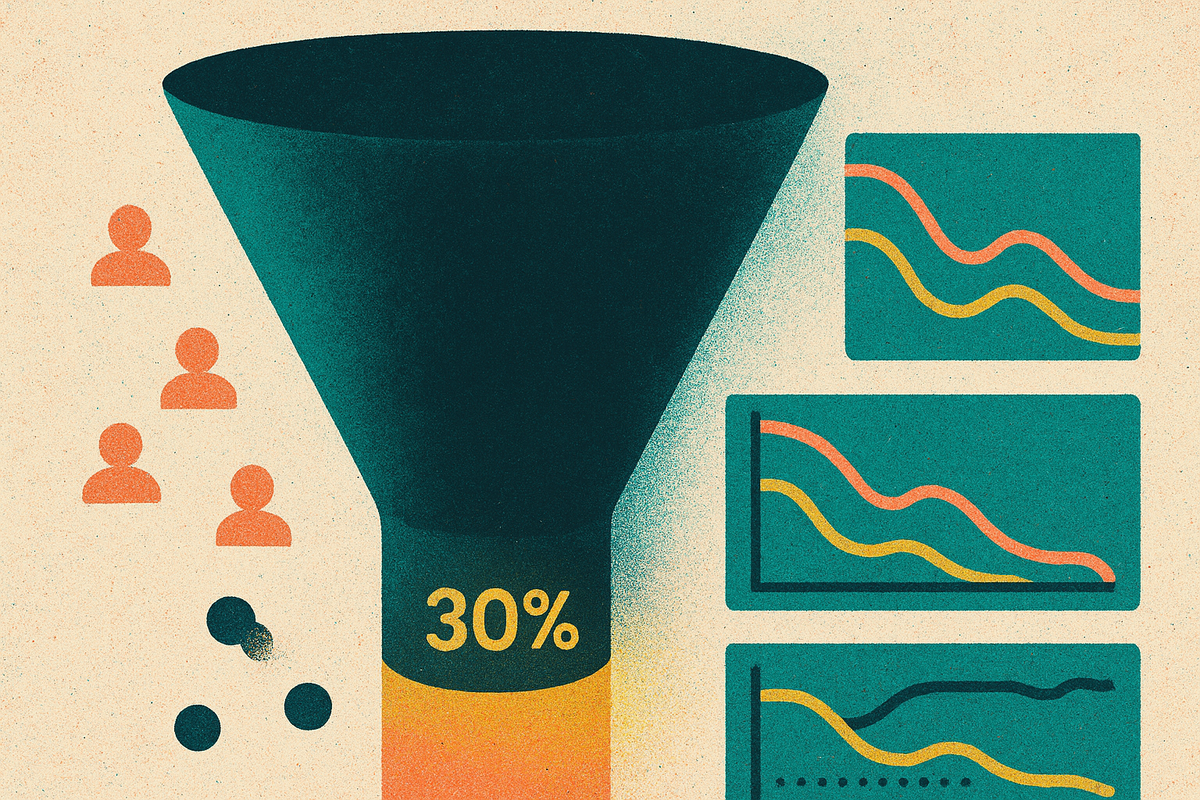
Activation rate is the percentage of new signups who reach your product's core value moment within a fixed window, usually 3 to 7 days. Median B2B SaaS activation sits near 30 percent, which means most funnels lose two out of three signups after the conversion event marketing celebrates. Improving activation usually costs less than buying the traffic to replace those losses.
I've watched marketing teams toast a record signup month while the product dashboard, one tab over, showed most of those signups never came back after day one. Nobody was lying. The two teams were just reading different scoreboards, and the marketing scoreboard stops counting at the exact moment the money starts to leak.
Marketing owns the signup. Nobody owns the next 72 hours.
Every funnel review I've sat in covers the same territory: impressions, clicks, landing page conversion, cost per signup. Then the meeting ends. What happens between the signup and the first moment of real product value belongs to no one, because it sits in the gap between marketing's dashboard and product's roadmap. Metrics that sit between departments don't get fixed.
The math is what makes this expensive. If your activation rate is 30 percent, your effective cost per activated user is 3.3 times your cost per signup. That multiplier never shows up in the ad platform, so a $40 signup that looks fine in the weekly report is actually a $133 activated user. Paying for signups without tracking activation is like paying a doorman to pack a restaurant and never checking whether anyone orders food. The room looks full. The kitchen is idle.
And to be fair, this isn't a new insight inside product-led growth circles. Guides like Appcues' rundown of PLG metrics have treated activation as the hinge of the whole model for years. It just rarely crosses over into the marketing meeting, which is strange, because marketers are the ones paying for the unactivated signups.
Your activation event is probably wrong (or you don't have one)
Activation only works as a metric if the event behind it actually predicts retention. The famous examples get quoted a lot: Slack's threshold of 2,000 team messages sent, Dropbox's first file uploaded and synced. Appcues has a good rundown of how these were found. What gets quoted less is that these companies worked backwards from retention data to find them. They didn't guess.
Lenny Rachitsky's newsletter ran a piece on determining your activation metric that I think is the most useful framework available: brainstorm candidate "aha" moments from usage data, run regressions against 30-day retention, then run experiments to confirm the relationship is causal. The line worth stealing: a good activation metric is causal for your retention, not just correlative. One e-commerce example from that piece stuck with me. Customers who placed two orders retained at twice the rate of one-order customers, so the activation event became the second order, not the first. Nobody's intuition would have picked that.
Most teams skip all of this and pick something flattering instead. Usually onboarding completion, because it's already instrumented and the number looks respectable.
Onboarding completion is not activation. It measures whether people finished your tour, not whether they got value.
A user can click through five tooltip screens and churn on day two. A user can skip the tour entirely, import their data, and stay for three years. If your activation metric can't tell those two apart, it's decoration.
The benchmarks are humbling, and martech sits at the bottom
Tandem's 2026 benchmark roundup puts B2B SaaS activation at roughly 30 percent median and 36 to 37.5 percent average, measured within a 3-to-7-day window for moderately complex products. The vertical breakdown is where it gets uncomfortable for this audience: martech tracked the lowest onboarding completion of any category they measured, around 12.5 percent. The industry that sells funnel optimization software builds the products people abandon fastest. I don't have a defense for us there.
Ranges vary a lot by how strict your event definition is, so compare against yourself month over month before comparing against anyone else. Product School's benchmarks land in the same place (36 percent average, 30 percent median) and note that strong teams aim for 40 to 60 percent or higher. The same piece cites a stat worth pinning above your desk: somewhere around 80 to 90 percent of users churn if they don't see the product's value in the first week. If you're above 60 percent with a complex product, though, your activation event is probably too easy, and it seems more likely you've defined activation as "logged in" than that you've solved onboarding.
Here's the working threshold I'd use. Measure activation on a 7-day window. If you're under 20 percent, stop increasing acquisition spend until you've moved it, because you're pouring water into a cracked bucket at a known rate. Between 20 and 40, run acquisition and activation work in parallel. Above 40 on a genuinely predictive event, congratulations, go spend on traffic.
A one-afternoon audit to find where signups die
You don't need a data team for the first pass. You need about three hours and whatever analytics you already have (GA4, Mixpanel, Amplitude, even raw database queries work).
First, pick a candidate activation event using the retention logic above. If you have no retention data yet, use the founder-interview shortcut from Lenny's piece: ask recent happy customers what moment told them the product solved their problem, then instrument that.
Second, build a three-step funnel: signup, first key action, activation event, with a 7-day window. Note the biggest single drop. In most cases I've seen, it's the step where the product asks the user to do setup work before showing any value: connect a data source, invite a teammate, configure something.
Third, and this is the marketer-specific part, cohort that funnel by acquisition channel. This is where the audit pays for itself. Benchmark: any channel activating at less than half your median is buying junk signups, no matter how cheap its CPA looks. I've seen paid social deliver signups at 60 percent of the cost of search and activate at a quarter of the rate, which makes it the expensive channel once you do the division. Kill it or fix the targeting, but stop reporting its CPA with a straight face.
The fixes, ranked by effort (start with email, honestly)
The unglamorous truth is that the highest-ROI activation lever for most teams is the welcome email sequence, because it's fully in marketing's control and ships in days. The mistake is writing welcome emails about features. Point every email at the activation event instead: one email, one push toward the single action that predicts retention. We've written before about how a five-email welcome sequence out-earns broadcasts by a wide margin, and activation is exactly the job that sequence should be doing. (Related: if your list is old, decay is eating it faster than you think, and unactivated signups decay fastest of all.)
Next tier up: remove steps. Every screen between signup and first value bleeds users, and the products with three-step onboarding activate at a large multiple of the ten-step ones. The test I'd run is blunt. Cut your onboarding flow in half and measure activation on the next two weekly cohorts. If it doesn't move, you learned the steps weren't the problem. If it jumps, you just got growth for free.
Top tier: contextual in-app guidance at the specific friction point your funnel exposed, rather than a generic product tour. Tandem's data suggests this deploys in days, not the months a flow redesign takes. On paper a full redesign sounds like the proper fix. Sometimes it is. Usually the tooltip ships this sprint and the redesign ships never.
One prediction, with a number attached: within a year I expect activation rate to show up next to CAC in most PLG board decks. The 30 percent median probably won't move much, but from what I've seen of how the top quartile operates, they'll pull past 45 percent and the gap will start functioning like a moat. Cheap signups can be copied. A funnel that turns half its signups into retained users can't.
Questions worth answering straight
What's a good activation rate?
Around 30 percent median for B2B SaaS, 40 to 70 percent for simple tools with fast time-to-value. But the number only means something if your activation event actually predicts retention. A strict event at 25 percent beats a soft event at 55.
How is activation rate different from onboarding completion?
Onboarding completion measures whether users finished your setup flow. Activation measures whether they reached the value moment that correlates with sticking around. They can move in opposite directions, and when they do, trust activation.
What time window should I use?
Seven days is the common standard, and 3 to 7 days fits most moderately complex B2B products. Users who will activate tend to do it quickly. If your product genuinely needs 30 days to show value, measure that honestly, but treat it as a problem to shrink, not a fact of life.
Most teams I talk to don't have an activation measurement problem so much as an ownership problem. The metric lives between two departments, and orphaned metrics don't improve. Put one name next to activation rate this week, even if it's yours. That's the whole move.
Notice Me Senpai Editorial