Google Dropped Lift Tests to $5K, but Your First One Should Cost $0
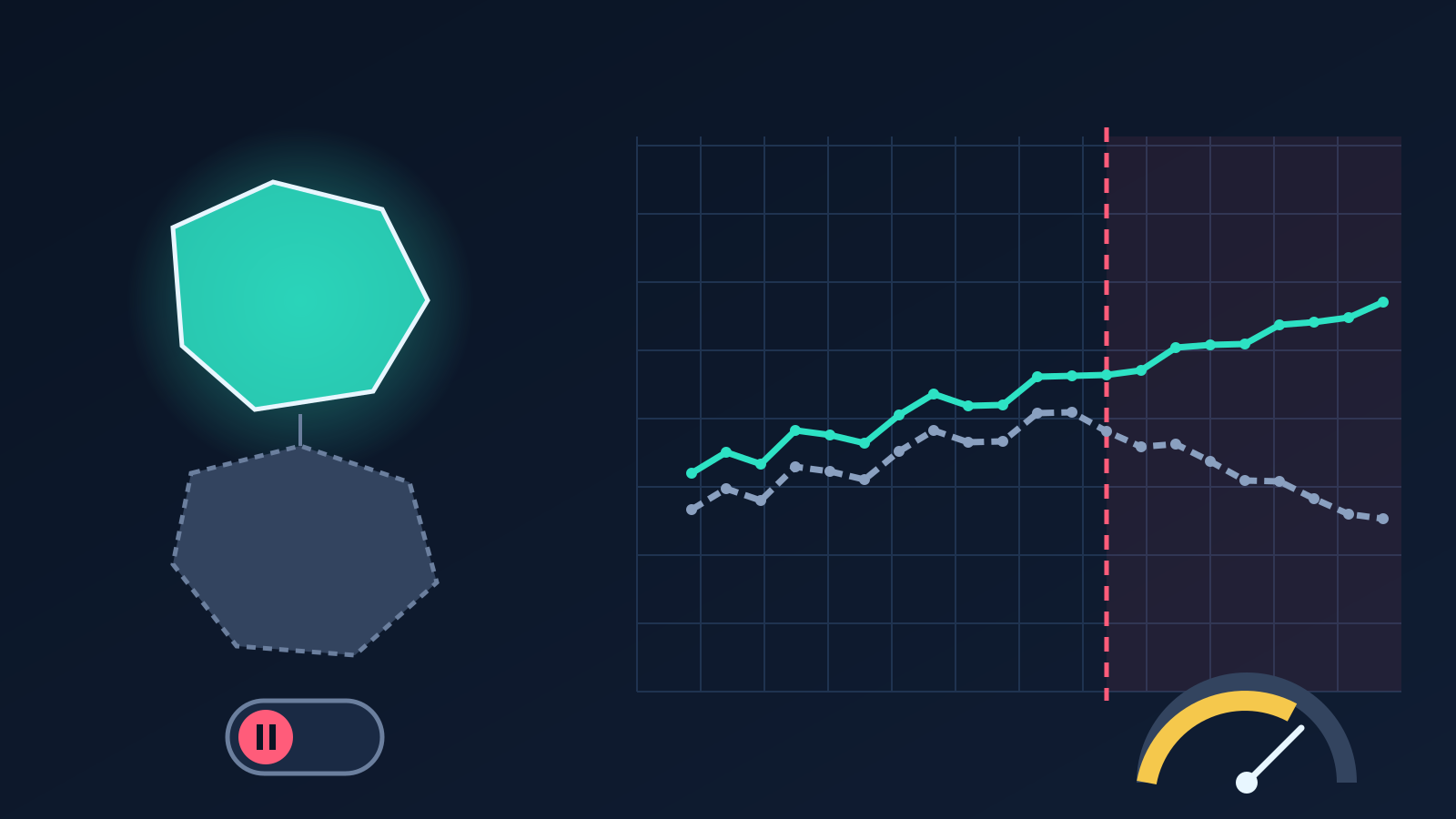
Incrementality testing measures how many conversions a channel actually causes by comparing a group that saw your ads with a group that didn't. Google cut its Conversion Lift minimum to a $5,000 study budget, but the cheapest useful test costs nothing: pause one channel in a matched set of regions for 4 to 8 weeks and compare.
That second part is what most "incrementality on a budget" advice buries under vendor pitches. You don't need a data team to run a lift test. You need a spreadsheet, a few weeks of patience, and the willingness to switch something off and leave it off even when week two looks scary. I think the patience part is honestly harder than the math.
This piece zooms in on the testing itself. If you're trying to decide between experiments and modeling more broadly, our plain-language breakdown of how marketing mix modeling works and how much data it needs covers the other half. In most cases I've seen, small teams should run a lift test before they ever touch MMM, because a test answers one question cleanly while a model tries to answer twelve at once.
Your first lift test should be brand search
If you only run one incrementality test this year, make it a branded search holdout. It's cheap (you're spending less, not more), it's easy to set up with location targeting, and it targets the channel most likely to be taking credit for sales that would have happened anyway.
The evidence for that suspicion is old but still uncomfortable. In a large field experiment at eBay, economists Thomas Blake, Chris Nosko, and Steven Tadelis stopped paid search on brand keywords and found that almost all the lost paid clicks simply moved to the organic listing. The brand ads were mostly buying traffic eBay already owned.
eBay is an extreme case, though, and I wouldn't assume your account looks like theirs. Aaron Levy, writing for Search Engine Journal, says he has seen brand search incrementality as low as 15-20% on SERPs with no competitors bidding, and as high as 85% in competitive categories like mattresses, fitness, and home services. That's a massive range. Which is exactly why you test instead of copying someone's conclusion.
Here's a simple version that most teams can launch this week:
- Pick two groups of states or metro areas with similar brand-search revenue over the last 3 to 6 months (more on matching below).
- Exclude the holdout group from your brand campaign using location targeting. Leave everything else running in both groups.
- Track total revenue and total orders per group, from your store or CRM, not from Google Ads. The ad platform can't see sales it didn't drive.
- Run it for at least 4 weeks, ideally 6.
A rough benchmark for the readout: if the holdout regions keep 80% or more of the revenue they'd normally get relative to the control regions, your brand campaign is mostly harvesting demand, and you can probably cut its budget (or tighten it to competitor-heavy terms) without much damage. Under 60% and the ads are pulling real weight. Between the two, it's a judgment call, and that's fine.
The $5K platform tests are useful, just don't let them grade their own homework
The platforms have made lift testing a lot more accessible. At Google Marketing Live in May 2025, Google said advertisers could launch an incrementality test with an experiment budget as low as $5K, using Bayesian statistics to reach conclusions with smaller samples. Before that, tests typically needed budgets in the tens of thousands.
The fine print matters, though. Google's own setup page for user-based Conversion Lift lists a $5,000 minimum budget and at least 1,000 observed conversions. It recommends running for at least 14 days and warns that studies with long conversion lag that run shorter than that have shown up to a 17% drop in measured absolute lift. Results between 50% and 90% certainty get labeled "directional."
So if you get fewer than 1,000 conversions over the study window, the $5K headline doesn't really apply to you. Meta's version has its own gates. According to measurement firm Haus, Meta's Conversion Lift needs minimum seven-day test periods and at least 10% of your audience in each test cell, and Meta can reject tests that don't have enough conversion volume. (Haus sells independent testing, so read their framing with that in mind.)
My take: use these tools if you qualify, because they're cheap and the randomization is genuinely good. But treat the output as one input among several. A platform measuring its own incrementality is a bit like a restaurant writing its own Yelp review. It might be accurate! You'd still want a second opinion. We made the same point when Meta claimed an 18.9% conversion lift from its GEM model without saying what it was compared to.
The number worth taking away from any lift test, platform or homemade, is what Haus calls an incrementality factor: incremental conversions divided by platform-reported conversions. Their example is simple and kind of brutal. A channel reporting 4x ROAS with an incrementality factor of 0.7 is really doing 2.8x, which loses money if your break-even is 3x. Multiply your reported ROAS by your factor before your next budget meeting. That's most of the trick, really.
A geo holdout that holds up in front of a CFO
If you don't qualify for platform tests, or you want to test something the platforms can't see (like a channel's effect on retail sales), you build your own geo holdout. This is where small teams usually go wrong, and almost always in the same place: picking markets.
Amsive's guide to designing defensible geo holdout tests is the most practical free resource I found on this, and a few of its rules are worth copying directly:
- Match on trends, not size. Test and control markets can have different sales levels, but their weekly sales lines have to move together before the test. Plot both on one chart. If they diverge in the pre-period, swap the pairing.
- Make the pre-period at least as long as the test. Running a 6-week test? Look at 6+ weeks of history first, ideally more.
- Plan for 4 to 8 weeks of test time for most paid media, and longer for upper-funnel channels.
- Write down the decision rule before you launch. In Amsive's YouTube example, the team agreed in advance to renew budget only at a lift of 15% or more.
The part that surprised me is how much power you give up with a small number of markets. In that same YouTube case, a 17-week test with 4 control cities could only reliably detect a lift of 21.5% or bigger. With 12 cities, that dropped to 13%.
A test that can only see a 20% lift is a test for channels you suspect are doing close to nothing.
Which, to be fair, is a perfectly good use of a cheap test. Brand search, retargeting, and affiliate coupon sites are the usual suspects, and a blunt test can tell you if any of them are near zero. What a small geo test can't do is tell you whether a prospecting campaign is producing a 7% lift or a 12% lift. If that's the question, you need more markets, more weeks, or a bigger budget. Probably all three.
If someone on your team can run R, Meta's open-source GeoLift package will handle market selection and the power math for you, for free. If nobody can, the spreadsheet version still works. Lebesgue's incrementality guide for Shopify owners suggests the simplest possible setup, two states with similar sales over the past 3 to 6 months, and honestly for a first test that's a reasonable place to start. Just make sure your regional reporting is clean first. If your GA4 property is still running on default settings, fix the GA4 settings that quietly break reporting before you trust any region-level numbers.
Read sessions, not just sales, before you cut anything
The most common mistake in write-ups of first tests is looking at one metric, seeing no change, and killing the channel. That can be a really expensive misread.
Mees Frima of Billy Grace described two tests in an InternetRetailing guest post that show both sides. In one, a global workwear brand with strong organic traffic found that a meaningful share of a channel's claimed conversions would have happened anyway, and it moved more than 10% of its total online ad budget to channels with a stronger case. In the other, a Meta holdout showed conversions holding roughly steady, which looked like a reason to cut. But site sessions fell in the holdout regions, meaning Meta was creating demand that converted later through other channels.
So, a few rules for the readout:
- Check total revenue, orders, and sessions in both groups. For awareness channels, sessions often move first.
- Keep watching for 2 weeks after the test ends. Effects from video and social tend to linger.
- A null result means "we couldn't detect a lift at this size," which is different from "zero lift." If your test could only see 20%+, a 10% lift is invisible to it.
- Right-size before you cut. The workwear brand trimmed the channel. It didn't kill it.
One messy thought I can't fully resolve: outside shocks will mess with your test no matter how well you plan. A competitor runs a big promo in three of your control states, or a heat wave hits half the country. You can't control that. Anyway, you write it down, you note it in the readout, and if it's big enough you rerun. Incrementality testing works a lot like weighing yourself on a scale that's a little off. One reading is noisy. Three readings in a row start to mean something.
My prediction, for what it's worth: I'd bet more than half of brands spending under $50K a month that run one honest brand-search holdout will end up cutting brand spend by 20% or more within a quarter. Not all of them, because Levy's 85% cases are real. But enough that it should probably be the first test on your list.
FAQ
How much budget do you need for incrementality testing?
For Google's Conversion Lift, at least $5,000 in study budget plus 1,000 observed conversions. A homemade geo holdout has no minimum spend, since you're pausing ads, but you need enough conversions per region to see a change. If a region gets single-digit orders per week, group regions together until the weekly numbers stop jumping around.
How long should an incrementality test run?
Platform studies can technically run 7 days, but Google recommends at least 14. Geo holdouts usually need 4 to 8 weeks plus a pre-period of at least equal length. Upper-funnel channels need longer: Haus reports that upper-funnel Meta tests averaged 34 days across its experiments.
Is an incrementality test the same as an A/B test?
Close cousins. An A/B test compares two versions of something; an incrementality test compares something against nothing. The same discipline applies, though, especially about not stopping early. Our guide on why hitting 95% significance is the worst time to stop applies to lift tests almost word for word.
I don't think you need a perfect measurement setup to make better budget calls. You probably just need one test that shows you which channel has been taking credit for sales it didn't make, and the nerve to act on it.