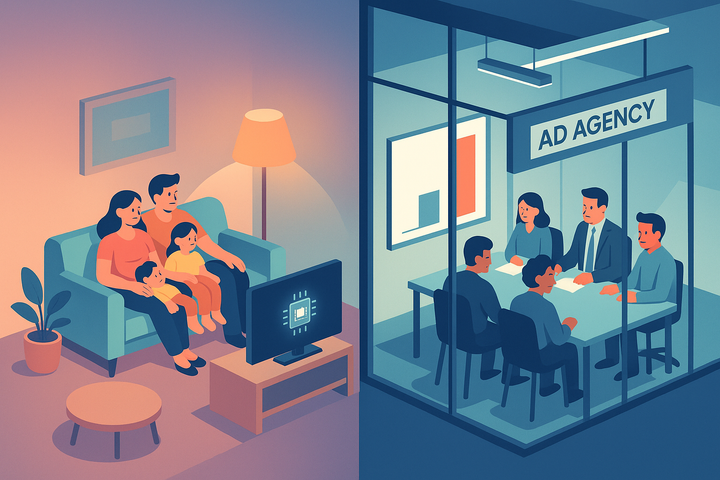
67% of Marketers Brief AI With the Data 59% Say Doesn't Work

WARC, TikTok and LIONS Advisory surveyed 400 marketers across the UK, US, Australia and Brazil in May 2026 and found 67% still brief generative AI tools primarily with demographic data. Across the same research program, 59% agreed traditional demographic segmentation no longer works. Only 17% consistently feed those tools audience insight that goes past age and gender.
The report is called The New Creative Advantage, and it landed on July 14. The headline finding everyone picked up was the volume-versus-quality gap: 88% of marketers say they are producing more creative since adopting AI, and only 45% say it got meaningfully better. That gap has been written about a lot. The input number underneath it has not, and it is the more useful one.
The targeting layer got rebuilt. The briefing layer didn't.
Think about what the last four years did to audience targeting. Meta stripped out detailed targeting options and told everyone to trust the algorithm. Google pushed accounts toward signal-based audiences and broad match. Apple's ATT knocked out a chunk of the third-party data that made granular demographic buying work in the first place. Most teams I know grumbled, adapted, and stopped writing "W25-44" at the top of a media plan.
Then generative tools showed up, the brief quietly became a prompt, and the prompt asked: who is this for?
And the answer a lot of teams typed back was "women 25 to 44, urban, household income over $75k."
That is the contradiction the WARC data caught. The bias didn't come back through the buying layer where everyone was watching. It came back through the input layer, where nobody was.
Two numbers, two samples, and why that matters
Before this stat travels any further, it's worth being precise about where the halves come from, because they are not from the same questionnaire. The 67% figure is from the new survey of 400 marketers, fielded in May 2026. The 59% figure, per PPC Land's writeup, comes out of WARC's Marketer's Toolkit 2026, a separate study. Same publisher, different sample.
So it isn't quite 400 people contradicting themselves inside one form. It's one population of marketers saying demographic segmentation is finished while a different population of marketers keeps typing demographics into the prompt box. Slightly weaker as a gotcha. Still a real gap, and honestly the cross-sample version is more damning, because it means the belief and the behavior are widespread enough to show up independently in two different studies.
Generic output is usually an input problem
The complaint list from the same research is specific, which I appreciate. Asked what limits AI-generated creative, 40% cited overreliance on generic visual styles, 36% cited unpredictable quality, 32% said output lacked originality, 26% struggled to hold brand voice, and 23% saw quality vary across a single asset set, according to PPC Land's breakdown of the findings.
Read those top three together. Generic, unpredictable, unoriginal. That is almost exactly what you get from any competent production process handed a thin brief. It's like booking a session musician and giving them a chart with only the key signature filled in. They will play something. It will be technically fine. It will not sound like you.
The model isn't inventing the blandness. It's averaging across everything it knows about "women 25 to 44," because that is genuinely all you told it, and the average of a demographic is by definition the most generic thing in it.
What marketers say is missing is the opposite of what they use
This is the part that made me sit up. Asked what input was most missing from their AI creative workflow, 45% named audience behavioural data covering how people engage rather than who they are. Then 40% said quality brand guidelines, and 35% said real-time cultural signals.
So the single most-cited missing ingredient is the direct opposite of the single most-used one. Teams know what the brief needs. They just keep shipping the brief without it.
Andy Yang, TikTok's global head of creative and brand ads, framed it in the report foreword as "not a technology gap, it is an intelligence gap," and described brands briefing powerful tools with "static demographics, legacy assumptions, data that tells you who someone was, not what they care about right now." It's a good line. It also happens to conclude that the fix is community and cultural signal, which is the thing TikTok sells, and the report is co-published by TikTok. Both things can be true. I'd just read the conclusion knowing who paid for the microphone.
Worth noting the same pattern is showing up on the buying side, where AI systems given decent signal have started outperforming human buyers on CPM rather than underperforming them. The tools are not the weak link anymore. In most cases I've seen, the brief is.
Pull your last three briefs and count the lines
Here is the audit, and it takes about twenty minutes.
Open the last three creative briefs your team handed to any generative tool. Could be a formal brief doc, could be a Slack message, could be the prompt itself. Go line by line and sort every audience description into two buckets. Bucket one: lines describing who they are. Age, gender, income, job title, location, household composition. Bucket two: lines describing what they do. What they search before buying, what they complain about in reviews, which creators they already follow, what objection kills the deal, what they call the product when they aren't reading your website.
If your who-to-what ratio is worse than 1:2, that is your generic-output problem, and no amount of model-switching will fix it.
The behavioural inputs are cheaper to get than people assume. Search Console query exports tell you the language people actually use. On-site search logs tell you what they can't find. Your last 200 reviews and support tickets are free qualitative research nobody reads. Subreddit and comment threads for your category take an afternoon to skim and will give you five phrasings your copy team would never have written. None of that requires a data partnership or a new vendor.
Benchmark to hold yourself to: after rewriting one brief this way, run the AI output past someone on your team who did not see the brief and ask which brand it's for. If they can't tell, the input is still too thin.
The unglamorous part nobody wants to own
And to be fair, demographics aren't useless. Reach planning still needs them. Frequency modelling still needs them. Anyone telling you to delete age from your planning deck is selling a framework, not advice. The problem is narrower than the takes will make it sound. It's using demographics as the only description of a person, handed to a system that takes you completely literally and has no instinct to ask a follow-up question.
If I had to put a number on where this goes: I'd expect the next wave of this survey to show quality satisfaction climbing from 45% into the high 50s, and I'd bet almost none of that movement comes from better models. It comes from teams doing the boring work of rewriting the brief template. That is not a fun thing to put in a deck. It doesn't need budget approval either, which is probably why it keeps not happening.
The uncomfortable version of this finding is that most teams already own the fix and just haven't gotten around to it. Twenty minutes with three old briefs will tell you whether you're one of them.
Notice Me Senpai Editorial