AI Overviews Hit 83% of Brand Searches, and Wikipedia Is Writing Them
Google showed an AI Overview on 82.9% of US desktop results for branded keywords as of September 29, 2026, up from a 61.3% monthly average in July, according to an Ahrefs analysis of 232.8 million SERP crawls. The summary that sits above your own homepage is mostly sourced from Wikipedia (cited in 71.9% of branded AIOs), not from your site. Audit what it says about you this week.
Ahrefs framed the risk as competitors getting to "control the narrative of your brand directly in the search results." I read the same dataset a little differently, and I think the less dramatic version is actually the more useful one for anyone who owns a brand SERP.
The 83% number, and the 73% number hiding under it
Two figures are doing different jobs in the Ahrefs study, so it's worth separating them before anyone puts "83%" on a slide.
The 82.91% is a point-in-time reading from September 29. The monthly averages are lower but still climbing fast: 61.3% of branded keywords triggered an AI Overview in July, 65.1% in August, and 73.3% in September. That's a 12-percentage-point jump in one quarter. Non-branded keywords sat at 78.3% in September, so branded queries are basically catching up to everything else.
Other trackers reported a similar spike in September, some starting from a much lower base. Whichever baseline you prefer, the direction is the same, and most of the climb happened over a few weeks.
Ahrefs also ran a separate panel of 100 brands from Interbrand's Best Global Brands 2025 list. By September 30, 63 of those 100 bare brand-name searches showed an AI Overview, and 76.2% of the time it sat in position one (average position 1.49). So for a big chunk of famous brands, the first thing a searcher reads after typing your name is a paragraph you didn't write.
One caveat: this is US desktop data. Mobile layouts and other markets may look different, and Ahrefs didn't publish a mobile split here.
Wikipedia is the real author of your brand SERP
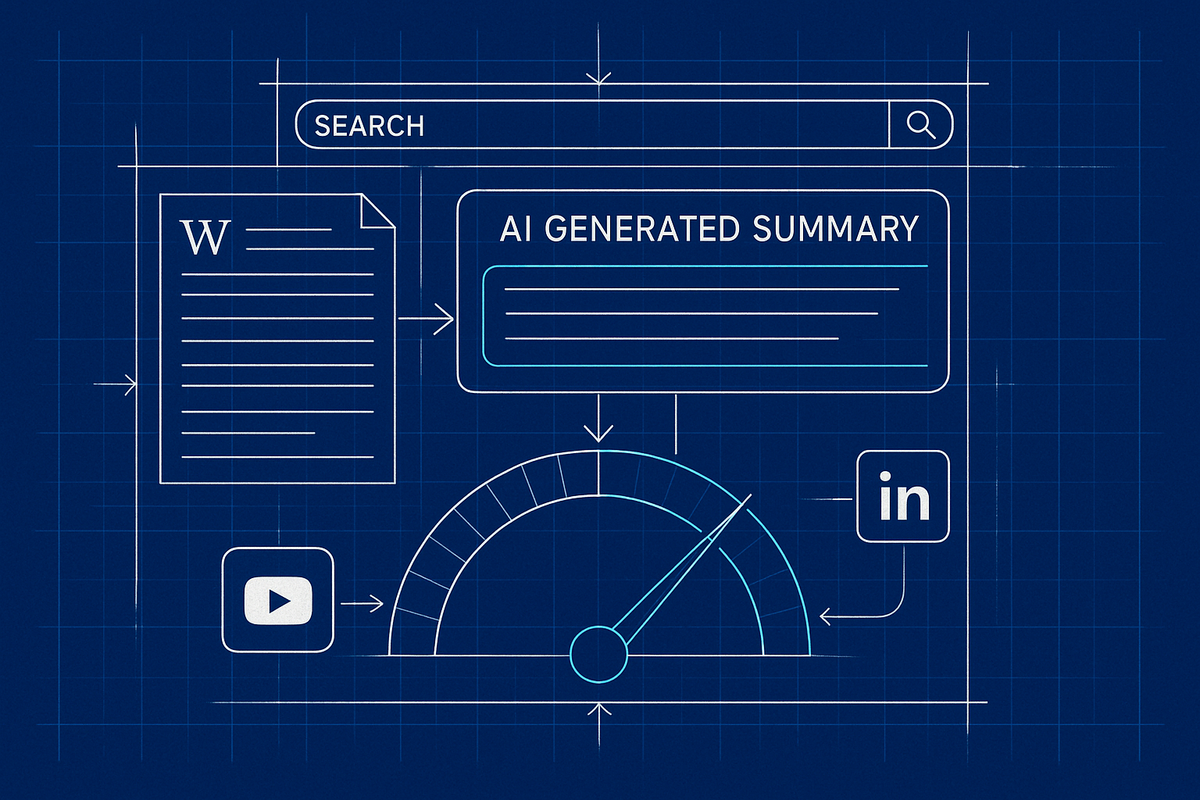
This is the part of the study I'd print out. Across branded AI Overviews, the most-cited external domains were:
- Wikipedia: 71.9%
- YouTube: 38.6%
- LinkedIn: 22.8%
- Yahoo Finance: 15.8%
- Facebook: 10.5%
- Walmart: 7.0%
And competitors? Only 3.4% of the branded AI Overviews explicitly discussed a competitor, and Ahrefs found exactly one verified competitor-owned website across 57 source lists.
So the "competitors are hijacking your brand query" story doesn't really hold up in the data, at least not yet. What the data does show is that a handful of third-party platforms are writing the summary, and most marketing teams treat those platforms as somebody else's problem. Wikipedia belongs to nobody on the team. The YouTube channel is a dumping ground for webinar recordings. The LinkedIn company page was last edited by an intern in 2023.
Your brand SERP now has an editor, and it reads Wikipedia first.
Think of it like a store where someone else stocks the front window. You still own the shop, but walk-in traffic forms its opinion from a display you never arranged.
How much of the click survives
Branded queries were always the safe ones. Someone types your name, you rank first, they click. That math is getting shakier.
Ahrefs' updated CTR study of 300,000 keywords found the presence of an AI Overview correlates with a 58% lower average click-through rate for the top-ranking page. That dataset wasn't split by branded versus non-branded, though, and I'd expect brand searches to hold up better because a lot of people searching your name genuinely want your site. Honestly, nobody has published clean branded-only CTR numbers yet that I trust.
The more interesting signal comes from Seer Interactive. Their 2026 update, covering 53 brands and 2.43 billion organic impressions, found organic CTR averaged 2.07% when the brand was cited in the AI Overview versus 0.94% when it wasn't. Paid CTR on those same AIO queries was 15.74% when cited and 11.19% when not.
Seer's data isn't branded-only either, so I wouldn't lift those exact numbers into a forecast. But the mechanism seems to carry over: being in the summary appears to lift both the organic and the paid listing below it. If your own domain isn't among the AIO's cited sources on your own brand query, that's probably costing you clicks on both sides of the SERP.
We saw a version of this pattern with Shopping, where CTR rose because AI Overviews absorbed the low-intent queries. Branded search may end up the same way: fewer clicks overall, but the ones left are more deliberate.
The 20-query brand audit (about 40 minutes)
On paper, you could buy a tracking tool and call it done. And sometimes that's the right move. But the first pass is worth doing by hand, because you need to actually read what Google says about you.
- Build the list. Take your brand name plus these modifiers: pricing, reviews, vs [top competitor], alternatives, login, cancel, refund, is [brand] legit, and your two biggest product names. That's roughly 20 queries.
- Search each one in a logged-out browser on desktop, US location. Screenshot every AI Overview.
- Log four things per query: did an AIO appear, is anything in it factually wrong (old pricing, discontinued products, a lawsuit from 2019), which domains are cited, and is your own domain one of them.
- Score it. My rough bar: if your domain is cited in fewer than half of the AIOs that show up on your own branded queries, your owned content isn't answering the questions people attach to your name.
- Check Search Console. Compare branded-query CTR at position 1 for July versus September. If impressions held and clicks dropped, the AIO is likely why.
If you'd rather automate it, Ahrefs suggests filtering Site Explorer by branded intent plus the AI Overview SERP feature, or using its Brand Radar report. Fine. Just read the summaries at least once yourself before outsourcing it to a dashboard.
Fixing a summary you don't control
You can't edit the AI Overview. You can edit (or influence) most of what it reads.
Start with Wikipedia, carefully. Don't rewrite your own page, that gets reverted and flagged fast. Instead, check for outdated facts and make sure reliable third-party coverage exists that an editor could cite. Then go to YouTube: a short, plainly titled "What [brand] costs in 2026" or "[Brand] vs [competitor]" video answers the exact modifiers your audit surfaced. Update the LinkedIn company page so the description matches current positioning, because apparently Google reads it more often than your prospects do.
On your own site, build pages that answer the modifier queries directly: a real pricing page with numbers, a comparison page, a cancellation page. AI systems pull from those in slightly different ways depending on the engine, which we covered in getting cited by ChatGPT, Gemini, and Perplexity.
And to be fair, none of this is entirely new. Brand SERPs always had Wikipedia knowledge panels and review sites. It just used to sit on the right rail, and now it sits on top, in sentence form, sounding confident.
Where branded paid search fits now
The old argument against bidding on your own brand was "we rank first anyway." With an AI Overview sitting at position one roughly three times out of four in the Ahrefs panel, "first" now means first after a summary. I wouldn't panic-buy brand terms across the board. But I'd run a holdout test on your top 10 branded queries that show an AIO, pausing brand ads in one region for two weeks, and see whether total branded clicks drop by more than the ad clicks you saved.
My prediction: by the end of Q1 2027, more than 85% of branded searches will carry an AI Overview in Ahrefs' monthly average, and brand-term CPCs will rise as more teams decide the paid slot is the only part of their own SERP they fully control.
I don't think the brands that come out ahead here will be the ones with the best ad copy. More likely it's the ones who notice that a Wikipedia paragraph is now their homepage, and quietly fix it.