Gemini 4 Hydrogen Is Coming for the Long Queries That Still Sent You Clicks
Google made Gemini 4 Hydrogen available in Google Search for all users globally on November 12, 2026, and reportedly made it the default model in AI Mode. Google says Hydrogen is better at multi-part questions, typos and highly specific requests. Those long, specific queries are where most content sites still earned clicks, so benchmark your 6+ word queries in Search Console now.
That last sentence is the part I'd actually act on today. Everything else in the announcement is the usual model-launch language, and honestly a fair amount of it can't be measured from the outside.
What Google said, and what it carefully didn't
The Search announcement from Robby Stein, Google's VP of Product for Search, calls this "the biggest model upgrade to Search yet." It lists four improvements: better intent understanding, an upgraded query fan-out that connects people to "a broader range of helpful links than before," more visual answers (images, comparison tables, custom tools), and more nuanced responses across AI Mode languages.
What it doesn't include is any number. PPC Land's read of the post points out there's no click data, no traffic data, no sub-query count, no list of affected Search surfaces, and no mention of ads. The post doesn't even name the model Hydrogen replaces. AI Overviews aren't mentioned in the blog post either, although Search Engine Roundtable reports that Stein said Hydrogen is the new AI Mode default and is also being used for the hardest questions in AI Overviews.
The model itself is the fast, cheap tier of the Gemini 4 family. Google's model announcement positions Hydrogen as the workhorse while Carbon and Argon handle long, hard reasoning. Per tbreak's summary of Google's numbers, it's 2.5x faster than Gemini 3.8 Flash, cuts fabricated claims by more than 5x, and costs $1.50 per million input tokens in the API. All of those benchmarks are Google's own, for what it's worth.
Cheap and fast matters here more than the benchmark scores do. A model Google can afford to run on every free search is a model it can afford to run on a lot more searches.
Why the long queries are the ones on the table
Look at the examples Google chose: "questions with multiple parts, hard-to-understand typos, or highly specific requests." That's a description of the long tail.
For most content sites, the short head terms were already lost to AI Overviews a while ago. What kept traffic alive was the messy, specific stuff. "Best CRM for a 6-person agency that already uses Gmail." "Meta ads learning phase reset after 20 percent budget change." Queries where the old Google couldn't really answer in a box, so it sent people to someone who could.
Hydrogen is being pitched as the thing that can now answer those in a box.
And people are typing those queries more, not less. According to PPC Land's coverage of Google's AI Mode numbers, the average AI Mode query is about three times the length of a traditional search, and AI Mode passed 1 billion monthly users in May. So the share of searches that look long, specific and multi-part is growing at the same moment Google gets a cheaper model that's better at closing them out.
The fan-out promise, read with some skepticism
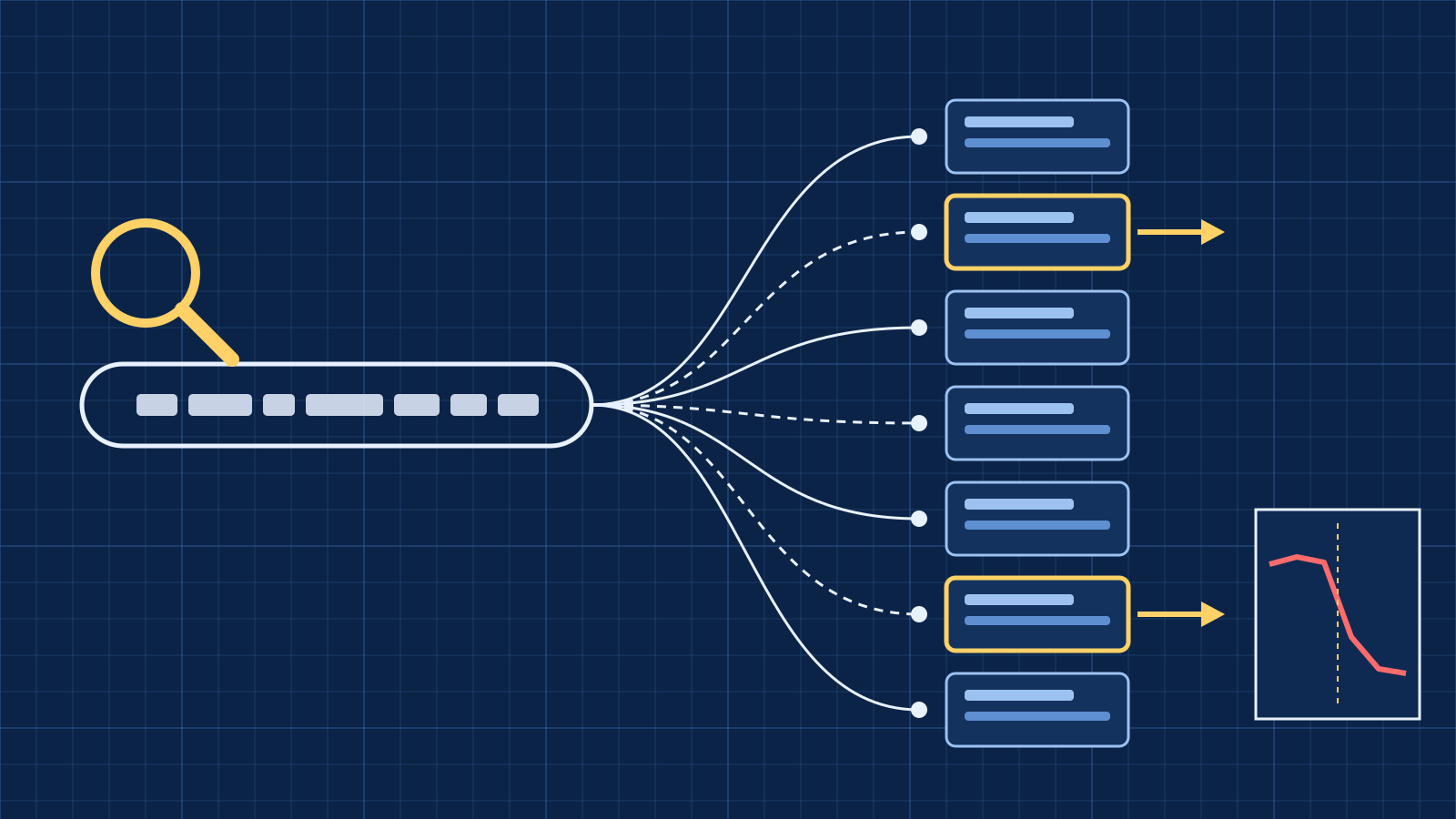
The optimistic reading is Stein's line that Search "helps you find sites you previously might not have discovered." Fan-out splits a question into sub-queries, searches them in parallel, and stitches the answer together with links. More sub-queries could mean more sites get cited, including smaller ones that never ranked top three for the head term.
On paper, that sounds like a win for niche publishers. And sometimes it might be.
The problem is that a citation isn't a click. The best causal data I've seen on this comes from a preregistered field experiment by researchers at Penn and Northeastern, which tracked 1,100 US Google users for a week in March 2026. When every search was forced into AI Mode, click-through to external websites dropped by 18.8 percentage points compared with normal Google. Relevant Audience's breakdown of the study adds the site-level detail: Reddit click-through fell 21.2 points, news sites 12.5 points. It's a preprint, the sample skews young, and it covers one week, so I wouldn't treat 18.8 as a law of physics. But the direction is pretty hard to argue with.
So "broader range of links" and "fewer clicks per search" can both be true at once. You might show up in more answers and still get less traffic, which is the scenario I'd plan for.
Two changes in one week, and no clean way to split them
Here's what makes this annoying. Google's November core update started rolling out on November 10 and can take up to two weeks. Hydrogen landed two days later. If your long-tail traffic moves next week, you won't know from the top-line chart which one did it.
And Search Console won't separate them for you. AI Mode clicks and impressions count toward your regular Search Console totals under Web, with no filter to isolate them. The newer generative AI report shows impressions in AI Overviews and AI Mode, but, as Search Engine Journal explains, it has no clicks, no CTR and no queries. (It's also still rolling out to a subset of properties, so you may not have it yet.)
Which means you have to build the separation yourself, using query length as a rough proxy.
The 10-minute baseline I'd pull before Monday
This takes about 10 minutes and you'll want it in three weeks.
- Filter long queries. In the Search Console Performance report, add a Query filter, choose "Custom (regex)," and use
^(\S+\s+){5,}\S+$. That matches queries with 6 or more words. - Set the window to November 1 through November 9. That's before both the core update and Hydrogen. Export clicks, impressions and CTR, by query and by page.
- Repeat with short queries. Use
^(\S+\s+){0,2}\S+$for 1 to 3 words. Export the same columns. - Compare in two weeks. If short queries are flat and long queries fell, that points at Hydrogen and AI Mode more than the core update, since core updates tend to hit page quality across query types. If both fell together, it's more likely the core update.
It's not a perfect test. Core updates can hit long-tail pages harder too, and there's Black Friday seasonality layered on top of everything. But a relative gap between those two buckets tells you a lot more than staring at a total.
The benchmark I'd use: if the 6+ word bucket's CTR drops more than 20% relative to baseline while impressions hold steady, that's the AI-answer pattern (you're being shown, not clicked). If impressions drop too, it's more likely rankings.
Where the ads fit (they always fit somewhere)
The Search post skipped advertising entirely, which feels a little deliberate. Google has been expanding ads in AI Mode, including a fourth ad slot below some answers, and Alphabet has already admitted that AI Mode queries earn less than classic search. A free, faster default model probably pulls more searches into AI Mode, and more AI Mode searches means more pressure to fit ads into the answers.
If you run Search or PMax campaigns in the markets where AI Mode ads are live, you're already eligible for those placements with no separate opt-out. Watch your search terms report for longer, conversational queries over the next couple of weeks. Those are likely AI Mode matches, and I'd expect them to convert differently from the keyword they matched to, though I honestly don't know in which direction yet.
A slightly uncomfortable thought about the long tail
For years the standard advice for small sites was "you can't win the head term, so go long and specific." It worked because Google was bad at long, weird queries, and people with real answers filled the gap.
Hydrogen is Google saying it's now good at long, weird queries. Maybe not as good as it claims (nobody outside Google has checked), but good enough and cheap enough to run for everyone.
I don't think that kills long-tail content. It probably shifts the value toward pages that have something the model can't synthesize: original data, actual testing, a strong opinion with a name attached. Pages that just rephrase the top three results for a longer query were always a bit fragile, and they might be the first thing you see thin out in that 6+ word export.
Pull the baseline now, while the data is still mostly clean. Someone is going to ask what happened to traffic in November, and it'd be nice to have an answer that isn't a shrug.