
Facebook's AI Answer Pages Pull 40M Google Visits a Month, Spam Policy or Not
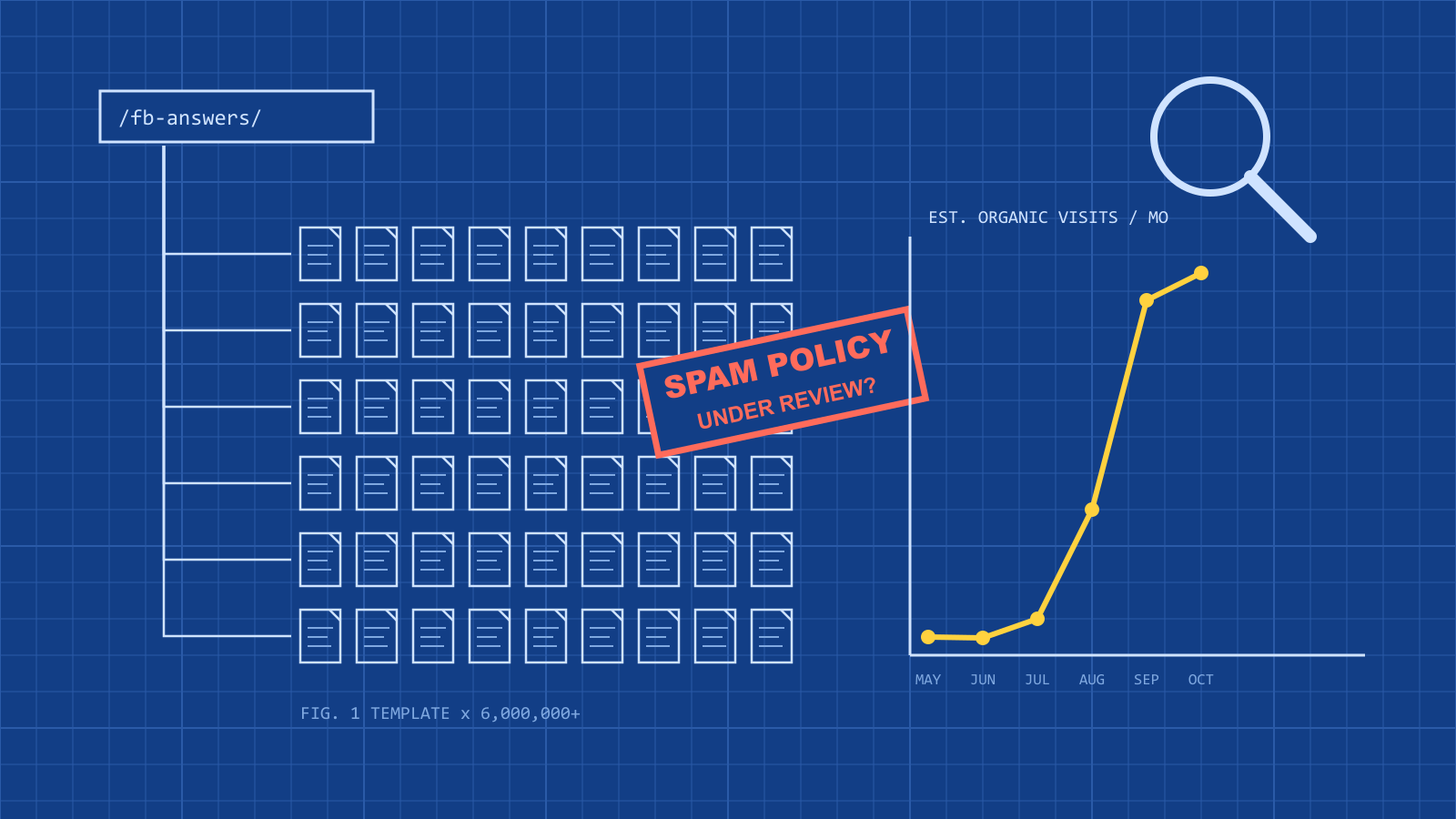
Meta has published millions of AI-generated summary pages under facebook.com/fb-answers/. Semrush estimates they drew about 40.6 million worldwide organic visits in October 2026, and they survived Google's September spam update. Each page is stitched from public Facebook posts, which is close to the wording of Google's own scaled content abuse examples. If you run programmatic pages, take one lesson from this: build them on source data nobody else has.
I've read the story twice now. The more I sit with it, the less it reads as a Facebook story and the more it reads as a rare look at where Google actually draws the line.
Barry Schwartz flagged it on Search Engine Roundtable this morning. He was working from a write-up by Saul Westbrook and commentary from Glenn Gabe, who summed it up in two words: "Scaled content abuse." The detailed numbers come from Westbrook's original analysis at Peripheral Creative, and they're worth going through slowly.
What Meta actually built, and how fast it grew
Each Facebook Answers page is an AI-written summary of a single topic. The sources are public Facebook posts, comments, group threads and Page posts, and the citations link back into Facebook. Under each summary sits a "More like this" box linking to sibling pages, plus a thumbs-up/thumbs-down prompt. Westbrook thinks the pages are probably static snapshots of output from Meta's AI Mode, the conversational search feature TechCrunch covered at launch in June, which answers questions by summarizing public posts across Facebook, Groups and Reels.
Here's the traffic curve, all Semrush estimates of worldwide monthly organic visits:
- May 2026: about 130,000
- July 2026: about 1.03 million
- August 2026: about 12.2 million
- September 2026: about 36.4 million
- October 2026: about 40.6 million
Over the same stretch, the number of keywords with a Facebook Answers page ranking went from 4 million to 53 million worldwide. Westbrook estimates more than 39 million of these pages rank for at least one US keyword. Schwartz and Gabe put the indexed count at roughly 6 million. Those two figures don't match, and I wouldn't lean hard on either one. Third-party tools tend to overcount URLs on huge sites, and a site: count is only an approximation. Still, any version of these numbers is enormous.
Some examples from Westbrook's data: a page about using Amex for travel ranks #2 for a query with roughly 368,000 monthly searches, and another ranks #1 for the location of the Las Vegas airport. Then there's padel tennis. He found over 180 English-language pages on that one topic alone, many of them overlapping. Honestly, that detail told me more than any of the traffic charts.
Read Google's spam examples next to this, line by line
Google's spam policies define scaled content abuse as "when many pages are generated for the primary purpose of manipulating search rankings" rather than to help users. The listed examples include "using generative AI tools or other similar tools to generate many pages without adding value for users," scraping content to generate pages, and stitching together content from other pages. Doorway abuse is defined as pages "created to rank for specific, similar search queries."
Now look at 180 overlapping padel pages, each one stitched from user posts by an AI model. On paper that ticks three boxes at once. Google added scaled content abuse to the policies back in the March 2024 core update, and said explicitly that it applies whether the content comes from automation, humans or both.
And to be fair, Google has never said AI content is spam in itself. Its 2023 guidance on AI-generated content says automation is fine as long as its primary purpose isn't manipulating rankings. So the question was always going to be about intent and value, and those are the exact judgments a classifier makes using signals you can't see.
The policy says "how it's made" doesn't matter. Then Facebook Answers shows that "who made it, and from what" matters a lot.
My read on why Meta gets away with it (for now)
I think three things are protecting these pages, and only one of them is something you can copy.
The first is domain trust. facebook.com has decades of link equity and brand searches behind it. A new domain putting out the same template would, in most cases I've seen, look like spam to the classifier within weeks. This is roughly what happens to a small affiliate site that tries programmatic SEO with nothing behind it.
The second is that the source data is first-party and nobody else has it. Every summary is built from posts that exist only inside Facebook, so there is literally no other page on the web that says the same thing. Westbrook makes the same point: if these pages keep ranking, SEOs may conclude that consistent sourcing and first-party data are what keep scaled content on the right side of the line. I mostly agree with him. Google's spam examples keep coming back to "without adding value," and unique input seems to count as value even when the writing is automated.
The third is that this is a demand Google seems to want filled. Users have been adding "reddit" to queries for years because they want what real people said. Reddit's Google traffic has been falling (Westbrook cites Semrush estimates of about 1.8 billion monthly visits, down from a 2.3 billion peak), and we covered how that hit when Reddit lost a third of its value this week. Facebook Answers sells the same thing, real people's opinions, just pre-digested.
Anyway, none of this means Google endorses it. Schwartz suspects the pages "won't be indexed too much longer" now that they've gone public. That's happened before: plenty of patterns survive until enough SEOs screenshot them, and then they don't.
The audit worth running on your own programmatic pages
You can't borrow Facebook's domain. What you can copy is the data moat, and you can check your own pages against it. Here's what I'd do this week, and the first pass should take around 30 minutes:
- Pull 20 random URLs from your largest template (location pages, comparison pages, glossary entries, whatever you generate at volume).
- For each one, count the facts that exist only on your site. Things like proprietary prices, inventory, reviews, internal benchmarks, or support data. A generated sentence about the topic doesn't count.
- Use a rough threshold. My own rule of thumb (an opinion, not a Google number): if fewer than about half the sampled pages carry at least one fact a competitor couldn't copy, the template is closer to padel-pages territory than to Facebook's data moat. Merge, enrich or noindex the thin ones before the next spam update decides for you.
- Look for near-duplicates. If three of your pages answer the same query with different slugs, you have your own 180 padel pages. Consolidate them.
There's a second, smaller job too. Search site:facebook.com/fb-answers "your brand" in Google, a query Westbrook suggests. If Meta's AI is summarizing user posts about your product, that summary may now rank for your brand's informational queries, and it could be built on a single complaint from 2019. Westbrook found pages citing posts as old as 2010, including one from a group with six members. Screenshot whatever you find. You can't edit it, but you can at least post corrections in the public spaces it draws from.
A prediction I'm not fully confident in
I'd put the odds at roughly 60% that the fb-answers directory loses more than half of its estimated organic traffic within six months, either through a quiet manual action or because Meta pulls back once the coverage piles up. The other 40% is the scenario I find more uncomfortable. If the pages are still pulling 40 million visits by spring, it means the scaled content line was never about AI or volume. It's about who you are and what data you're sitting on.
This connects to a pattern we noted when Aleyda Solis turned Google's quality guidance into 83 checks: most of the checks that matter come down to whether a page has something real behind it. Facebook Answers is an extreme version of the same test, and it happens to have the most first-party data of anyone on the internet.
I don't really blame anyone for being annoyed by this. Most of us got told to slow down and add value, and here's the biggest social network putting out millions of AI pages and ranking anyway. Being annoyed won't fix anything, though. What I'd actually do is find the one dataset only your company has and build pages from that.