Anthropic and OpenAI Both Skipped the Consulting Layer on May 4
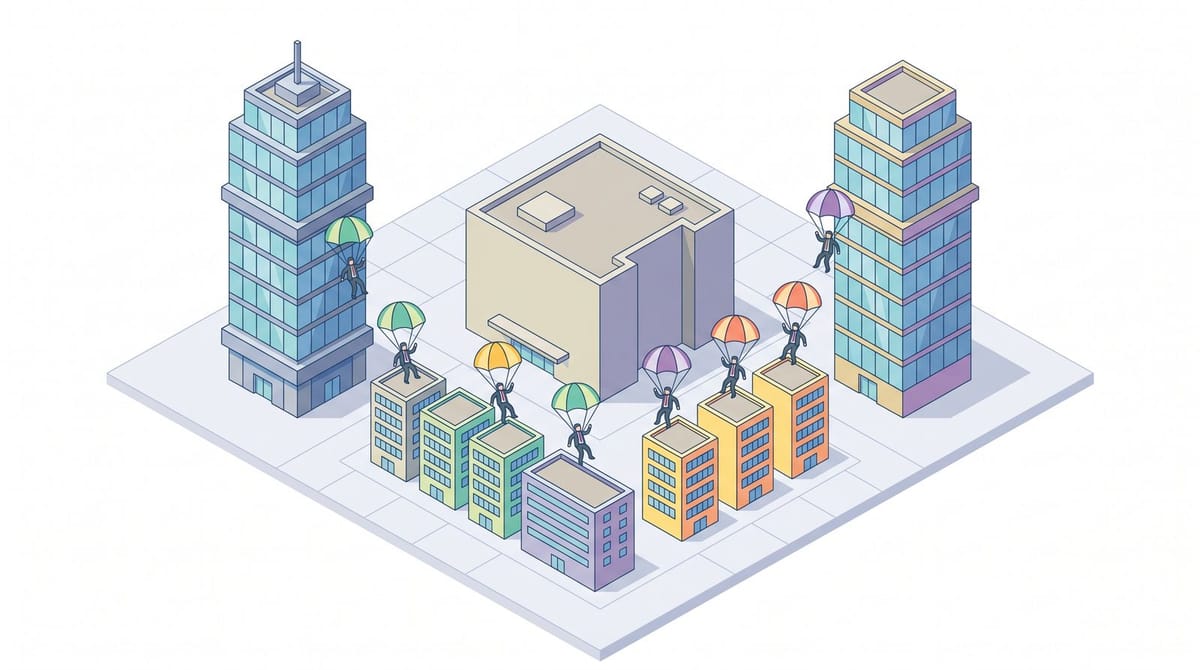
Anthropic and OpenAI each launched enterprise implementation arms on Monday, May 4. Anthropic's joint venture closed at a $1.5 billion valuation with Blackstone, Hellman & Friedman, and Goldman Sachs as founding partners. OpenAI's "Deployment Company" closed hours earlier at $10 billion with TPG, Brookfield, and Bain Capital plus 16 other investors, with OpenAI guaranteeing PE backers a 17.5% annual return over five years.
Two AI labs went from selling tokens to selling consulting hours, on the same day, with overlapping playbooks. That timing is not a coincidence. It is a positioning move against the firms that thought they were going to sit between the labs and the F500 for the next decade.
Both labs copied the Palantir forward-deployed model
The structural detail that matters most: both ventures embed lab engineers directly inside client orgs. Anthropic described its model as engagements that begin with the company's engineering team sitting down with clinicians and IT staff to build tools that fit into workflows the staff already use. OpenAI's setup is the same shape. Engineers ship into the client, build the workflow, leave the system, repeat.
That is Palantir's playbook word for word. It is also exactly what McKinsey, Accenture, Deloitte, and BCG sell when they wheel in their AI practice. The difference is staffing. Palantir-style FDEs are software engineers with model context. Big Four AI consultants are slide producers with subcontracted engineers. One of those models has gross margins in the 70s. The other lives off T&E billing.
If you are a marketing leader looking at a $400K AI implementation quote from a Big Four firm right now, the awkward question just got concrete. The lab itself can now bid on the same scope, with the engineers who actually built the model, at a price the JV's PE backers need to clear a 17.5% IRR on. That is not a fight the consultancies win on capability. They win on procurement inertia, and inertia erodes faster than people expect.
The 17.5% number is what tells you OpenAI is serious
Most coverage skipped the most important number in the OpenAI deal. Both The Next Web and The Decoder flagged it: OpenAI is guaranteeing a 17.5% annual return to the PE consortium over five years. That is not a soft return target. It is a contractual floor that OpenAI is on the hook for if the venture underperforms.
A 17.5% IRR floor on $4 billion of PE capital implies roughly $700 million in annual return obligation against the venture's economics, before OpenAI's own $1.5 billion of optional commitments. You do not sign that paper unless you have already modeled the revenue capture from the PE consortium's combined portfolio companies. TPG, Brookfield, Bain, and Advent collectively touch hundreds of mid-market and large-cap operating businesses. The deal is essentially a five-year exclusivity bet that those portfolio companies will buy AI deployment from DeployCo before they buy it from anyone else.
Anthropic's commitment is structurally lighter. Three founding partners each put up $300 million for a $1.5 billion total, and there is no public IRR floor. Fortune's read calls Anthropic's setup a shot at the consulting industry. That framing is right but understates it. The Wall Street partners are not just funding a venture, they are reselling Anthropic into their own portfolio first.
Why this lands hardest on the firms running your AI strategy
Marketing leadership has been buying AI implementation through three buckets in 2026: the labs directly via API and a small forward-deployed team, holding-company AI practices like Publicis CoreAI or WPP Open, and Big Four consultancies. Every one of those buckets just got disrupted from above.
The labs are not just upgrading bucket one. They are absorbing buckets two and three. Holding companies were selling "we know your category, the labs do not." That moat compresses fast when Anthropic's engineers can sit down with a client's engineering team for six weeks and learn the category at speed. The Big Four were selling change management. The labs are now bundled with PE distribution that already owns change management at the operating-company level.
There is a separate Anthropic-Deloitte alliance from earlier this year that puts Claude in front of 470,000 Deloitte employees, which Anthropic clearly views as a parallel channel. But the JV signals that Anthropic does not think Deloitte alone gets it there. They want a direct delivery arm in addition to the Deloitte one. That is the tell. They do not trust the consulting layer to convert their tech advantage into revenue fast enough.
This pattern is not unique to Anthropic. We covered OpenAI's robots.txt aggression earlier this year, and the read is the same. The labs are willing to break the existing intermediary stack to control the customer relationship directly. It is a Palantir-style consolidation play, executed on a five-year clock.
How procurement will look by Q1 2027
The action for marketing teams running a 2026 AI roadmap is concrete: when your next AI implementation RFP goes out, add a fourth column. You are already comparing your in-house build, your holdco's AI practice, and a Big Four bid. Add the lab JVs. Anthropic's venture takes Wall Street-affiliated mid-market deals first, OpenAI's DeployCo takes PE-backed portfolio companies first, but both will sell directly to F500 marketing within twelve months. Get the conversation started before procurement freezes around the existing three vendors.
The benchmark to use: if your Big Four bid is more than 30% above what the lab JV quotes for equivalent scope, you are paying a brand premium for slide decks, not capability. From what I have seen in adjacent enterprise software cycles, that kind of premium tends to evaporate within four quarters of a credible direct alternative entering the market. And honestly, the awkward part for procurement teams is that the lab JV quote is going to land in your inbox before legal has even figured out how to evaluate it.
One detail to look at when the bids start coming in: who signs the SOW. If it is the lab JV's own legal entity, your liability is capped at one party and your model access path is unified. If it is a Big Four firm subcontracting an FDE pool from the same JV, you are paying a markup to bear two layers of contract risk for one delivery team. Same engineers, two paper trails, often a 20 to 35 percent line-item difference. Most marketing leaders have not had to read an MSA against this comparison before because the option did not exist.
The thing nobody is saying out loud yet: the AI labs probably cannot service this volume without subcontracting back into the same consulting firms they are competing with. That is the unstable part. Either the labs scale FDE headcount fast, or the agencies they cut out get hired back as second-tier delivery partners on the labs' own engagements. Neither outcome is great for the holding companies' AI practices, which sit awkwardly in the middle of both.
From a distance, the part I am pretty sure of: the agencies and Big Four firms that thought they had a five-year runway to build AI service revenue probably need to redo that math by Q3.
Notice Me Senpai Editorial