Anthropic, Google, and OpenAI Shipped Browser Agents Your Site Can't Talk To

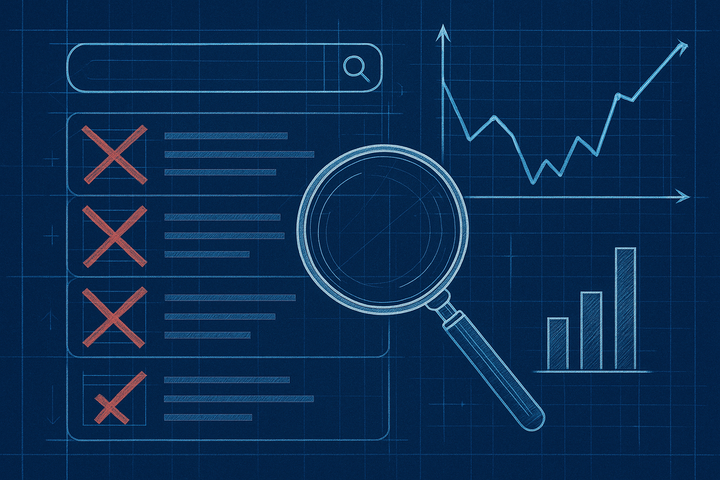
Anthropic shipped Claude for Chrome to 1,000 Max plan users, OpenAI launched ChatGPT Atlas, and Google's Gemini browser agent now navigates pages autonomously. Each one clicks, fills forms, and completes multi-step tasks on sites built for human eyes. The structural mismatch between agents and brand websites is becoming the new conversion gap, and most brand teams haven't priced it in yet.
The agents are not waiting for you to redesign
Anthropic's Claude for Chrome moved from research to a paid pilot in late 2025, starting with 1,000 Max-tier users and expanding through 2026. OpenAI shipped ChatGPT Atlas, Microsoft has Edge Copilot Mode, and Perplexity's Comet browser added an "Ask Before Acting" execution loop. Anthropic's own published numbers show prompt injection attack success rates dropping from 23.6% to 11.2% as the company hardens the agent loop. That number tells you the same thing the rollout does: this isn't a 2027 problem.
The Search Engine Journal interview with No Hacks podcast host Slobodan Manic puts it bluntly. "Websites are nowhere near being ready for this shift because structurally almost every website is broken," Manic told SEJ this week. He has been running a five-part series on his blog covering the same problem from different angles, and the throughline is uncomfortable. The site you optimized for human conversion is the wrong artifact for an agent that doesn't scroll, doesn't read CTAs, and doesn't care about your hero video.
Google's January patent gave it permission to skip you
On January 27, 2026, Google published patent US12536233B1, "AI-generated content page tailored to a specific user." The system scores a landing page on conversion rate, bounce rate, click-through rate, and design quality. If the score crosses a threshold, or if the page just lacks a product filter, Google can assemble an AI replacement page in real time using the user's search history and contextual signals. The user lands on Google's page instead of yours.
It's still a patent, not a launched feature. But Search Engine Land's coverage notes what every retailer should already see: Google has the data, the surfaces, and now the legal scaffolding to do this when it wants to. Going by the patent's scoring logic, the brands most exposed are the ones with high-bounce category pages, low-conversion product detail pages, and no native filtering. That's most of mid-market ecommerce, honestly.
What "machine-first" actually means in code, not theory
Manic's framing of "machine-first architecture" is doing some work, so let me unpack it the way I'd explain it to a CMO who keeps hearing the phrase in vendor pitches.
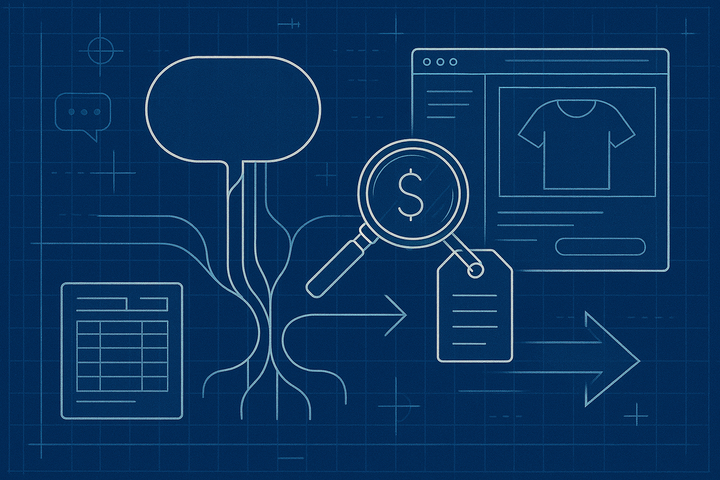
It's three things. First, your data layer needs to exist independently of your visual layer. Schema.org markup, semantic HTML, structured product data, and clean JSON-LD. If an agent can't read your page without rendering JavaScript, you've already failed half the test. Second, your robots.txt and crawler policies need an explicit position on AI bots. GPTBot, ClaudeBot, PerplexityBot, GoogleOther, and a growing list of others either get access or they don't, and "we never decided" is not a neutral position when the agent benchmark for conversion is dramatically higher than the human one. MetaRouter's 2026 commerce data has AI agents converting at up to 45 percent on enabled sites versus 2 to 3 percent for typical human web traffic.
Third, your interactive elements need to be operable without a mouse. That's where it gets unglamorous. Forms with proper label elements, accessible button names, predictable tab order, and a checkout flow that doesn't require six modal dismissals. Most of this overlaps with WCAG accessibility work that brand sites have been deferring for a decade. The agents are now the financial argument for fixing it.
The 30-minute audit that reveals where your site fails
Three things to check before lunch tomorrow.
Pull your raw access logs and search for user agents containing "GPT," "Claude," "Perplexity," and "AI." If you see them and your robots.txt is blocking them, you're invisible to a non-trivial slice of agentic traffic. If you don't see them at all, your CDN is probably dropping them at the edge. Cloudflare's default bot policies block several AI crawlers unless you've explicitly opted in.
Then run your category page and a top product page through Google's Rich Results Test and Schema Markup Validator. If either page renders less than half its content in the raw HTML response, an agent fetching the page server-side gets a half-built version. That's the "warehouse and storefront" failure Manic talked about, just translated into rendering pipelines.
Last one. Open your site in Chrome with Claude for Chrome installed (or Atlas, or Comet) and ask the agent to add your top SKU to cart and reach the email field. If it can't do it on the first try without your help, that's a measurable broken state. The agents that show up are the ones that succeeded somewhere. The brands they don't visit twice are the ones that failed the cart test.
Where this leaves the people who own brand sites
On paper, this looks like another SEO migration. Run an audit, tag the issues, ship the fixes. But I think most teams will underestimate how much of this is structural rather than additive. Adding schema isn't enough if the underlying HTML is built by a five-year-old React shell that holds the actual content behind a hydration step. Adding a robots.txt rule isn't enough if your cart flow requires a modal click that no agent can predict.
What I'd watch for over the next two quarters: the brands that get cited inside ChatGPT Atlas suggestions, the ones whose cart pages get completed by Claude without intervention, and the ones whose category pages don't trigger the Google AI replacement path because the bounce rate doesn't justify it. Those three groups are going to overlap a lot. We covered some of why this matters in our piece on AI shoppers outconverting humans on retail sites, and the Manic interview is roughly the technical companion to that. Worth pairing it with our writeup on Chrome's new AI Mode side panel if you want to see how Google is rolling this out on its own surfaces too.
The teams that win the next 18 months probably aren't the ones with the biggest SEO budgets. They're the ones who treat their site as a machine surface as well as a human one, and who do the unglamorous infrastructure work before the agents pick winners and losers for them.
By Notice Me Senpai Editorial