Why ChatGPT Ads Get a 0.91% CTR (and Why I'd Still Test Them)
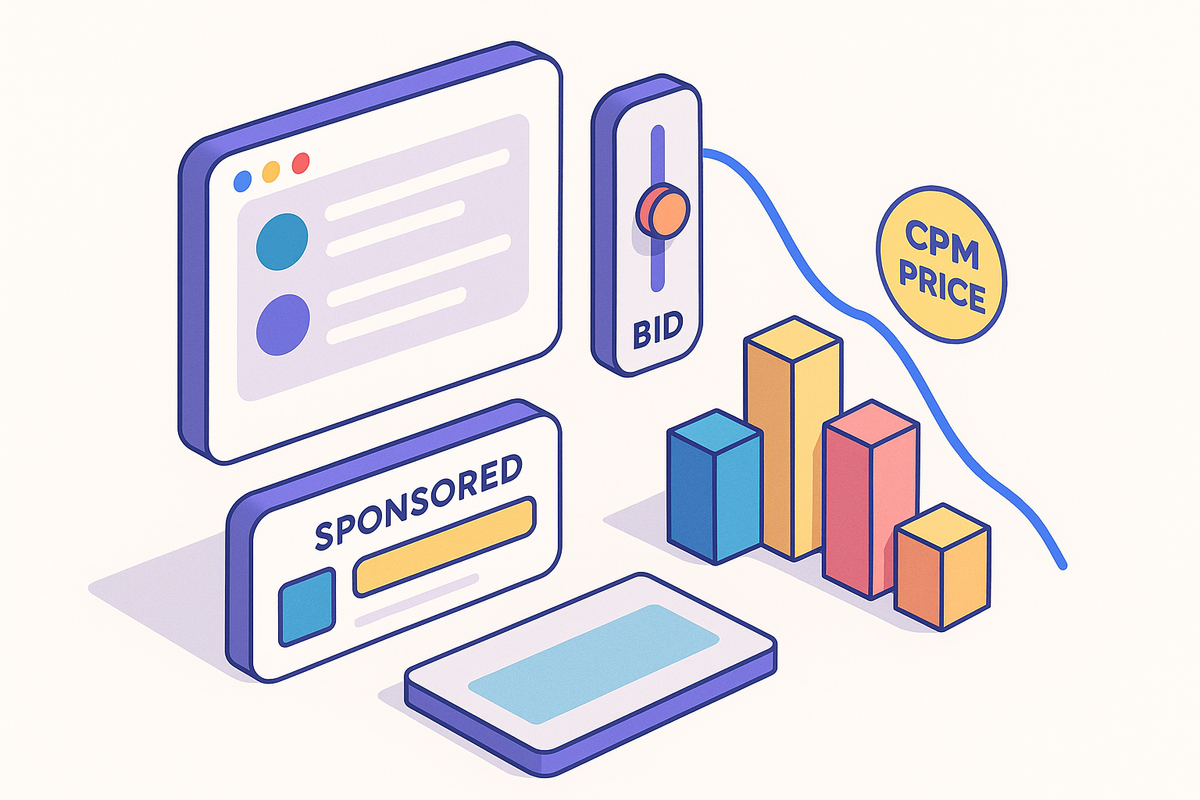
OpenAI's ad platform at ads.openai.com is now the public front door for buying ChatGPT placements, with no minimum spend and recommended CPC bids of $3 to $5. Early click-through rate is running around 0.91%, against roughly 6.4% on Google Search. The structural difference matters more than either number: there is no demographic or audience targeting available, only plain-language context hints.
The number everyone is about to quote wrong
0.91% versus 6.4% reads like a rout. It mostly isn't, and the reason is that the two numbers count different things. Google Search CTR benchmarks are dominated by branded and high-commercial-intent queries where somebody typed "nike pegasus 41" and the ad is basically the answer they were looking for. A ChatGPT sponsored unit sits underneath a response that already answered the question. The user got what they came for before the ad even rendered.
So the honest comparison isn't Search. It's display, or paid social, or an offsite retail media placement. Measured against those, 0.91% is fine. Measured against Search, it looks like a catastrophe. Whichever benchmark your finance team picks first is probably going to decide whether this line item survives its first quarterly review, which is a slightly depressing thing to write down but I think it's how these decisions actually get made.
The volume underneath it is not small. Pacvue's July guide puts ChatGPT at roughly 900 million weekly active users with about 20% of conversations carrying shopping intent, and cites its own Funnel Rewired research showing 53% of consumers use AI tools for product research and 28% doing it daily. Even if you haircut those numbers hard, a 0.91% CTR against that denominator is a real amount of traffic.
Your ad copy is doing the targeting now
This is the part that breaks media plans built on Google and Meta assumptions, and I don't think most teams have internalized it yet.
There are no audience segments. No lookalikes, no age brackets, no in-market lists, no keyword match types. What you get instead are context hints: plain-language descriptions of the conversations and situations where your product should surface. HawkSEM's writeup of their own campaigns shows the density people are landing on, something like eight or nine hints per ad group clustered around a single intent area. Their guidance, which matches what I'd expect, is that hints pulled from sales call language and review text beat hints reverse-engineered from a keyword tool. Problems, not features.
Then the auction sorts it out. It's a relevance-weighted second-price auction, so the winner pays just above the next bid rather than their ceiling, and relevance is weighted across your context hints, your ad copy, and your landing page fit. A lower bid with tight relevance can beat a higher bid with sloppy alignment.
Which means the creative brief and the targeting brief are now the same document.
If you've spent the last decade building the skill of segmenting audiences and letting mediocre copy ride, that skill is worth roughly nothing here. The character constraints make it sharper still. Pacvue's setup notes suggest keeping headlines around 16 characters and descriptions around 32. That is not a lot of room to be clever in. Sixteen characters is "Fix your CRM" with two to spare.
Which budget line this actually eats first
My read, and I'd hold this loosely: it isn't brand search. Nobody is going to cut their brand campaign to fund a ChatGPT test, and they shouldn't.
The vulnerable money is mid-funnel comparison and research spend. The "best CRM for small teams" and "X vs Y" query cluster, plus the non-brand Shopping and display budget that exists to catch people while they're still deciding. That's the exact behavior migrating into a chat window, and it's also the spend that has always been hardest to defend in a QBR because the attribution was already fuzzy. Replacing fuzzy attribution with different fuzzy attribution is an easier internal sell than it should be.
Retail media is the other one, and Target is already there. Per eMarketer, Target is running contextual ads in ChatGPT through Roundel, its retail media network, and bringing brand partners along with it. Their example of the mechanic is a good one: someone asks "what countertop appliances make everyday meals more convenient?" and a labeled air fryer ad from a pilot participant shows up next to the response. That's a brand getting into a consideration set it never bid on directly. If you sell through Target, some version of this decision is being made for you by somebody in Minneapolis.
The price collapse is the signal I'd actually trade on
Run the timeline back. February 2026: pilot launches at roughly $60 CPM with a $200,000 minimum commitment. May: self-serve Ads Manager opens to US businesses with the minimum removed and CPC bidding added at $3 to $5. By mid-2026 CPMs are being quoted in the $25 to $45 range. That's roughly a tenfold drop in effective cost of entry in about ten weeks.
Then in June, OpenAI started piloting cost-per-action bidding with a conversion pixel behind it, limited to advertisers who had tracking configured by a June 1 deadline. Analyst Claire Holubowskyj called CPA a "logical next step" that "expands the advertiser base and brings the system closer to competitors like Meta and Google."
Platforms don't move from $200K minimums to CPA bidding in five months because demand is overwhelming them. They do it because inventory is outrunning it. Ad density in US responses has reportedly climbed past 50%, and that supply has to clear somewhere.
Prediction, and put a number on it: I'd expect blended CPMs to sit under $20 by Q1 2027 unless OpenAI throttles density deliberately. The cheap window on a new placement usually runs three or four months before the market bids it up. This one seems to be running the other direction, which is unusual enough that I keep re-checking whether I've got it backwards.
And to be fair, this isn't entirely new behavior. Every platform discounts to fill early inventory. It just feels less like a launch discount here and more like price discovery on an asset nobody has valued yet.
How I'd spend a first $10,000
Pacvue notes most brands are starting somewhere between $10K and $25K per month. I'd start at the bottom of that, and I'd structure it like this.
Run CPC, not CPM. Cap the bid at $3 and leave it there for two weeks even if delivery is thin. You're buying a clean cost-per-click read, not volume, and CPM against an unknown CTR is just a donation.
Build exactly two ad groups. One around a problem your customers describe in their own words, pulled verbatim from sales call notes or review text. One around a competitor comparison scenario. Eight to nine context hints each. Do not build twelve ad groups; you will starve all of them.
Set the conversion pixel before you spend a dollar, because CPA access has already gated on having tracking configured once, and it will probably gate that way again.
Then judge it on cost per qualified action, never on CTR. The benchmark I'd hold it to: if your ChatGPT cost per lead lands within 1.5x of your non-brand Search cost per lead at $3 CPC, the channel is working and you should scale it. If it's north of 3x, your context hints are too broad, not your bid. Rewrite the hints, don't raise the bid. The auction is relevance-weighted, so the fix for bad delivery is usually upstream of the money.
Reporting is still thin, by the way. You get impressions, clicks, spend, CTR, average CPC, average CPM, and conversions if you've wired them up. Anything more sophisticated has to come from your own analytics, which is a familiar problem if you've been tracking how ChatGPT's separate search pipelines already resist clean measurement on the organic side.
The part I'm still not sure about
OpenAI has been clear that ads sit separate from responses and don't influence what the model says. Asad Awan, who leads ads and monetization there, framed it as keeping ads "separate and clearly distinct, relevant, and useful while maintaining the trust people place in ChatGPT." I believe that's the current design. I'm less confident it's the permanent one, and the gap between those two things is where the entire channel's long-term CPC sits.
For now the practical answer is fairly boring. It's a cheap, badly-measured, contextually-targeted placement attached to an enormous amount of shopping intent, and the cost of finding out whether it works for you is about $10K and two weeks of somebody's attention. That's a small enough bet that arguing about it internally for a month costs more than running it.
If it doesn't work, you'll know by August and you'll have learned what your customers actually type when they're deciding. Honestly that second thing might be worth the money on its own.
Notice Me Senpai Editorial