FreeWheel Says Only 10% of Viewers Dislike AI Ads (Buyers Guessed 48%)
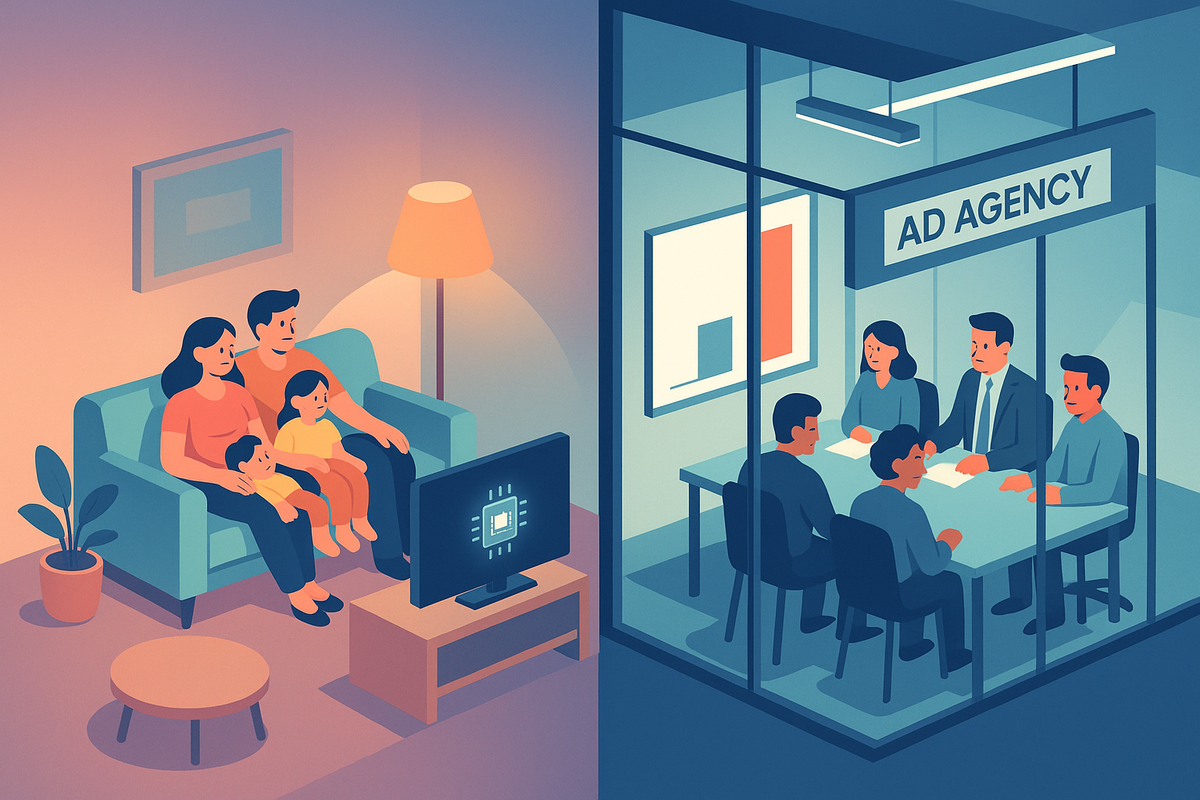
FreeWheel's report "AI in TV Advertising: The Buyer, Seller, and Viewer Perspectives," published September 5, 2026, found that 48% of media buyers assume viewers dislike AI-generated ad creative. When Dynata surveyed 2,496 US adults in April 2026 for the same report, 10% said they disliked the AI-made ads they had seen. That 38-point gap is mostly costing buyers a creative test they have been too nervous to run.
The full numbers, as reported by PPC Land: 48% of buyers and 39% of sellers told AdExchanger they assume viewers find AI creative off-putting. The buyer sample was 226 people, the seller sample 50, both fielded in April 2026. Viewers, asked directly, landed at 10%. Sellers overshoot by 29 points, buyers by 38. Nobody in the industry guessed low.
I want to be honest about who published this. FreeWheel is a Comcast Advertising subsidiary that sells the pipes for premium video. A report saying "viewers are fine with AI ads, please keep buying CTV" is not a disinterested document. To their credit, the same report carries the line that 48% of buyers say AI glitches make their jobs harder, which is not the kind of stat you include if you are only selling. But keep the source in mind as you read, because I am going to argue the number is probably right anyway, and I want you to see the argument rather than the press release.
Ad people mistake their timeline for the living room
The gap makes sense once you think about where buyers and sellers spend their day. Every AI spot that ships gets dissected on ad Twitter and LinkedIn within the hour. The hands have six fingers, the snow melts wrong, someone posts a frame-by-frame. If that is your feed, "viewers hate this" feels like settled fact. It is a bit like assuming your audience shares your Slack channels. They don't. They are watching a Bravo rerun with the ads on and their phone in their hand.
The FreeWheel number is not alone, either. Magnite's August 2026 live-viewing study, covered here by PPC Land, surveyed 835 US adults and found 78% said AI-generated commercials would not negatively affect their perception of a brand. Fifty-seven percent said such ads can be as engaging as traditional ones. Magnite also sells inventory, so apply the same discount. Two sellers agreeing is still not proof. It is, though, two independent samples landing in roughly the same place, and the "viewers hate AI ads" camp does not have a comparable field number pointing the other way.
The surveys that say the opposite are asking a different question
You have probably seen the scarier stats. Klaviyo and Datalily surveyed 8,000 consumers across eight countries in December 2025 and, as eMarketer summarized, found only 7% say visible AI-generated marketing makes them trust a brand more, while 31% say it makes them trust the brand less. Those are real numbers from a much bigger sample than FreeWheel's. They also contain the word that does all the work: visible.
FreeWheel asked whether people disliked the AI ads they had seen. Klaviyo asked how people feel when AI is visible. Those overlap less than they sound like they should. Most viewers can't tell. The 10% who can are writing the comments.
The IAB's January 2026 study with Sonata Insights, "The AI Ad Gap Widens," sits in the middle and is honestly the more useful read. It surveyed 505 Gen Z and Millennial consumers plus 104 ad executives. Eighty-two percent of the executives believed younger consumers feel positive about AI ads. Only 45% of the consumers actually did, and 37% felt negative, up 12 points from 2024. So the industry is wrong in both directions at once. Buyers overestimate how much viewers hate AI creative in general (FreeWheel), and executives overestimate how much younger viewers love it (IAB). What both surveys agree on is that the people making the decisions are guessing, and guessing from inside the building.
And to be fair, a lot of this isn't new. Every creative format arrives with a round of "audiences will reject this" that turns out to be mostly the industry projecting. It just feels louder this time because the tool is the story.
Coca-Cola is the case study both sides keep citing
Coke's AI holiday ads are the tidiest example of the gap. The 2025 spot drew a second consecutive year of press and social backlash, and at the same time Coca-Cola's global VP for creative strategy, Islam ElDessouky, told Marketing Dive it "scored off the charts" with consumers and was "one of our top-tested ads in history, period." His line on why is worth keeping: "The masses, the audiences, do not necessarily look behind the technology. They just look at the story that they're receiving, and then they respond to it."
You can read that quote as a CMO spinning a bad news cycle. I read it as a company that had the copy-test data and the comment section side by side, and chose to believe the copy test. Whether that was right depends on who was in the comments. Which brings up the one place where the 10% number stops being your number.
Where 10% quietly becomes 39%
The IAB study found 39% of Gen Z respondents feel negative about AI ads, against 20% of Millennials. The gap between those two groups nearly doubled since 2024. Twenty percent of consumers in that sample called AI ads "manipulative," where advertisers guessed 10%. So the FreeWheel 10% is an all-adult TV average. If your buy skews under 28, or your brand's whole positioning is craft or authenticity, you should assume your real dislike number is closer to the IAB figure than the FreeWheel one. A skincare brand selling to 22-year-olds on TikTok and a regional insurance brand buying Hallmark Channel are not running the same risk, even if their agencies read the same report.
Disclosure is the cheap hedge here, and the data on it is more consistent than the data on sentiment. In the IAB sample, 73% said knowing an ad was made with AI would increase or not change their likelihood to buy. In Magnite's sample, 71% said they would prefer brands disclose generative AI use. Meanwhile the IAB found 89% of advertisers using AI disclose "at least sometimes," and fewer than half always do. So viewers mostly want a label, the label mostly doesn't hurt, and most advertisers still skip it. That seems like a free point to pick up.
The 14-day test I'd actually run
The FreeWheel framing is CTV, but the test works on any video placement, and for most readers here it is easier to run on YouTube or Meta first. Take one campaign you already trust the baseline on. Build one AI-assisted variant of the existing creative: same concept, same length, same offer, with a short "Made with AI" line in the end card or description. Do not build a whole new AI campaign from scratch; you'd be testing the concept and the tool at the same time and you'd learn nothing about either.
Split it against the human control at equal budget and identical targeting for 14 days. Two numbers decide it: video completion rate and cost per completed view. On a 15- or 30-second unit, if the AI variant's completion rate lands within about 2 points of the control and cost per completed view is 15% or more lower, move it to a quarter of the line and rerun the read. If completion drops more than 5 points, or negative comments or hide rates on social placements run more than roughly double the control, you have just measured your own audience's dislike number, and it is worth far more than FreeWheel's. These thresholds are my starting points, not gospel. Tighten them if your baseline is already very efficient.
One more thing, and I realize this is the unglamorous part. Put a human QA pass on the AI cut before it ships. Hands, on-screen text, and product labels are where the glitches live, and the 48% of buyers who say AI glitches make their jobs harder are not wrong about that. The reason people notice AI ads is usually a visible mistake, not a vibe. Fix the mistake and the detection rate drops with it. This is the same logic behind why boring creative is winning in ChatGPT ads: the ad that doesn't announce itself is the one that performs.
What the 38-point gap is really measuring
I think the FreeWheel number is a measurement of buyer nerves more than viewer taste. That's not a knock. Nerves are rational when you're the one who gets the angry client email. But the cost of those nerves is a year of not knowing what AI-assisted creative does to your completion rate, while a competitor with the same media budget already has the answer. We saw the same pattern in the WARC data on how marketers brief AI: the tool gets blamed for outputs the process caused.
My prediction, with a number attached: when the IAB reruns its study in early 2027, the executive optimism figure drops from 82% into the 60s, while consumer sentiment barely moves from 45% positive. The industry will call that consumers "turning on AI." It will mostly be executives finally reading the consumer half of their own surveys.
I don't think the brands that win this are going to be the ones with the best AI tooling. It's probably just the ones who ran a small test early, learned their own number, and stopped arguing about everyone else's.
Notice Me Senpai Editorial