Fishkin's Zero Click Marketing Book Pins a 46% Number on the Web Collapse
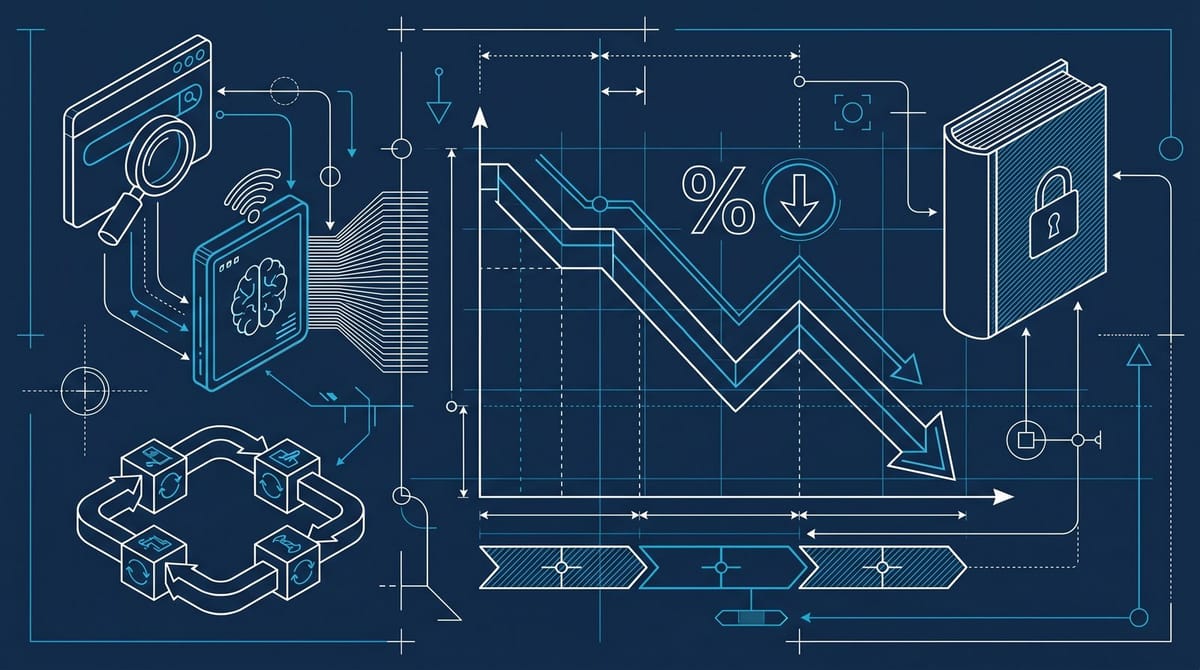
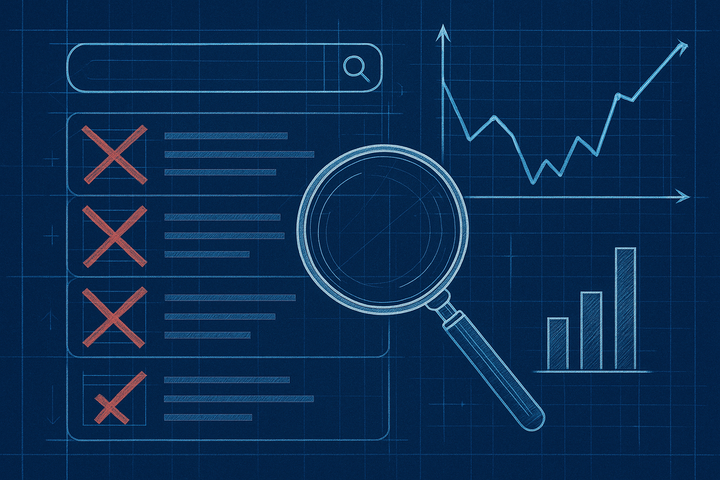
Rand Fishkin and Amanda Natividad opened pre-orders this week for Zero Click Marketing, a book that pins a single number on a shift marketers have been arguing about for three years. Open-web traffic is down 46% since 2023, per data Fishkin cited on LinkedIn. Teams still using session count as their marketing scorecard are running a 2022 dashboard inside a 2026 SERP.
The 46% isn't a trend line, it's a baseline now
The framing matters. A 46% drop sounds like a crisis, the kind of thing you wait out. The reality is closer to a new floor. Fishkin's own commentary in the Q3 2025 Datos and SparkToro report described the share of Google searches sending external traffic as sitting a couple percentage points above its all-time low, with a new normal in the low 40s for desktop searches that route to anyone but Google. The March 2026 SparkToro analysis of 41 websites had Google handling 73.7% of desktop searches with a 29.2% click-through rate to external sites. ChatGPT's external CTR? 1.3%.
So when AI tools eat queries Google used to serve, those queries don't translate into clicks at anywhere near the old rate. The book's argument, as far as I can tell from the pre-order materials, is that this is structural. Not a Google update you can wait out, not an algorithm change you can optimize against. The volume of attention is shifting into surfaces where attribution doesn't follow.
The Q1 2026 fine print most people skipped
The most-cited recent number is that zero-click searches in the US fell from 24.5% in December 2025 to 22.4% in March 2026, per the Datos Q1 2026 State of Search report. In the EU and UK, the drop was steeper, from 22.5% to 19.6%. On paper, that sounds like the click economy is healing. And maybe, slightly, it is.
But the same report shows AI tools still under 2% of total desktop activity. The shift isn't users abandoning ChatGPT for Google. It's that Google's AI Overviews appear to have started serving fewer informational queries directly in the panel in early 2026, likely a quality response after the earlier rollouts ate publisher traffic. The structural exposure didn't change. The interface tuning did. We covered the same Q1 2026 report when it landed and the takeaway then is the takeaway now: this is interface volatility on top of a permanently smaller traffic pool.
The attribution side compounds the problem. NMS documented last-click's exposure to AI referrer stripping earlier this month: roughly 70.6% of AI-driven sessions arrive at sites without a referrer attached. Same problem, different surface.
Where the missing traffic actually went
Three things absorb most of what the open web lost:
- Google's own answer surfaces. AI Overviews, knowledge panels, Business Profiles, Maps. One commenter on Natividad's LinkedIn thread described a medical spa pulling 400 monthly calls directly from its Google Maps listing while the associated website recorded zero analytics sessions. That call volume is marketing performance. It's just not in the dashboard.
- Social platforms that algorithmically suppress outbound links. Facebook, Instagram, Reddit, Pinterest, LinkedIn, TikTok, YouTube. Each has internal economic reasons to keep users from clicking out. Organic reach for link-bearing posts is systematically lower than for native content, which Natividad documented back in her 2022 essay before the term "zero-click marketing" was a recognized category.
- AI tools as discovery layer. ChatGPT, Claude, Perplexity, Gemini. These intercept the informational query before it ever reaches a search box. Ahrefs research from late 2025 found AI Overviews alone cut position-one CTR by 58% on queries where they appear, and that's just one surface among several.
The aggregate is a marketing world where audiences are still finding brands at roughly historical rates. They're just doing it inside walled-garden interfaces that produce no measurable referral. That's the part that breaks most year-over-year traffic comparisons: the denominator changed, but the dashboard pretends it didn't.
And to be fair, this isn't entirely new. Publishers have been talking about declining referrals since 2018. What's different now is the speed and the visibility of the absorbing layer. AI Overviews didn't ramp gradually; they appeared on a meaningful share of informational queries inside about eighteen months, which is a faster pull-forward of the trend than almost anyone modeled.
Why Condé Nast pulled the trigger first
News publishers absorbed the cleanest version of this hit. PPC Land reported in December 2025 that Google Web Search traffic to news publishers fell from 51% of all publisher traffic in 2023 to 27% by Q4 2025. Condé Nast hit a similar wall and publicly stopped chasing session counts as its primary metric, an admission that mattered because it came from a publisher with audience pull. Most brands don't have that pull. They keep optimizing for the channel that's compressing.
If you're a working performance marketer or SEO lead, the practical implication is that the budget tied to "organic sessions" or "click-through to PDP" is increasingly disconnected from where attention actually happens. Some of your best demand work is invisible to GA4 and last-click reports. That doesn't mean it isn't paying off. It means you can't prove it with the tools you're currently using.
The dashboard rebuild that has to happen this quarter
The book ships in fall 2026 but the work doesn't wait. From what I've seen across paid social audits this year, the single most defensible move is to add a brand-search baseline panel to whatever attribution surface you're already running. Track branded query volume in Search Console, branded mention volume on Reddit and LinkedIn (SparkToro and Alertmouse both surface this; Brand24 or Talkwalker work too if you're not in the SparkToro ecosystem), and direct-traffic deltas after major content drops. None of these are perfect. Together they're a much better proxy for "did the content do something" than session count alone.
Target benchmark to set this week: a 30-day rolling baseline for branded search and unattributed direct traffic on your top 10 landing pages. Anything moving more than 10% week-over-week is signal. Smaller moves are noise. It isn't a clever framework, it's just the cheapest version of a dashboard that will still make sense in 2027.
The book's pre-order page lists a hardcover, audiobook, and ebook, plus bonuses including a $50 SparkToro credit, 50% off an Alertmouse subscription, and seats at Zero-Click Summer School. Practical note for international buyers: shipping from Damn Gravity to the UK runs about £35 on a £24 hardcover, which has been the loudest complaint in the comment thread. The ebook and audiobook bundle dodges that entirely.
A small irony nobody's pretending to ignore
The book about not clicking requires clicks to pre-order. Fishkin acknowledged it in the comments. The whole exchange reads less like a contradiction and more like an honest take on the constraint: the channels that move purchase intent and the channels that produce trackable clicks have separated. You can write a book about the gap. You just can't get someone to buy it without bridging the gap, which is more or less exactly the problem the book is about.
The thing worth carrying out of all of this isn't the book or the 46% headline. It's that the dashboards most marketing teams renewed for 2026 are still answering questions from 2022. Renewing the same dashboard for 2027 is the actual risk. Fishkin and Natividad's book is one way to start re-framing that. Building a measurement layer that survives the next twenty-four months is the other, and that part you can probably start this afternoon.
Notice Me Senpai Editorial