Ghost Creators Are the PBNs of Social, and YouTube Just Started Deindexing Them
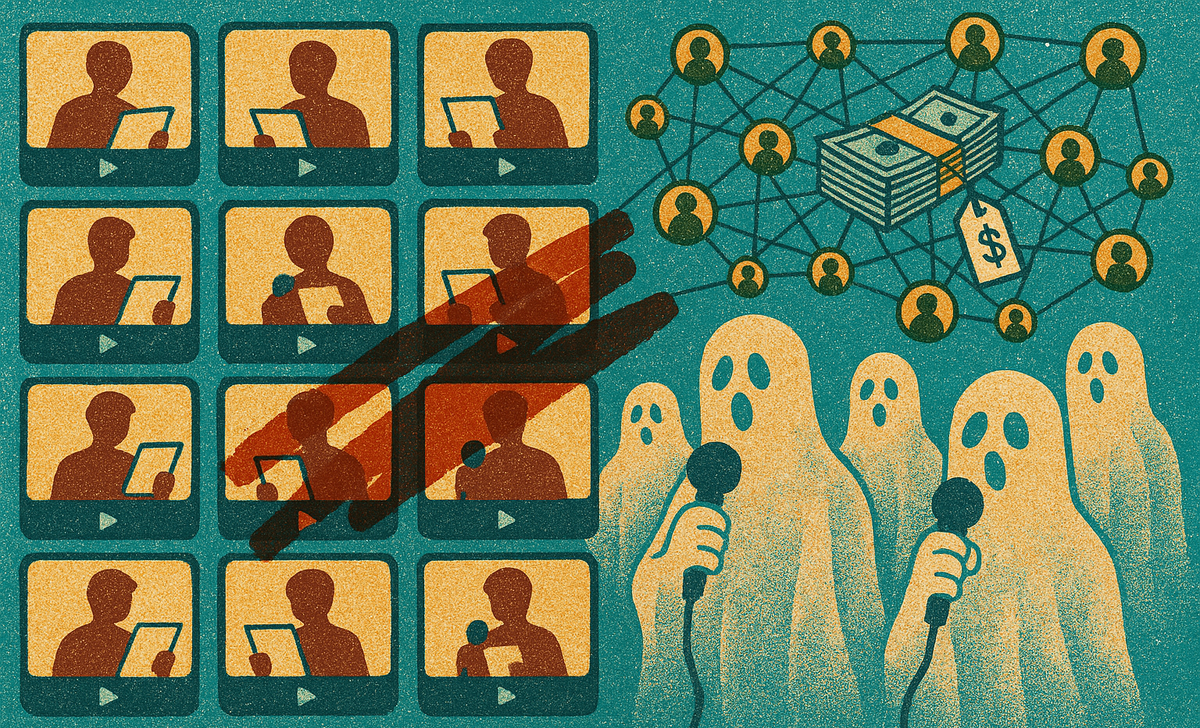
Semafor reported on September 2, 2026 that a network of "ghost creator" channels tied to Virelox, a company selling spun-up creator accounts to brands, pulled more than 45 million YouTube views using paid actors reading AI-written scripts. YouTube terminated 20 of those channels the next day under its spam policy. If your "UGC at scale" vendor runs the same playbook, that reach now sits one policy review from zero.
Digiday followed up this morning with an explainer on what a ghost creator actually is, and the honest answer is that marketers have been buying this for years under friendlier names. Faceless channels. UGC farms. Creator-as-a-service. The political angle got it noticed, but the mechanism is a brand marketing product, and I think a lot of growth teams are about to find out they own a piece of it.
It is a private blog network with faces on it
If you did SEO between 2010 and 2015 you know this shape. Dozens of sites you control, same templates, same writers, cross-linked, all pointed at one ranking goal. It worked until Google decided it did not, and then it stopped working for everyone at once. We wrote last week about how Google treats programmatic SEO as a site-wide trust problem rather than a page-level one. The social version is now getting the same treatment.
The Virelox numbers, which come from founder Caleb Chan's own posts as quoted by Semafor: more than 106 YouTube accounts running by April with a goal of 300 by May, roughly two new channels a day, 2,500 videos a week, and a claimed 500-plus ghost creators generating "billions of views every month." One line from Chan explains the whole business model better than anything I could write: "if 26 accounts post the same # within 10 minutes, the algorithm thinks it's 'breaking news.'"
The presenters were hired off Backstage and Fiverr at $26 per video. Researchers at Riddance, a media intelligence firm, identified the network the way you would identify a PBN: the same b-minor background music across ten-plus channels, the same formulaic openers ("here's the part that should stop you cold"), cross-linked profiles, and an internal dashboard that labeled channels by content lane. Nobody needed to detect AI. They needed to notice the wallpaper was identical.
The detectors missed it, and that stopped mattering in 24 hours
The Next Web's read on this is the one I would send to a platform lead: YouTube's enforcement stack was built to catch synthetic media, and a real human reading an AI script trips none of it. Scripts, thumbnails, headshots and websites were generated. Only the face was real, and the face is the only thing the classifier looks at.
So the automated layer failed. Then a journalist published, and YouTube terminated 20 channels the following day, with this statement: "We have strict policies against spam and deceptive practices. After a review, we terminated 20 channels, including all 13 referenced in this article and seven related channels, for violating our spam policies."
Note the policy cited. Not misinformation. Spam. YouTube's spam policy already prohibits using automated tools or AI to churn out high volumes of similar content with minimal changes, and the help page literally gives the example of channels that reuse the same background music while each video reads out an AI-generated script. The rule was there. Enforcement was waiting for someone to point.
That is the part that should worry brand teams more than the political stuff. The seven "related" channels were not named in the story. YouTube found them by walking the graph from the 13 that were. If your product got promoted across that graph, your videos went down with it, and you were not consulted.
This was sold to brands as a 95% CPM discount
Virelox's pitch to clients, per Semafor, was "up to 95% lower CPMs than traditional social media paid ads." The showcase client was Cluely, the "cheat on everything" AI app, which the network claims it pushed to number one on the App Store with millions of views. Cluely was already running its own version of this: by one breakdown of its UGC strategy, the company had 50-plus interns producing 200 or more videos a day at peak.
Digiday's piece makes it clear this is an established market with more than one vendor in it. Julian Ivaldy, who runs an app studio called THE QUEST on a farm of 60 TikTok accounts, defines the product without embarrassment: "You're paying for their ability to create content and reach people, rather than for an existing audience." He has a public post titled Ghost Creators: The Rise of Creator-as-a-Service and a Medium walkthrough called, and I am not paraphrasing, Create an Automated TikTok & Instagram Farm. None of this is hidden. It is a category with playbooks.
Jeremy Carrasco at Riddance gave Digiday the line that I think actually explains the economics: "They're pretty replaceable. You can spin up a bunch, and hope that one hits." That is the whole thing. The 95% discount exists because the vendor is not pricing in the chance that the accounts get wiped. You are.
Buying reach from a ghost farm is like renting an apartment from someone who does not own the building. The rent is great right up until the actual landlord shows up.
Why the Semafor story is the inflection, not the Digiday one
Before September 2, "ghost creator" was a phrase on a founder's LinkedIn. Now it is a phrase YouTube's trust and safety team has a file on. Max Tani, the Semafor reporter, summed it up on X: the founder himself said he used AI to spin up ghost creator accounts on behalf of brands, aiming to go viral by gaming the algorithm. That is a description of the mechanism, published, with brand clients attached.
TikTok did not respond to Digiday. Neither did YouTube. I read that silence as the usual thing, which is that policy teams do not comment while they are drafting. TikTok already committed, per CreatorIQ's summary of its enforcement plan, to running commercial content detection across 100% of US creator accounts by the end of March 2026. Coordinated brand-run account clusters are a short hop from there.
My prediction, with stakes: within six months at least one consumer brand gets publicly named as a ghost farm client, and the platform response includes the brand's own ad account, not just the vendor's channels. If I'm wrong about the timing, I don't think I'm wrong about the direction. Google took about four years to go from tolerating PBNs to nuking them wholesale. Social platforms have that playbook already written and a much shorter memory for tolerance.
Joseph Perello at Props Media put the strategic cost to Digiday plainly: if you make the creator "completely interchangeable or anonymous, you risk removing the very thing that makes creator media powerful: a real person putting their identity and reputation behind what they say." I agree, and to be fair, this is a media executive defending his own category. He is still right.
Four questions to ask your UGC vendor before Friday
This takes about 20 minutes and one email. If you have any "UGC at scale," "faceless," "organic distribution," or "creator network" line item on the media plan, send it today.
1. Who owns the accounts? If the vendor owns them and can "spin up more," you are buying a farm. Ask for the account creation dates on everything that delivered views last quarter. My rough line: if more than about 20% of your delivered views came from accounts younger than 90 days, the reach is PBN-shaped and should be valued as temporary.
2. Pull three scripts from three different accounts. Riddance caught Virelox on shared openers and shared music. If the first 15 seconds match across accounts, you paid for one script in different costumes, and that is exactly the "high volumes of similar content with minimal changes" language in YouTube's spam policy.
3. Is every video disclosed? Paid partnership label on TikTok, the paid promotion checkbox on YouTube, an FTC-compliant material connection statement in the caption. Ghost farms skip this almost by design, because disclosure would make 26 identical posts look like what they are. A vendor that cannot show you disclosure on a random sample of ten videos is a vendor you have a compliance problem with, separate from the platform risk.
4. Are presenters using their real names? Carrasco's framing to Digiday: "Hiring people and giving them fake names… that's inauthentic content by definition." Fake personas are the tell that separates a scaled creator program from a farm. Actors are fine. Actors playing "William Reports News" are not.
What to buy instead is not complicated, and honestly the industry was already moving there. Pick a smaller number of creators for actual expertise, then put paid distribution behind the best posts through Spark Ads or partnership ads, where the creator's real handle carries the message. That is roughly the model we covered when Beast Industries pitched programmatic creator buys, and it is the model that survives a policy sweep because there is nothing to sweep.
Where I land on the 95% discount
I get the appeal. Creator CPMs are high, attribution is a mess, and a vendor promising billions of views for a fraction of the cost sounds like a growth hack worth trying for a quarter. Some of those views were probably even real people.
But the discount was never really 95%. It was the platform's enforcement lag, borrowed against your brand, and the lag just got a lot shorter. Semafor needed one story to get 20 channels and 45 million views removed in a day. The next story might name the client. I would rather be the brand that audited its vendor this week than the one explaining to legal why its product appeared in a terminated network.
Notice Me Senpai Editorial