Google's SERP Trackers Spiked Again 15 Days After the March Core Update Closed

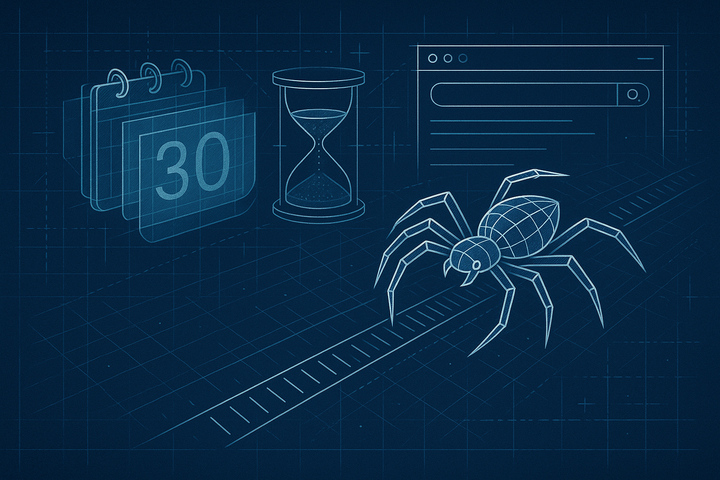
Google's March 2026 core update ended on April 8. Fifteen days later, on April 23, Semrush, Mozcast, Sistrix, and the Wireboard aggregator all lit up again, with several tools recalibrating their default scales to handle the new range. Google's own guidance says to wait a full week after a core update completes before analyzing Search Console data. That week is over, and the second spike is arriving on top of whatever movement the March update already left behind.
The trackers are louder than the community this time
Barry Schwartz called it out in his April 23 piece at Search Engine Roundtable, and the roll call is long: Semrush, Advanced Web Rankings, Wincher, Zutrix, Accuranker, Sistrix, Mangools, SimilarWeb, Data For SEO, Algoroo, SERPstat, and the Wireboard aggregator that plots all of them on a single chart. Several of the tools recalibrated to fit the upper range. That detail is the one worth sitting with. Tracker vendors do not rebuild their default y-axes for a normal refresh. They only do it when the previous scale cannot visually represent what is happening day to day, which means whatever this is has been running hot for long enough that the old chart template was starting to clip off the top.
The second thing that stands out is what's missing. WebmasterWorld and the usual forum threads are quiet. One German practitioner posted a grim line about organic search being "as good as dead" for anyone who relies on it, but the comment threads are thin. A year ago, a spike this loud would have produced forty concurrent threads of panic and speculation. Now the professional SEO crowd mostly shrugs and waits to see if Google confirms anything, which is itself the most interesting signal in the story.
This is supposed to be over
The March 2026 core update started on March 27 and finished rolling out on April 8, making it one of the faster recent broad core updates at twelve days and change. Search Engine Land noted the impact was not as severe as some prior updates, though plenty of sites still saw large surges or drops. Search Engine Journal covered the confirmation the same day, and various recovery guides started appearing within 48 hours.
Here is the problem with assuming a completed core update means stability resumes. The trend since early 2025 is that Google runs smaller, unnamed refinements in the background on what feels like a weekly cadence, which means the gap between named updates is no longer a calm period. Barry Schwartz has been covering what he calls algorithm "twitches" for months. What we're seeing on April 23 might be the March update finally working its way through the index, or it might be an unannounced refinement stacking on top of the March effects. There is no clean way to tell from the outside, and that ambiguity is part of why the forums have stopped trying.
Google's 7-day rule, and why this spike just broke it
Google's core update documentation is pretty specific about the diagnostic workflow. Wait at least a full week after the update completes before opening Search Console to investigate. Compare the week after completion to a week before the update started. Review top pages and top queries, not aggregate traffic. If the drop is small (say, position two to position four), do not make drastic changes, and specifically avoid editing content that was performing well.
The math on this one is unkind. March 27 start, April 8 end, plus a seven-day hold puts the "cleared to analyze" date at April 15. If you did that analysis between April 15 and April 22, your numbers are probably the cleanest read you will get for this core update. Because now April 23 happened, and your comparison window just got contaminated. If you open Search Console today and compare March 20-26 against the last seven days, you are not measuring the March update anymore. You are measuring the March update plus whatever is happening now, mixed together into a single baseline.
From what I've seen, the right move is to pull the April 15-22 comparison if you have not already, treat that as your clean post-update read, and treat anything from April 23 onward as a separate diagnostic window. Two comparisons, not one. It sounds fussy, but the alternative is making content decisions based on a baseline that has at least two different movements mixed into it.
The audit order worth running before you change anything
Most of the changes people make in response to a spike like this are wasted. Pages that moved will move back in many cases. Pages that stayed put were probably fine. What's worth checking, in roughly this order:
Start with query-level impression changes, not position changes. Position changes inside the top ten are noisy and tell you little about intent. If you lost impressions on high-intent commercial queries but held informational ones, that is a different diagnosis (probably an AI Overview or AI Mode redistribution eating the click, see small publishers lost 60% of search traffic for the scale of that redistribution across 2026). If you lost informational queries first, it's more likely the core update's quality signals hit the content itself.
Then look at which URLs lost. If the losers are thin, template-heavy, or programmatic pages, the update likely targeted them directly and a content-quality response is reasonable. If the losers are your strongest evergreen pieces, something else is going on, and panic-editing those pages is one of the fastest ways to make the drop permanent. Google's own documentation explicitly tells you not to rewrite content that was previously performing well.
Finally, cross-reference against the pages where AI Overviews or AI Mode now appear for your target queries. John Mueller has been explaining for a while that core updates and the AI features are separate systems with separate rollouts. Ranking drops that coincide with a new AI Overview appearing for a query are not the same as ranking drops from a quality-signal change, and the fix is different. One is a content problem you can act on. The other is a visibility problem that is largely outside your control until Google evolves its AI citation mechanics.
The signal from the forum silence
The quietest part of this story is the most useful one. Professional SEOs have stopped performing panic in public when the trackers light up. That silence is not indifference. The watching is just happening privately now, and the workflow has changed underneath it. The practitioners who've actually adjusted to 2026 are pulling two-week rolling comparisons, ignoring anything inside a normal variance band, and only acting on durable three-week shifts. That cadence matches how Google actually updates now, not how it updated in the named-core-update era.
If your instinct on April 23 was to open Search Console and start making changes, that instinct is several years out of date. The audit worth running this week is the one that separates the signal you can fix from the noise that will reverse on its own. Most of what the trackers are showing is the second category, and most of the time the tools are quietly telling us to hold position rather than act.
Notice Me Senpai Editorial