Google's Universal Cart Finds the Deal Before You Reach a Coupon Site
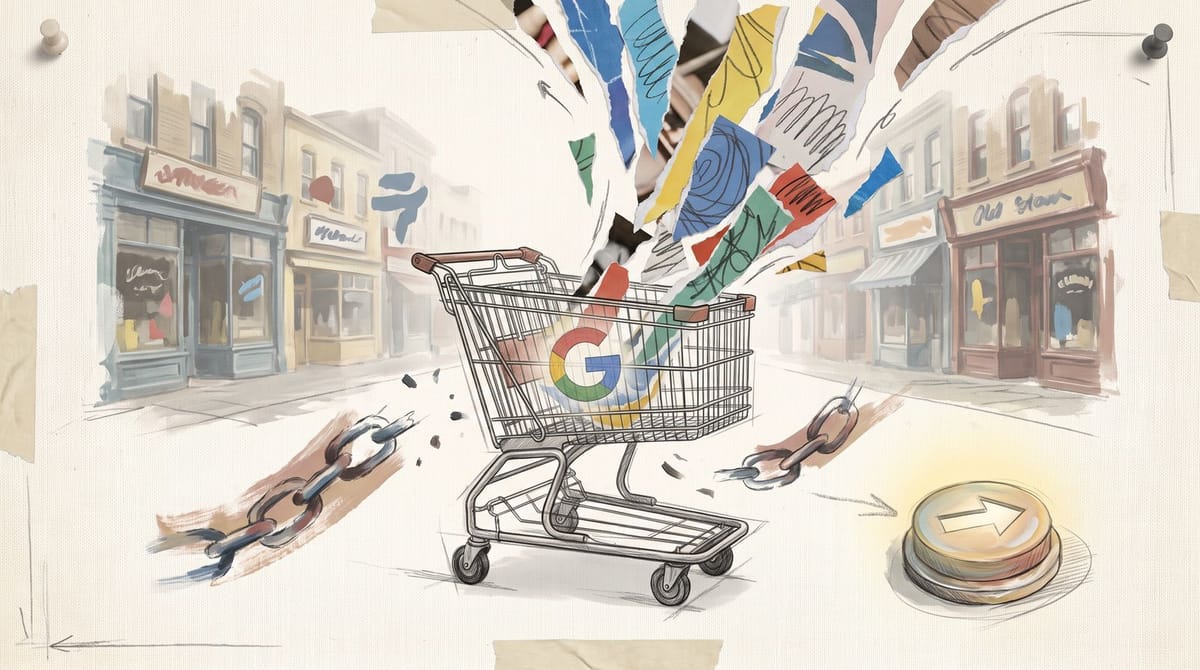
Google's Universal Cart, unveiled at I/O on May 19, 2026, lets shoppers add products to one Google-managed cart from Search, Gemini, YouTube, and Gmail, then hunts for deals and price drops automatically before checkout. The threat to coupon and deal sites is structural, not competitive. If the discount surfaces inside Google before a purchase, the shopper never clicks through to RetailMeNot or fires up a Honey-style extension, and that missing click is exactly where the affiliate commission lives.
Most of the coverage framed Universal Cart as a merchant story: new feed attributes, a new checkout flow, another thing for ecommerce teams to configure. Google's own announcement leans into the consumer convenience angle, and TechCrunch described it as Google wanting to follow your entire shopping journey across the internet. Both are accurate. But the group with the most to lose here barely got mentioned, and it's the one whose entire business is being the place you go to find a code.
Where the money actually sits in a coupon transaction
A coupon or deal site does not make money from the coupon. It makes money from the click that the coupon justifies. The standard mechanic is last-click attribution: whoever sent the final referral before purchase gets credited with the sale and earns the commission. RetailMeNot, by one business-model breakdown, pulls roughly 96% of its revenue from affiliate commissions and around 63% of its traffic from search engines. Commission rates typically land in the 3% to 10% range of order value. So the model is: rank for "[brand] promo code," intercept the shopper at the moment of intent, drop a tracked link, collect a cut.
That model has two dependencies, and Universal Cart pressures both. The first is the search ranking, because most of this traffic comes from people Googling a discount before they check out. The second is the click-through, the actual navigation off Google and onto the deal site. Universal Cart sits upstream of both. It finds the deal inside the same surface where the search happened, which means there's no second query and no reason to leave.
The Honey scandal already showed how fragile that click is
If you want a preview of how quickly value can move at the checkout layer, look at what happened to Honey. In December 2024, the YouTuber MegaLag published an investigation alleging that PayPal's Honey extension rewrote affiliate links at checkout to claim the last-click credit, even when it applied no working coupon. Digiday called it a wake-up call for the creator industry's affiliate partnerships, because creators who sent the original referral were watching the commission get reassigned at the final step. A class action followed later that month.
The detail that stuck with me from that whole mess: by late 2024, Honey reportedly listed around 181,000 stores in its system while holding active affiliate partnerships with roughly 35,000 of them, according to the follow-up reporting. The point isn't that Honey was uniquely bad. It's that the last-click model is so loosely defended that whoever controls the checkout moment can quietly capture credit for work other people did. Honey did it with a browser extension that users had to install. Google can do it with the default cart, no install required.
Universal Cart does the same thing, except it owns the operating system
Here is the part that should worry anyone running a deal site. Honey needed you to download something. Universal Cart is being built into the surfaces people already use to shop. As eMarketer noted, this is Google pushing deeper into agentic shopping, where the system can watch a cart, track price history, and in some configurations complete a purchase on your behalf once your conditions are met. The original argument that this could gut coupon and deal sites came from PPC Land, and I think they framed it correctly. The discount stops being a destination and becomes a background feature.
Walk the shopper's path. Today: search a product, see a price, search again for a code, land on a coupon site, click out, buy. Each of those steps off Google is a billable event for somebody in the affiliate chain. With Universal Cart, the path collapses to: add to cart, Google surfaces the better price, check out. The coupon site's two revenue dependencies, the ranking and the click, both happen to be the steps Google just removed. And to be fair, this is not entirely new. Google has been compressing the distance between query and purchase for years, eating travel meta-search and product comparison along the way. It just feels a lot less avoidable when the cart itself is the product.
There's also an attribution question Google has not publicly answered. If Universal Cart surfaces a discount that originated in an affiliate network's feed, who gets credited when the sale closes inside Google? On paper, that sounds like a fixable accounting detail. In practice, the entity that controls the checkout surface tends to write the attribution rules, and Google is now that entity.
What still has to be true for this to actually hurt
I'd push back on the doom version a little, because the rollout has real friction. Universal Cart's native checkout only fires for product listings carrying the native_commerce attribute. No attribute, no Buy button, regardless of how good the feed is. So coverage is gated by merchant adoption, and a lot of merchants move slowly on new feed requirements. Google also keeps the brand as merchant of record, which means this is not Google quietly becoming the store, at least not yet. And the launch is staged: rolling out across Search and the Gemini app in the U.S. this summer, with YouTube and Gmail to follow, then Canada and Australia, then the U.K. later. This is a 2026-2027 pressure, not a switch that flips next week.
That staging is the opening, honestly. Coupon and deal sites have a window where the behavior they depend on still exists at scale, because not every shopper is in an agentic cart flow yet. The mistake would be treating that window as stability. It's more like the runway you get to restructure before the default changes underneath you. We made a similar argument about who actually survives Google's shift toward AI-mediated results in our piece on which query types still send organic clicks, and the logic rhymes here: the broad, commoditized intent gets absorbed first, and the defensible stuff is narrower and more specific than anyone wants it to be.
If you run an affiliate program, audit your attribution mix this quarter
Concrete move, and you can start it this week. Pull your last 90 days of affiliate payouts and bucket them by partner type: content and review sites, creators, loyalty and cashback, and coupon and deal sites. Calculate what percentage of your commission spend is concentrated in that last bucket. From what I've seen, if more than about 30% of your affiliate payouts route to coupon and deal partners on last-click, you're carrying real exposure to exactly the checkout layer Universal Cart is moving in on. Treat that as a planning input for next quarter, not a fire drill.
The hedge against it is the same one the Honey fallout pointed to: stop overpaying the last click and start crediting the click that created the demand. Shift budget toward content partners and creators who generate genuine first-touch intent, tighten your terms so checkout-layer tools can't claim credit they didn't earn, and consider testing multi-touch or first-click attribution on a slice of your program to see how the numbers move. RetailMeNot's organic traffic was already softening before any of this, so the deal-site channel was wobbling on its own. Universal Cart just gives you a deadline.
I don't think the coupon site disappears in a year. The ones tied to genuine cashback economics and loyalty data have something Google's cart doesn't replicate cleanly. But the thin ranking-and-redirect operations, the ones whose only asset was showing up first for "promo code," are about to find out how much of their traffic was a habit Google can now satisfy without them.
Notice Me Senpai Editorial