Meta's Muse Picks Products From 2 Websites (Your Catalog Feed Is the Backup)
Meta's Muse shopping agent typically shows six product cards, and about four of them come from just two merchant websites its browser visited, according to a 50-prompt test Profound ran on September 30, 2026. Meta's product catalog supplied roughly 94% of the candidates but only about a third of the final picks. A clean catalog feed gets you considered. It does not get you shown.
The study is from Profound's research team, written up by Allison Huang as "The era of personal agents: Muse and Instinct" and broken down in detail by PPC Land on October 11. Most of the coverage has focused on the traffic numbers. I think the shortlist math is the part that should change what ecommerce teams work on in Q4, because it cuts against the obvious playbook of "just get your feed into Meta and you're covered."
Two pipes, very different odds
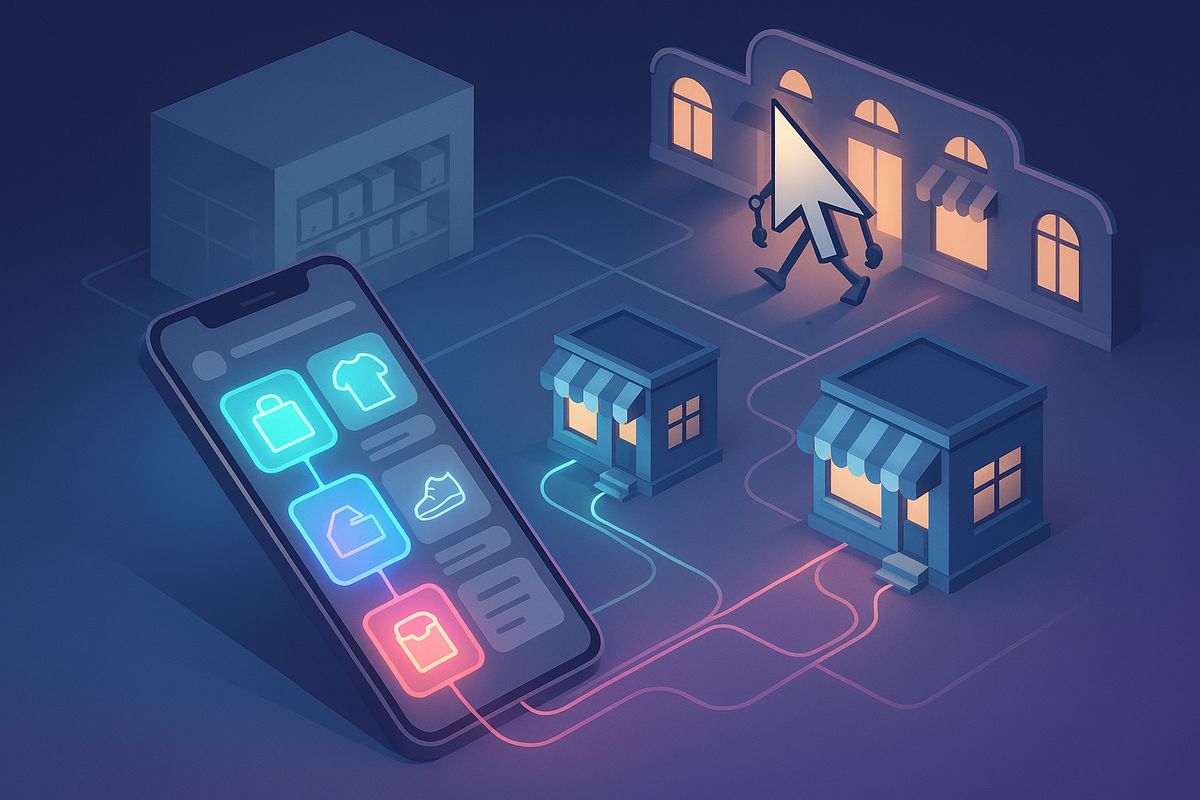
Muse runs discovery through two sources at the same time. One is a browser session that visits merchant sites directly. The other is a query against Meta's product catalog, the same one that powers shopping on Instagram and Facebook. Then it filters and ranks the combined pile into a final set of cards.
Here's how Profound's medians shook out per prompt:
- Browser: about 3 domains visited, about 4 products returned, from 2 merchant sites
- Meta catalog: about 60 products from about 30 merchants
- Final output: about 6 product cards, roughly 2 from the catalog and 4 from the browser
So a product that arrives through the browser seems to have something like a near-certain shot at a card, while a catalog product is competing with 59 others for two slots. Call it roughly a 3% chance per catalog product versus close to 100% for whatever the browser brought back. Those are my rough numbers from Profound's medians, not theirs, and the medians don't add up neatly across rows (PPC Land flags this too). But the direction is hard to argue with.
Think of it like a grocery store where 30 suppliers ship to the warehouse, but the eye-level shelf goes to whichever two brands the buyer happened to walk past on the way in.
The catalog is the waiting room. The browser is the shortlist.
Before anyone rebuilds their roadmap around 50 prompts
Profound is pretty upfront that this is "a small, exploratory sample": one Muse instance, 50 prompts, one retail category, one day. They call the patterns "illustrative rather than definitive," and I'd take them at their word. A different category (say, furniture versus skincare) could easily flip the ratio.
The traffic side is shakier still. Profound tracked unverified Meta-WebIndexer requests across 280 ecommerce sites and found US and Canada sites jumped 1,313% after the September 8 launch, against 827% elsewhere. PPC Land points out the near-zero baseline inflates those percentages, and that Meta's ad push for Muse ramped around September 16, which muddies the timing. Profound itself calls the metric "only a proxy."
And honestly, one more wrinkle: Profound sells AI visibility analytics. That doesn't make the data wrong. It does mean the conclusion "you need to measure agent visibility" is also their sales pitch, so weigh accordingly.
Still, even a rough signal is useful when the alternative is no signal at all. Neither Muse nor Instinct cites the sources it visits by default, and neither identifies itself as an agent. They browse from residential connections and look like ordinary humans in your logs. You can't see this channel in GA4. This is about the only window anyone has right now.
Why the browser picks matter more than they look
Muse is not some niche experiment. Meta put it inside WhatsApp and a standalone app on September 8, with checkout running through Stripe's Link and one-time cards per transaction. Sensor Tower estimated more than 5 million installs across the US and Canada within 22 days, per PPC Land. Mediaweek reported that Zuckerberg pitched a transaction model on stage at Connect ("we will profit by taking a small fee from transactions") and that Meta hasn't announced an advertising product for Muse yet.
That last bit is the interesting part. There's no paid placement inside Muse today. Which means the organic shortlist is the whole game for now, and the browser decides most of it.
It also means that window probably won't stay open. Koddi's June survey found 84% of commerce media leaders would invest in boosting brand visibility inside AI-generated answers, and 56% of consumers said they'd accept paid shortlist inclusion if it's labeled. Meta has never left an attention surface unmonetized for long. My guess: Muse gets some form of sponsored card inside 12 months, and when it does, the browser slots become the only organic real estate left.
We wrote last month about Meta's small business agent grading Meta's own ads. Same company, same pattern: build the agent, become the gatekeeper, figure out the toll booth later.
Getting into the two-site club
Nobody outside Meta knows exactly how the browser chooses its three domains. Profound doesn't say, and I'm not going to guess at a ranking algorithm that hasn't been documented. But a few things are within your control, and most of them take an afternoon.
1. Run your own 20-prompt test this week. Open Muse (US or Canada only), and run 20 realistic shopping prompts for your category. Not your brand name. The way a customer actually asks: "waterproof hiking boots under $150 for wide feet." Log which domains show up in the cards. If the same two or three sites dominate, those are the gatekeepers for your category, and getting stocked there may be worth more than anything you do on your own site. Benchmark: if you appear in fewer than 2 of 20 shortlists, you're effectively invisible in this channel.
2. Check your site the way the agent reads it. Profound says the Muse browser navigates using the accessibility tree, which is built from your HTML and accessibility labels. Open Chrome DevTools, go to the Accessibility pane, and look at your top product page. If your "Add to cart" button is an unlabeled div, or your size selector is a custom widget with no labels, the agent is basically squinting at your page. Semantic HTML fixes are cheap and also help actual humans using screen readers, so this one is close to free.
3. Write product copy for a buyer who reads every spec. Profound's brand recommendations come down to making clear who a product is for: intended use, compatibility, dimensions, materials, limitations. Agents compare across sites literally. A PDP that says "perfect for any adventure" loses to one that says "fits a 15-inch laptop, 1.2 kg, not waterproof."
4. Keep the catalog feed clean anyway. Two slots is still two slots, and the catalog is where you'll compete with 30 merchants rather than nobody. Fill in every attribute field. Missing attributes are the easiest way to get filtered out of a pile of 60.
The bot-blocking problem nobody planned for
This part surprised me a little. Because Muse doesn't announce itself, your bot protection can't treat it differently from scrapers. Amazon cut Muse off from purchasing on Amazon.com on September 20, partly because the agent doesn't identify itself, per PPC Land. Most smaller sites are going the other direction by accident: DataDome found only 2.4% of 21,491 high-traffic domains blocked all 10 of its test bots, and 65.3% blocked none.
So for most mid-size stores, the agent is probably getting through fine. If you run aggressive bot management (Cloudflare challenges on product pages, CAPTCHA on add-to-cart), it's worth testing whether Muse can actually complete a session on your site. Being blocked by your own WAF would be a pretty silly reason to lose a shortlist slot.
Where this probably goes
I keep coming back to the ratio. Thirty merchants competing in the catalog for two cards, two merchants getting four cards through the browser. If that pattern holds at scale, agentic shopping looks less like search (ten blue links, lots of chances) and more like a concierge recommendation, where being second-best is the same as not existing.
We've seen a softer version of this with AI Overviews leaning on a handful of sources for brand queries. Muse just makes it more extreme, because there's a checkout button at the end.
I don't think small DTC brands are locked out, exactly. It's more that the work moved. Less of it is feed management and bidding, more of it is boring stuff like labeled buttons, honest spec sheets, and knowing which two sites the agent trusts in your category. Probably worth finding out before Meta starts charging for the answer.