Why ChatGPT Ads Click Better in Brazil Than in the U.S. (It's Not the Users)
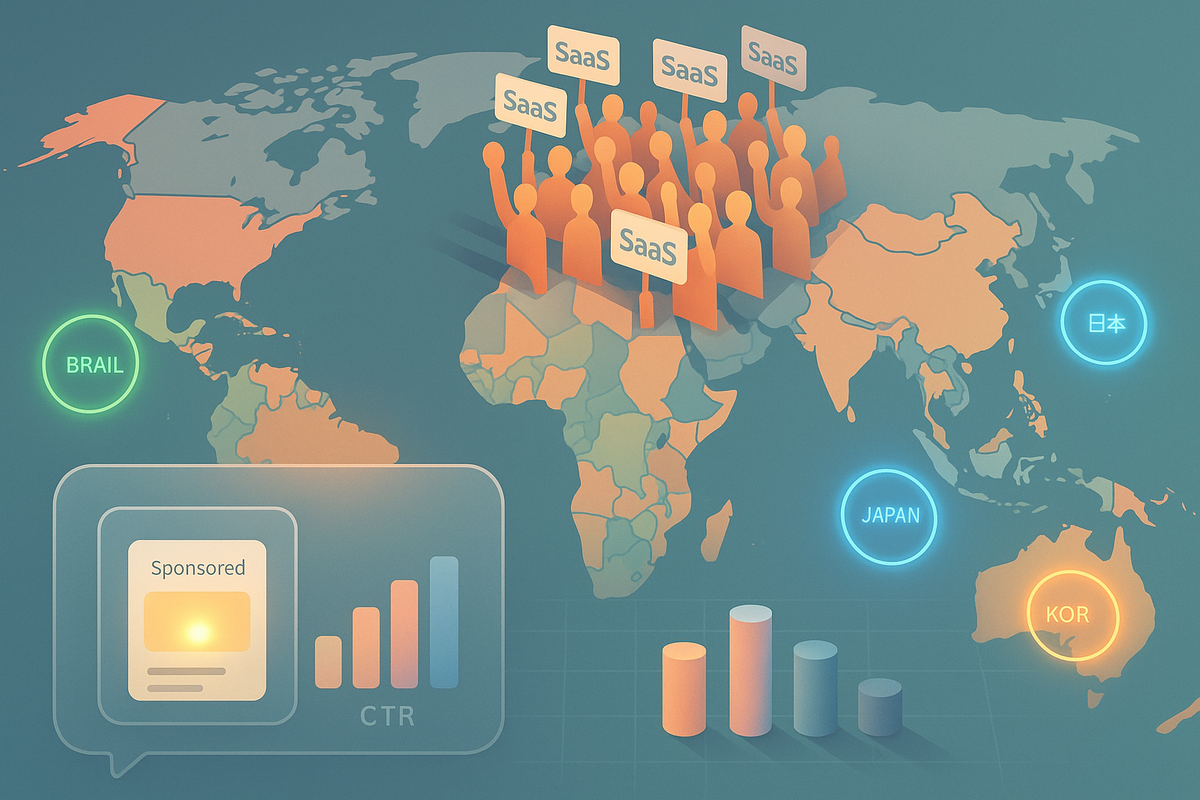
ChatGPT ads averaged 0.73% click-through rate in the U.S. through mid-September 2026, while Brazil hit 1.91%, Mexico 1.55%, Japan 1.53% and South Korea 1.21%, according to a Graphite report built on Similarweb panel data. The gap looks more like auction crowding and advertiser mix than audience intent, so U.S. advertisers should stop benchmarking against international launch numbers.
The numbers come from Graphite's State of ChatGPT Ads report, published September 29, and Search Engine Journal broke out the market-level CTRs. Every English-language market sits in a tight, slightly depressing band: U.S. 0.73%, U.K. 0.74%, Canada 0.75%, Australia 0.67%, New Zealand 0.6%. Four newer markets all cleared 1%. Brazil at 1.91% is more than two and a half times the U.S. rate.
The easy read is "Brazilians click more on ads." I don't buy that, or at least I don't think it explains most of the gap. And I think the wrong read here costs U.S. advertisers real money, because it leads to killing tests that are actually performing fine for their market.
Five English markets, one suspiciously tight band
Start with the pattern, since it's the most telling thing in the data. The U.S., U.K., Canada, Australia and New Zealand launched at different times, have different ad loads and different local advertisers. They still land within 15 basis points of each other. That's odd if the story is about culture or intent.
What those five markets share is the advertiser pool. English-language creative travels. A SaaS company running ChatGPT ads in the U.S. can switch on Canada, the U.K. and Australia without rewriting a word. So the same crowd of repeat advertisers shows up everywhere, and users seem to learn to scroll past them.
Graphite's advertiser data points the same direction. Jotform and Resume.io ranked among the top advertisers in all 20 weeks measured. Cursor and Monday.com showed up in 15 of 20. In the U.S., B2B SaaS accounted for 19.9% of impressions across 1,210 advertisers between March 30 and August 4, per the SEJ breakdown. That's a lot of project management tools chasing a lot of the same conversations.
If you've ever run Facebook ads in 2016 and then again in 2019, you know how this feels. Same platform, same users, a completely different auction once everyone showed up.
Newer markets are still in their honeymoon (probably)
Brazil, Mexico, Japan and South Korea got ChatGPT ads on August 11, according to the SEJ timeline. Some markets in the dataset have as few as five weeks of data. The U.S. has had ads since the February 9 test began.
Five weeks is not much. Fewer advertisers means a user sees a more varied set of ads, and the ads that do run are often from brands that bothered to localize, which in most cases I've seen correlates with better creative. Graphite also found that top advertisers write 98% new copy for ChatGPT instead of recycling search ads, and I'd guess the early movers in Brazil skew toward that kind of advertiser.
Now the messy part, and honestly it complicates my own argument. Graphite says U.S. CTR has roughly doubled since launch. If novelty were the whole story, U.S. CTR should have dropped over time, not climbed. So something else is happening in the U.S. too: better targeting, the shift to self-serve, advertisers learning what works (the context hints mechanics we covered in July matter a lot here). My best guess is that both forces are real. U.S. advertisers got better, and the auction got a lot more crowded, and the second effect caps the first.
One more caveat worth flagging. Similarweb didn't disclose panel volumes, so the smaller markets could be running on thin samples. I'd treat 1.91% as directionally interesting, not a number to put in a board deck.
Set your CTR floor by market, not by headline
The practical problem: plenty of advertisers seem to be judging ChatGPT ads against whatever number they last saw in a trade headline. That's a problem when the headline number is from a market you don't run in.
Separate benchmarks, then. Something like this:
- U.S., U.K., Canada, Australia, NZ: treat 0.7% CTR as par. Anything above 1% in a single ad group is a winner worth scaling. Below 0.4% after a few thousand impressions, rework the creative before you blame the channel.
- Brazil, Mexico, Japan, South Korea: treat 1.2% as par for now, and expect it to drift down as more advertisers arrive. A 1.5% CTR in Mexico is roughly average, not a breakout.
- Newly launched markets: no benchmark yet. Log your weekly CTR from day one so you can see the decay curve yourself instead of waiting for a report.
Practitioner data lines up with that U.S. band, more or less. A B2B SaaS advertiser on r/PPC reported roughly 1% overall CTR (0.8-1.2% by ad group) since March, and another test split 0%, 1.15% and 2.4% across three ad groups, per Tru Commerce's roundup of r/PPC reports. That spread matters more than the average. The same account can produce a dead ad group and a 2.4% ad group in the same week, which tells you relevance to the conversation does most of the work.
For context, Tru Commerce cites an eMarketer industry figure of roughly 0.9% for chatbot ads. Comparing that to Google search CTRs is mostly pointless. A ChatGPT ad shows up after the user already got a full answer. You are interrupting a finished thought, not answering a query.
The cheap test is probably in Jakarta, not Chicago
OpenAI rolled ads out to Indonesia, Malaysia, the Philippines, Singapore, Thailand, Vietnam and Taiwan starting September 23, which puts ChatGPT ads in more than 60 countries. PPC Land notes all seven opened with self-serve buying on day one, unlike India, which launched without it.
If you sell anything into those markets (or can ship there), this is roughly the same setup Brazil had in August: few advertisers, fresh users, self-serve access. I wouldn't move a big budget. I would run a small creative learning test there, in parallel with the U.S., using the same offers.
The reasoning is simple enough. A lower-competition market gives you cleaner signal on which angles actually get clicked, because you aren't losing every impression to Monday.com. Take the winning angle back to the U.S. and see if it holds at a lower rate. It won't hold at the same rate. That's fine.
A concrete version: allocate 10-15% of your ChatGPT test budget to one newly launched market for three weeks, run three to four copy angles, and promote any angle that beats 1.5% CTR there into your U.S. campaigns. If it clears 0.9% in the U.S., you're already ahead of the Graphite average by about 20%.
On paper, that sounds like a lot of work for a channel still finding its feet. And sometimes it is. But the alternative is running one U.S. campaign, seeing 0.6%, and deciding ChatGPT ads "don't work" based on a number that's about average for the market.
Where the Brazil number probably ends up
My prediction: by the end of Q1 2027, CTR in Brazil and Mexico falls below 1.2% as advertiser counts climb and the same SaaS names that dominate the U.S. switch those markets on. Japan might hold up better, since Japanese-language creative is harder to recycle. I'm less sure about that one.
If you ran ChatGPT ads earlier this year and paused them because the numbers looked bad (our early data breakdown has more on what "bad" looked like), this report is a decent reason to revisit what you compared them against. A 0.7% CTR in the U.S. wasn't failure. It was the market.
I don't think the lesson is "go international." It's closer to this: know which auction you're standing in before you decide whether the ad worked.