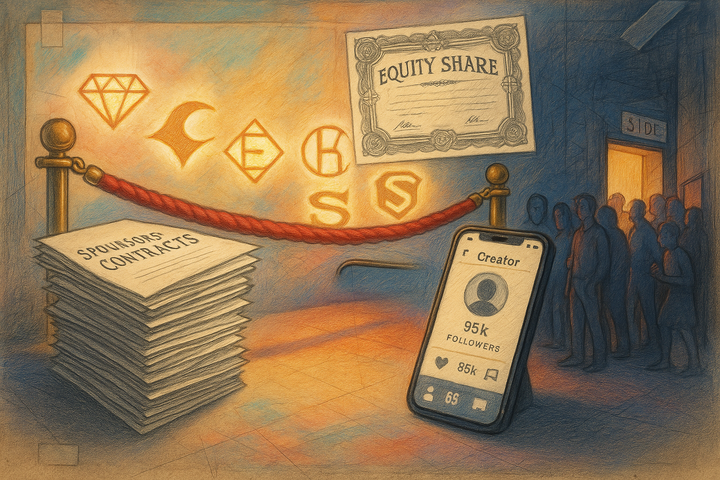
Target Pulled Creator Commissions and Replaced Them With a Game

Target told Ad Age on April 16, 2026 that it is ending cash commissions in its Creator Program. Gift cards and Target products, earned through gamified challenges, replace the old revenue share. The admission under the press release language: Target could not justify paying its full creator roster a cut of every transaction, while Walmart still pays cash commissions and added gamified tiers on top, not instead of cash.
The mechanic that actually changed
Target swapped two currencies. Creators no longer get a percentage of each qualifying sale. They get gift cards redeemable at Target and Target products themselves, earned by completing challenges the retailer picks. Both are cheaper for Target than cash. Gift card liability redeems into Target’s own margin. Products cost Target wholesale, not retail. And because challenges gate the payout, Target only pays when behavior matches what it wants to pay for.
Compare that to the Impact Radius program it replaced. Public category rates sat at 1% for health and beauty, 3 to 5% for baby gear, and up to 8% for apparel and home, with a 7-day cookie and commissions paid 20 days after validation. That is a transaction model. The new program is closer to a contract-for-behavior model with Target-denominated currency.
It’s the affiliate equivalent of paying in chips instead of cash. The chips only spend at the house.
For a creator running a spreadsheet, that matters immediately. When Target.com links paid 5 to 8% cash, creators with decent conversion treated Target like a utility in their content mix. Swap the payout for a $50 gift card when three April challenges close and the math changes. The creators with large audiences and real affiliate income already have better options, which is the part Target seems to be betting its audience won’t notice fast enough to matter.
What Target’s move quietly admits
Ad Age did not spell it out, but the shape of the change tells you the reasoning. Retailers kill broad cash commissions when the incrementality math stops penciling. A creator tagging a Target find on TikTok is often reaching a viewer who was already going to buy from Target. Commission paid on that click is a transfer from Target’s margin to a creator in exchange for revenue Target would have captured anyway. It is not a new problem. It is a well-known tax on every retailer running a long-tail affiliate program.
Walmart knew this. Amazon knew this. Both responded by tiering hard instead of flattening toward zero. Walmart’s bonus program was layered onto commissions, not in place of them. Target chose the flatter, cheaper move. The program now looks closer to a loyalty mechanic than an affiliate one, which will read as a downgrade to the creators actually driving revenue.
I think most teams watching this will read it wrong. The first reaction tends to be that creator commerce is cooling. It isn’t. US creator marketing spend is on track to hit roughly $43.9 billion this year per eMarketer, with direct creator partnerships at about $11.6 billion, up 21%. The money still moves. It just moves through fewer, bigger, better-measured relationships instead of thin cookie-based commissions paid out across a long tail of publishers and creators who never drove incremental revenue in the first place.
Walmart just got handed a roster
Walmart’s Creator Program is the other side of the same bet. It still pays cash commissions, kept higher category rates in food, home, and apparel, and layered gamified milestone rewards on top of the existing commission structure. The new Creator Collabs layer connects sellers directly to creators with no cap on commission, according to Walmart’s November 2025 corporate update. Gamification as an additive layer reads very differently from gamification as a replacement for cash.
If you’re a creator in the 50K to 500K follower range with food, home, or apparel content, the choice is close to decided. Target’s program pays in store credit. Walmart’s pays you money, in categories that overlap almost entirely, with better first-party performance data tied into retail media. Marketing Dive’s reporting on Walmart’s playbook shows Walmart has spent two years building a structured operating model around creators, affiliates, and retail media together. From what I’ve seen in creator rate conversations, rational migration from Target is not a 60 to 90 day story. It is more like two weeks.
The pressure on Target is bigger than one program. 82% of retail media networks were already using creators as of late 2024 per an LTK and Northwestern study cited by Digiday. If Target’s new program slows the creator pipeline feeding its retail media inventory, the ad business feels it even if the affiliate line item looks cleaner on an internal P&L.
The audit most brand creator programs should run now
If you operate a creator program at a brand (not a retailer), this is the week to audit two things.
One: your commission structure. Pull a random sample of 30 creators and split them by whether they drove first-time customers or repeat purchasers over the last 90 days. Compare LTV to commission paid, by segment. A ratio under 2:1 on the repeat segment is where most brands are quietly losing money without knowing it, because they are paying full commission rates on demand they would have captured through email, paid search, or direct. That ratio is the single number to put in front of finance before the next budget review.
Two: your payout mix. If you are rethinking how creators get paid, avoid Target’s mistake. Gift cards and products look cheaper on paper and are worse in practice, because they set a ceiling on which creators will stay in your program. The creators whose content actually converts are the ones with better offers somewhere else, and those offers exist. Walmart at higher commission rates, Amazon Influencer tiers, direct brand deals on flat fees. If your program starts losing your top 10% of creators, the other 90% do not produce enough to keep the program funded, and that collapse tends to happen within one quarter of the first top creator leaving.
If you are a creator: go check Q1 earnings by retailer, not in aggregate. Anything routed through a Target link stops compounding under the new structure, and honestly, probably sooner than the public timelines suggest. Reallocate before your April and May content calendars fill with Target posts that no longer pay anything you can convert to rent.
For category context on why creator programs are so volatile right now: the broader creator economy is still expanding, with US creator marketing spending projected past $21 billion this year. Retailers are fighting over the same top-tier creators with very different tools, which is part of what makes Target’s move land so strangely. We covered a related version of this volatility in how brands kept drawing the wrong lesson from Fruit Love Island, where visible creator tie-ins got copied without the mechanics underneath.
The uncomfortable read
The headline read on Target is that retail is pulling back on creators. The mechanic underneath is simpler. Target decided to keep the traffic signal and stop paying for it, with the bet that enough of its creator roster won’t notice fast enough to migrate before the 2026 holiday push. From what I’ve seen in past retailer affiliate resets, that bet works for a quarter and then breaks. My guess is Target walks at least part of this back before Q4 holiday 2026, once the reporting shows which categories lost creator-driven traffic and which kept it.
Target just told its roster that the next dollar of value only spends at Target. Walmart is going to spend the rest of the year quietly signing the creators who did the math.
Notice Me Senpai Editorial