Scaling AI Content Without Sounding Like the Other 74% of the Internet
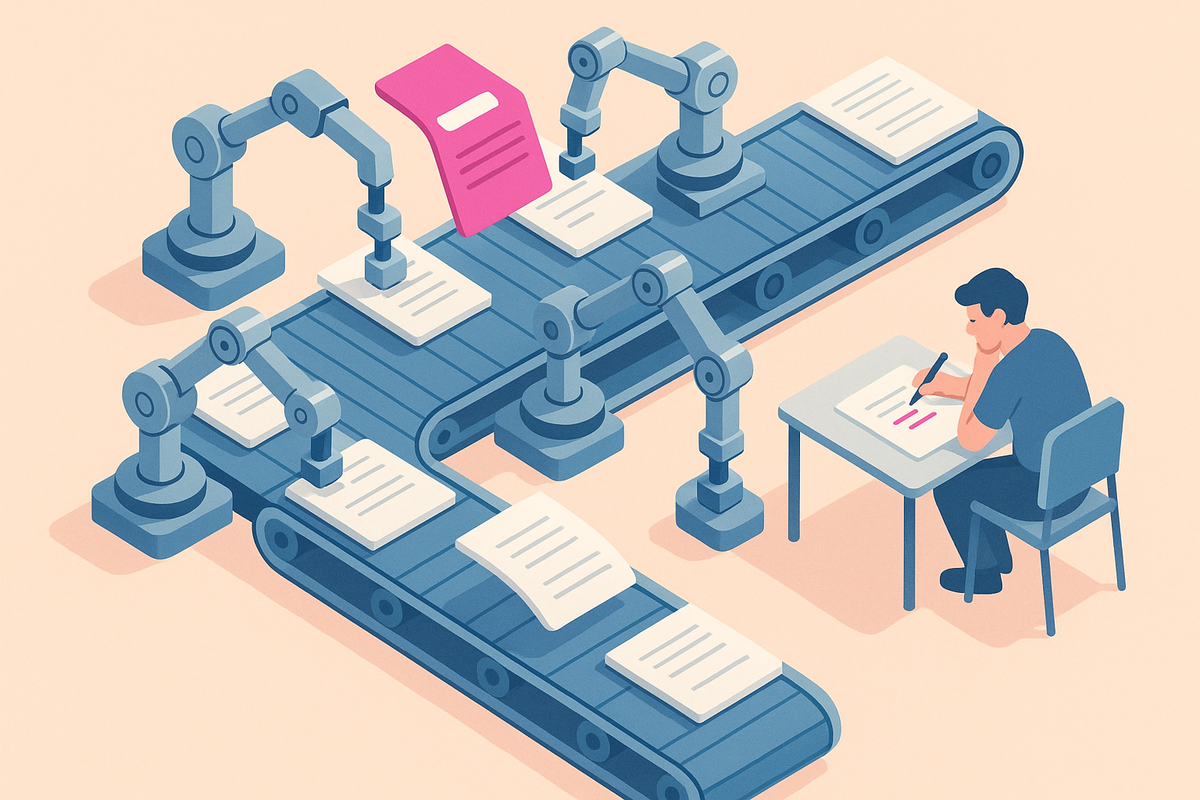
Ahrefs analyzed 900,000 newly created web pages in April 2025 and found that 74.2% contained AI-generated content. Only 2.5% were pure AI; 71.7% mixed human and machine writing. Since most teams now draft with the same handful of models, scaled content converges on the same statistical average. Escaping that convergence takes a documented voice system, not a better prompt.
By Notice Me Senpai Editorial
Everyone hired the same ghostwriter
Sit with the Ahrefs numbers for a second, because the headline stat undersells the interesting part. Pure AI pages were just 2.5% of the sample. The overwhelming majority of AI-touched pages, 71.7% of everything crawled, were blends: a human brief, a machine draft, some edits, publish. Within that blended group, roughly 36% of pages were majority-AI. The same study's survey of 879 content marketers found 87% already use AI somewhere in their content process.
So the market has answered the "should we use AI" question. What nobody budgeted for is that every team in your niche effectively hired the same ghostwriter, and he is writing everyone's blog under different logos.
The sameness has a mechanical cause, not a moral one. A language model, left unconstrained, produces the most statistically likely continuation of your prompt. Writer and marketing consultant Juliet Relstad put it plainly: models default to the most statistically average response, so generic prompts produce the same content for you as for your competitor. That averaging is a feature when you want a serviceable draft in forty seconds. It becomes a tax the moment your category has fifty companies pulling drafts from the same distribution.
What you end up with is copy that reads fine, scans fine, and does absolutely nothing, and honestly the "fine" part is the problem. Nobody flags it in review. It just quietly fails to give anyone a reason to remember you.
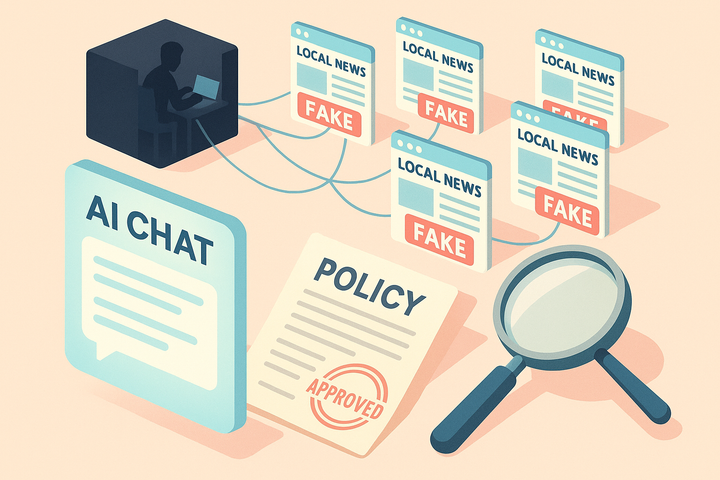
Google's classifier doesn't read your prose. It reads your pattern.
Google's scaled content abuse policy is deliberately method-agnostic: many pages created primarily to manipulate rankings rather than help users, "no matter how it's created." The company said as much when it rolled the policy out in March 2024. And the ranking data backs up the neutrality claim. Ahrefs ran a separate analysis of 600,000 pages and found AI-generated content does not, by itself, hurt Google rankings.
I can offer some first-hand experience here, the uncomfortable kind. This site publishes with AI in the loop, and earlier this year Google's classifier deindexed us almost overnight. The individual articles weren't the trigger, at least as far as I can tell. The pattern was: a young domain, double-digit daily publishing, thin author signals. Every one of those is a spam-profile feature, and stacking all three seems to be what flips the switch. We cut cadence hard and started rebuilding trust signals, and I'd rather you learn that from this paragraph than from your own Search Console.
The practical benchmark: if your domain is under a year old and you're pushing more than 3 to 5 AI-assisted posts per day, you are inside the classifier's profile regardless of how good each post is. Check your ratio this week. Count last month's published URLs, divide by 30, and if the number makes you nervous, fix velocity before you fix prose.
Five inputs the model can't generate for itself
A voice system is a set of documented constraints that force the model off the statistical average. From what I've seen, five inputs do most of the work.
1. A calibration corpus. Collect your 10 to 20 best pieces and put them in front of the model every time it drafts. Not style adjectives ("witty, confident"), actual finished text. Adjectives get interpreted at the average; examples get imitated.
2. A banned list. Words, phrases, and structures the model reaches for under pressure. Ours bans em dashes entirely, along with a couple dozen phrases. The list only works if it's enforced as a separate editing pass, not a polite request in the prompt.
3. Sourced specifics on a quota. One named source, stat, or dated event per 300 words, minimum. This is also where most teams sabotage themselves upstream: WARC's research found 67% of marketers brief AI with demographic data that 59% of them admit doesn't predict behavior. Generic inputs, generic outputs. Feed it your customer tickets, your sales call notes, your actual numbers.
4. An opinion pass. Read each section and ask whether a competent competitor could disagree with it. If every section is agreeable, you've published a summary, and summaries are exactly what models produce at scale. Add the position you'd actually defend in a meeting.
5. Deliberate texture. Hedges where you're genuinely unsure, an aside where a human would make one, sentence lengths that vary. On paper this sounds like sanding a table to make it look hand-made. Sometimes it is. It also happens to be how people actually write, which is the point.
A quick before-and-after so this isn't abstract. Average draft: "AI tools can help marketers create content more efficiently, but it's important to maintain brand voice." That sentence could run anywhere, which means it runs nowhere. After the system: "Our support tickets mention onboarding confusion 3x more often than pricing, so that's what next month's content covers, and no model knew that until we told it." Same topic. One of them is inventory; one of them is yours.
The pass/fail test for the whole system is what I'd call the swap test: paste any paragraph into a competitor's most recent post. If it fits without friction, rewrite it or cut it.
The 20-minute interchangeability audit
Before building any of the above, measure how generic you already are. This takes about 20 minutes.
Pull your three most recent posts and three from direct competitors. Strip logos, bylines, and product names. Shuffle the six intros and hand them to a colleague who knows your brand, with one question: which ones are ours? Random guessing gets three of six right. If your colleague can't beat four, your voice is not currently an asset. You can run the same test through an LLM ("which of these six paragraphs were written by the same publication?") and it's often harsher than the colleague.
A reader who can't tell your paragraph from a competitor's has no reason to subscribe to either of you.
Make it a recurring measurement, not a one-off. Re-run the audit monthly with fresh posts and log the score next to your traffic numbers. A reasonable trajectory: four of six within one quarter of adopting the voice system, five of six within two. If the score stalls at three for two consecutive months, the model isn't the bottleneck; your briefs are, and that's worth a separate working session with whoever writes them. (Slightly tedious, I know. So is watching organic traffic flatline while your content calendar stays full.)
Score below four? Start with the calibration corpus and the opinion pass. Those two move the audit score fastest, in most cases I've seen, because they attack the two things averaging destroys first: rhythm and point of view. The banned list matters more once volume goes up.
And a prediction with stakes attached: Ahrefs measured the pure-human share of new pages at 25.8% in April 2025. By the end of 2027 I'd put it under 15%. Every quarter that number falls, the premium on a recognizable voice goes up, because scarcity is doing your marketing for you. The Content Marketing Institute's 2026 trends roundup runs 42 experts deep and the throughline is the same: differentiated, credibility-backed content earns the visibility that volume used to.
Three questions that keep coming up
Does Google penalize AI-generated content?
Not as a category. The spam policies target scaled production without added value, whatever the production method, and Ahrefs' 600,000-page analysis found no inherent ranking penalty for AI text. The risk lives at the site level: velocity, author signals, and interchangeability, compounding into a pattern.
How much human editing is enough?
Wrong unit of measurement, in my opinion. Ten minutes of adding a sourced stat, a real opinion, and a specific benchmark beats an hour of polishing transitions. Edit for inputs the model didn't have, not for smoothness. Smoothness is the one thing it already does too well.
Will watermarking change the math?
It raises the stakes on disclosure, not on quality. Anthropic now watermarks Claude's output, and others will likely follow. If your differentiation survives being provably AI-assisted (because the sources, opinions, and experience are yours), watermarks are a non-event. If it doesn't, the watermark isn't your real problem.
The going rate for average is zero
The model's default output is the market's average opinion, available to everyone at the same price, roughly free. Whatever you layer on top of it (your data, your calls, your scars from a deindexing) is the only part a competitor can't generate this afternoon.
I don't think the winners of the AI content era will be the teams with the best models. Everyone has the best models. It'll probably be the teams that kept an editorial spine while everyone else optimized for volume, and honestly, the audit above tells you in 20 minutes which kind of team you're on.