Brand Voice Development: A Framework for Teams, Not Just Founders
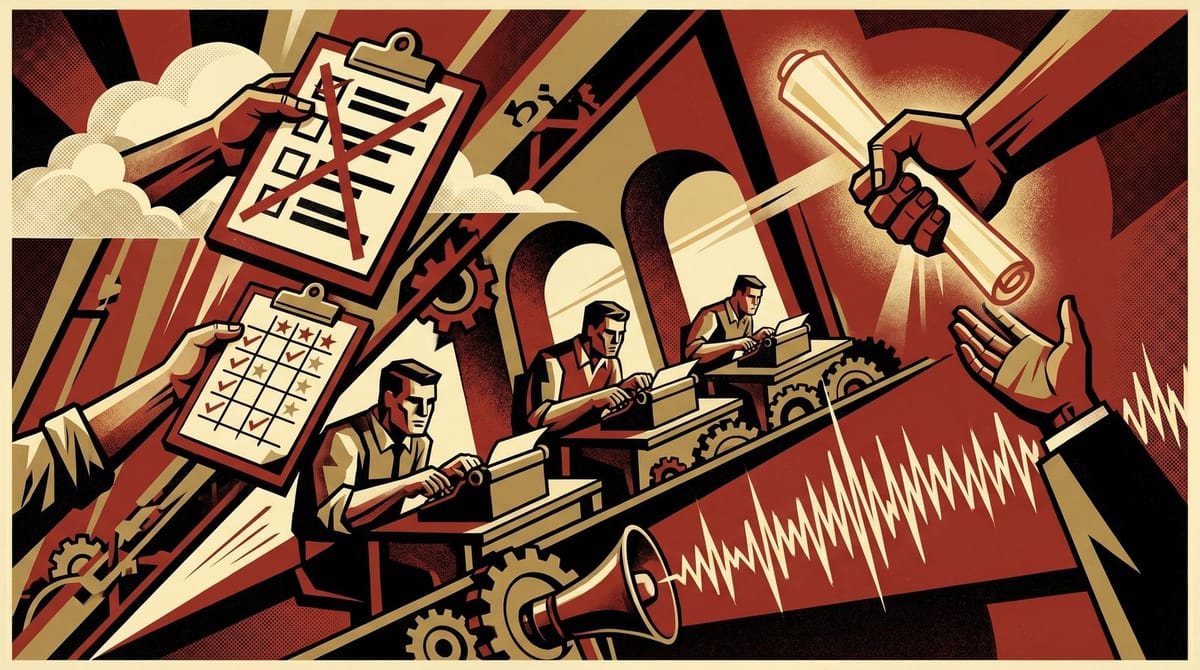
A brand voice framework only works if it survives the handoff from founder to team. Most fail because they describe how the founder sounds rather than giving writers a repeatable way to produce that sound. The fix is operational, not philosophical: rules, examples, and exclusion lists, graded on every piece of work.
This is a zoom-in on a specific problem inside the broader startup brand marketing playbook. The pillar covers how to build a brand on a small budget. This piece is about what happens after you have a voice and need a second human to write in it without rewriting every draft yourself.
Why founder-written voice docs break the moment a second person writes
Most early-stage brand voice documents describe vibes. "Confident but warm." "Irreverent but smart." "Human, not corporate." Those phrases mean something to the founder who lived through every product decision and customer call that shaped them. To a freelance writer onboarded in week one, they are useless. You cannot grade a draft against "warm." You can grade it against "uses 'you' more than 'we' in every paragraph" or "names a specific product in the first sentence."
The clearest signal a voice doc is not working: every junior writer's first draft gets rewritten by the founder before it ships. That is not a quality problem. It is a translation problem. The doc never converted the founder's intuition into rules a second person can apply on autopilot.
I think most teams figure this out the slow way. They onboard a second writer, the drafts do not sound right, and they assume the writer is the problem. After hiring three more writers with the same result, they realize the doc never actually contained instructions. Just adjectives.
The fix starts with a different question. Stop asking "what does our voice feel like" and start asking "what would a writer who has never met us check, line by line, to know they got it right." That question is the entire framework.
Start with the four-axis chart, but score it like Mailchimp
The most useful starting point I have seen is the Nielsen Norman Group's four dimensions of tone of voice: funny vs serious, formal vs casual, respectful vs irreverent, enthusiastic vs matter-of-fact. Place your brand on each spectrum with a specific point, not a range. "We sit at 70% casual" beats "casual-ish." A specific point is something a writer can disagree with and adjust toward. A range is permission to drift.
That gets you started. But the four axes are still abstractions until you do what Mailchimp's content style guide did and pair every claim with side-by-side examples. Mailchimp does not just say "we are conversational." It shows a paragraph written the right way, then the same paragraph rewritten the wrong way. The writer sees the move, not the principle.
The other useful reference is Slack's voice and tone guide for app developers. Slack treats voice as something that has to ship inside bots, notifications, and integrations, where the writer might be an engineer rather than a copywriter. That constraint forces clarity. The guide reads like instructions, not a manifesto. That is the bar.
For a startup, the full enterprise grid is overkill. Start with three contexts: marketing pages, transactional emails, and support replies. Get the paired examples right in each, then expand. A 200-employee version of the doc can wait until you have 200 employees.
The exclusion list does more work than the inclusion list
Honestly, this is the part most teams underweight. Writers reach for clichés under deadline pressure. They do not reach for them because they like the phrases. They reach because clichés are the path of least resistance. The job of a voice framework is to block the path.
A good exclusion list is specific. Not "avoid jargon" but a numbered list of exact phrases that never ship: "leverage," "unlock," "in today's landscape," "we are excited to announce," "delve," "robust," "seamless," "holistic." The longer the list, the easier it is to grade a draft. Run find-and-replace on the manuscript. If the list has 40 entries, a typical first draft will hit at least four. That is your first round of edits done before a human reads the file.
The exclusion list should also cover sentence patterns, not just words. Plenty of teams now ban the "X isn't a Y, it's a Z" reframe because it has become the single most recognizable shape of AI-generated prose in the last two years. Banning shapes, not just vocabulary, is the move that closes the gap between human and machine output. From what I have seen, this is the rule that does the most work on AI-assisted drafts, because the underlying model loves that pattern and will produce it three times per article unless explicitly blocked.
Pair every exclusion with a "house move" substitution. If a writer wants to express enthusiasm and "we are excited" is banned, what do they reach for instead? Give them the answer in the same row. "Today, X" or "X is live" or whatever shape your team actually uses. The exclusion paired with the substitution is what turns the list from a critique into a tool.
The grading rubric that turns the doc into a workflow
A framework only matters if there is a checklist a writer can run before submitting work, and an editor can run during review. Both checklists should be identical, so the writer self-edits to the standard before another set of eyes touches the draft. That is the productivity unlock. The founder stops being the rewriter. The rubric does the work.
Make it scorable. Twelve to fifteen yes-or-no checks, no five-point scales. Examples that have worked across the teams I have seen do this well:
- Does the opening sentence name a specific entity, number, or event?
- Is there at least one first-person opinion in the first three paragraphs?
- Does the exclusion list come back clean after find-and-replace?
- Does each section have one concrete action or benchmark a reader can use this week?
- Are paragraph lengths varied (some one or two sentences, some four or five)?
- Is there at least one piece of sourced data with a real link?
- Does the last line land as a specific take, not a wrap-up summary?
Anything scoring below 10 out of 15 goes back to the writer with the missing checks highlighted. Anything at 14 or 15 ships without a rewrite. The middle scores get a short editor pass.
I would not bother grading drafts with anything more complicated than this. Likert scales invite negotiation. Yes-or-no checks do not. A line either has a benchmark or it does not.
The AI addendum: feed the framework in, but do not trust output past 800 words
Most teams now route some portion of writing through ChatGPT or Claude. The framework should map directly into a system prompt. Voice axes, exclusion list, paired examples, scoring rubric. All of it.
The catch is the fade. Practitioners building in-house AI writing tools, including the team that wrote Search Engine Land's guide to training LLMs on brand voice, note that voice fidelity degrades after roughly 500 to 800 words of generation. The model loses the thread of the early instructions. By the end of a 2,000-word article, the prose has reverted to a generic default register, regardless of how detailed your prompt was. This seems to be a function of how attention drifts over a long output window, and it does not get fully solved by longer system prompts.
Two ways to handle it. Generate in chunks of 400 to 600 words, with the system prompt re-injected between chunks. Annoying, but it works. Or treat AI output as a first draft to be aggressively edited against the rubric, never a finished product. The second path produces better work, but only if the editor knows the rubric cold enough to run it in their head while reading.
One pattern worth lifting from that guide: exclusion lists work better than inclusion lists in prompts, for the same reason they work better with human writers. "Do not use these phrases" gets followed more reliably than "use the warm and confident tone we discussed." Models, like new hires, can grade themselves against negative rules. They cannot grade themselves against vibes.
If your team is leaning into AI-assisted writing, the framework also needs an "AI tells" section that lives next to the exclusion list. Em dashes. Three-word kicker sentences. Tricolon list-of-three patterns. The reframe shape. These are the giveaways that survive every other layer of editing. The cleanest way to catch them is a final pass dedicated specifically to AI tells, with the prompt blind to whether the draft was written by a human or a model.
What this framework gives you that vibes do not
Three things, in order of how much time they save.
First, onboarding compresses. A new writer can ship publishable work in week one instead of week three, because the rubric tells them what good looks like before they have absorbed the founder's sensibility.
Second, AI output stops being unusable. Most teams I have talked to have a complicated relationship with ChatGPT for content. They cannot get past the sameness problem. The framework, fed in as structured rules, gets the model 70% of the way to your voice. The remaining 30% is editor work. That ratio is the difference between AI as a tool and AI as a distraction.
Third, the founder stops being the bottleneck. The whole point of building a brand without a marketing team is volume of output, and the founder cannot personally write or rewrite every piece. The rubric turns voice from tacit knowledge into a hand-off-able asset. That is what makes the brand survive past the first hire.
If you only do one thing this week, write the exclusion list. Forty phrases. Three sentence patterns. The list does more for consistency than any inclusion-side document I have read. The rest of the framework can follow.
FAQ
How long should a brand voice document be?
The most useful ones I have seen run 8 to 15 pages. Anything longer does not get read. Anything shorter does not have the paired examples writers need to calibrate. The Mailchimp content style guide is much longer, but they have 1,200 employees writing in the voice. A 10-person company does not need 60 pages.
Should the founder write it or hire someone?
Founder writes the first draft. A senior writer or content strategist turns that into the operational framework with examples, exclusions, and a rubric. The founder owns the voice. The strategist owns the doc. Splitting those two roles is what stops the doc from being a memoir.
How often should it be updated?
Quarterly review, annual rewrite. Voice drifts. Pull six pieces of recent work, score them against the current rubric, and see what is not matching. Update the doc to match the actual voice that is shipping, not the aspirational one written 18 months ago. If the rubric and the reality have separated, the rubric is wrong, not the writers.
The whole point of writing the framework down is not control. It is leverage. Plus one more piece you can use right after this: how to turn one earned-media moment into 30 days of coverage, which assumes you already have a voice locked in.
Notice Me Senpai Editorial