Flat Fee vs Revenue Share vs Hybrid: The Base Fee Is the Whole Negotiation
Creator compensation comes in three shapes: a flat fee for deliverables, a revenue share on tracked sales, or a hybrid with a smaller base plus commission. Marketers who found creators open to affiliate-only terms fell from 63% in 2024 to 26% in 2025, per a Modash survey of 50-plus marketers. The hybrid is now the default offer, and the base fee is the whole negotiation.
Most of the writing on this topic lists the three models, gives a pros-and-cons table, and tells you it depends. It does depend. But I think the choice comes down to one question: who is carrying the performance risk, and are you paying them enough to carry it? Everything else in this piece is that question worked out with numbers. Fair warning: a lot of the sources here are vendors that sell affiliate tracking, so their enthusiasm for commission deals is not neutral. I have leaned on the survey data rather than the sales copy where I could.
Commission-only died because creators stopped saying yes
The Modash number is the one to pin on the wall. In 2024, more than 63% of surveyed marketers said influencers were increasingly open to becoming affiliates. A year later that figure was 26%, and over 45% of marketers said creators had become less open to it. The same survey found 61% of marketers used some form of performance-based compensation in 2025, so brands did not abandon performance pay. Creators just stopped accepting it without a floor. About 23% of marketers said creators were open to performance-based terms only when a flat fee came with it.
The reason is simple economics on the creator side. The Influencer Marketing Factory's 2026 report, based on a survey of 1,000 US-based creators, found 48.7% earn under $10,000 a year, and affiliate plus product sales make up only 21.2% of creator income. A creator earning $8,000 a year cannot underwrite your conversion rate. If your checkout is slow, a coupon site scrapes your code, or Instagram halves reach that week, the creator eats all of it under a commission-only deal. We covered a version of this when Colin Rocker took equity in Favikon because 80% of creator deals pay under $300. The creators worth working with have done this math already.
So commission-only still works as a long-tail program for hundreds of small creators who opt in on their own. It does not work as an outbound offer to a specific creator you actually want. Send that offer and the good ones just won't reply, which is worse than a rejection because you learn nothing.
Flat fees buy content and rights. They do not buy sales.
The flat fee is still the most common structure. An Ipsos report cited by eMarketer put "flat rate by campaign" as the single most common compensation type for US creators at 31%. And the ranges are wide. Shopify's 2026 pricing guide puts Instagram micro-influencers at $250 to $5,000 per post and mid-tier at $1,600 to $10,000, with YouTube integrations from mid-tier creators running $9,000 to $25,000.
On paper a flat fee looks like the brand taking all the risk, and that framing is mostly right. But it misses what the flat fee is actually good at buying:
- Deliverables on a date. A launch on the 14th needs the video on the 14th. Commission deals give creators no reason to hit your calendar.
- Usage rights. Modash's pricing data has usage rights adding 25% to 100% on top of the base fee for one to three months. There is no base to mark up on a commission-only deal.
- Creators above the micro tier. Macro creators with agencies do not take commission deals, and the agency will not even forward the email.
The mistake is using a flat fee when the goal is measurable sales. If the KPI in the brief says revenue and the payment structure says "we pay regardless," you have written a contract that contradicts your own brief. The Traackr survey of 500 US marketers cited in the same eMarketer piece found the top obstacle in setting creator pay was internal budget constraints (23%), followed by a lack of pricing benchmarks (21%). Which is a polite way of saying finance asked what the $12,000 bought and marketing did not have a number.
Anyway. The flat fee is the right tool for awareness, for launches, for content you plan to run as paid ads, and for creators you have already validated. It is the wrong default for a performance program.
Revenue share is a volume game, and most brands don't have the volume
Pure revenue share has an obvious appeal: you only pay for what happens. The commission rates are fairly settled. Modash found three-fifths of surveyed brands pay 10% to 14% per sale, with the rest paying 15% or more. ContentGrip's roundup of B2B programs shows the top end, with ActiveCampaign paying 20% to 30% recurring and HubSpot paying up to $1,000 per qualified sale.
The problem is statistical, not philosophical. Commission programs work like an index fund: a small number of creators produce most of the return, and you cannot know which ones in advance. Social Snowball, which sells this kind of tracking, is honest that performance is unpredictable early and you need enough creators in the program to find the ones that convert. Their own framing is to go from 10 creators to 100 or more before commission becomes the dominant model.
If you have 12 creators on revenue share, you do not have a performance program. You have 12 people who each posted once, saw $140 in commission, and quietly moved on. The Modash data backs this up in a roundabout way: only 54% of marketers actually ran more long-term creator deals in 2025, down from over 75% who said they had in 2024. Commission-only deals tend to be one-post relationships because nothing in the structure rewards a second post.
Where revenue share genuinely shines is the self-serve affiliate tier: creators who find your program, apply, and post because they already like the product. That tier costs almost nothing to run and occasionally produces a creator who outperforms everyone you paid. Keep it. Just don't confuse it with your creator strategy.
The hybrid math: base at 40 to 60% of the flat rate, then pay for the upside
The hybrid deal is a reduced base fee plus commission, sometimes with bonus tiers. impact.com's 2026 trends guide recommends a base fee with a 10% to 15% commission plus bonus tiers that trigger at sales milestones, and reports 74% of brands are moving budget into creator programs this year specifically because sales are now trackable.
The number nobody states clearly enough is how big the base should be. The working range I would use is 40% to 60% of what the creator's flat rate would have been. Matt McWilliams, who has run affiliate programs for years, gives the concrete version: mid-tier creators with 50,000 to 200,000 followers are landing $1,500 to $2,000 upfront plus 10% to 15% commission, and a creator who normally charges $3,000 for a dedicated YouTube video might take $2,000 plus 15%. His conservative testing offer is $1,000 flat, 12% commission, and a $250 bonus if tracked sales pass $5,000 in 30 days.
Work that last one through. At 12% commission, the creator needs about $8,300 in tracked revenue to earn $1,000 in commission and match the flat rate they gave up. Below that, the brand paid less than a flat deal. Above it, the brand paid more but on revenue it can see. That crossover point is the whole deal, and I would calculate it before every negotiation rather than after.
Cut the base too far and you are back to commission-only with extra steps. Creators read a $200 base plus 10% as an insult wearing a suit.
The bonus tier is the part I think most teams skip, and it is arguably the most useful piece. A $500 bonus at $10,000 in attributed revenue turns a one-post deal into a month of the creator replying to comments with the link. McWilliams reports brands that moved to hybrid saw a 28% reduction in cost per acquisition and average partnership length go from two months to seven. Vendor-adjacent numbers, so I would not bank on 28% exactly, but the direction is consistent with everything else in the data.
A few contract details that matter more than they look:
- Attribution window. 30 days is the common consumer default; McWilliams sees 30 to 60. B2B needs 60 to 90 days minimum because the sales cycle is longer. Put the number in the contract, not in an email.
- Codes plus links. Track both. Codes catch the TikTok viewer who typed your URL into Safari. Links catch the swipe-up. Either alone undercounts, and undercounting is how you lose a creator who was actually performing.
- Split the base payment. Half on content delivery, half at the end of the 30-day window. Payment delays are the top complaint for 41% of creators in a March 2025 Influencer and Crowd DNA report cited by eMarketer. Pay the first half on time and you are already better than most of your competitors.
Which model at which stage (and the version I'd avoid)
Here is how I would sequence it for a brand doing this without an agency. This is partly my opinion and partly a synthesis of the Social Snowball staging model, which is the clearest one I found.
First 90 days, five to ten creators. Hybrid on every deal. Base at roughly half the flat rate, 12% commission, one bonus tier. The goal is data, not scale: which creators convert, which formats convert, and what your real cost per acquisition is next to paid social. McWilliams suggests judging within 60 days on CPA against baseline, promotional posts per 30 days, and creator retention at 90 and 180 days. I'd add a fourth: how many creators asked for a second deal unprompted.
Scaling, 100-plus creators. Commission-heavy for the long tail, hybrid kept for the ten or twenty creators who proved they convert. Raise commission tiers for those creators before they ask. A creator who hits $10,000 in month one and gets an unprompted bump from 12% to 15% will tell other creators, and that referral is worth more than the three points.
Mature program. Flat fees come back, but only for validated creators and only when the fee buys something specific: launch timing, usage rights for paid ads, or an audience overlap you have already measured. At that point the flat fee is a reward for proven performance, which is a very different thing from a flat fee as the opening offer.
The version I would avoid is the one most mid-size brands actually run: flat fees for everyone because that is how the program started, plus a neglected affiliate link nobody promotes. Target's move to fork its creator program into a reach track and a sales track is the large-company fix for exactly that. Reach and sales will not share a brief, and they should not share a payment structure either.
One messy thought, and to be fair I am not certain about it: I suspect base fees will keep drifting down over the next two years as tracking improves, then snap back up once creators notice how much risk has moved onto them. My guess is the 40% to 60% range becomes 30% to 50% by 2028 for mid-tier creators, and the ones who accept the low end will be the ones who can't get flat deals anyway. Plan for that, but don't be the brand that pushes it.
Two questions that come up every time
What commission rate should a brand pay creators?
Three-fifths of brands surveyed by Modash pay 10% to 14% per sale, and impact.com recommends 10% to 15% inside a hybrid deal. High-margin subscription products go higher: ActiveCampaign pays 20% to 30% recurring. Start at 12% on a hybrid and keep room to move to 15% for creators who prove out.
Is a flat fee or commission better for influencer deals?
Flat fees win when you need a deliverable on a date, usage rights for paid ads, or a creator above the micro tier. Commission wins as a self-serve tier for a large roster. For any specific creator you want on a sales KPI, a hybrid with a base of 40% to 60% of their flat rate is what most creators will accept in 2026.
Pay for the thing you can't measure, share the thing you can
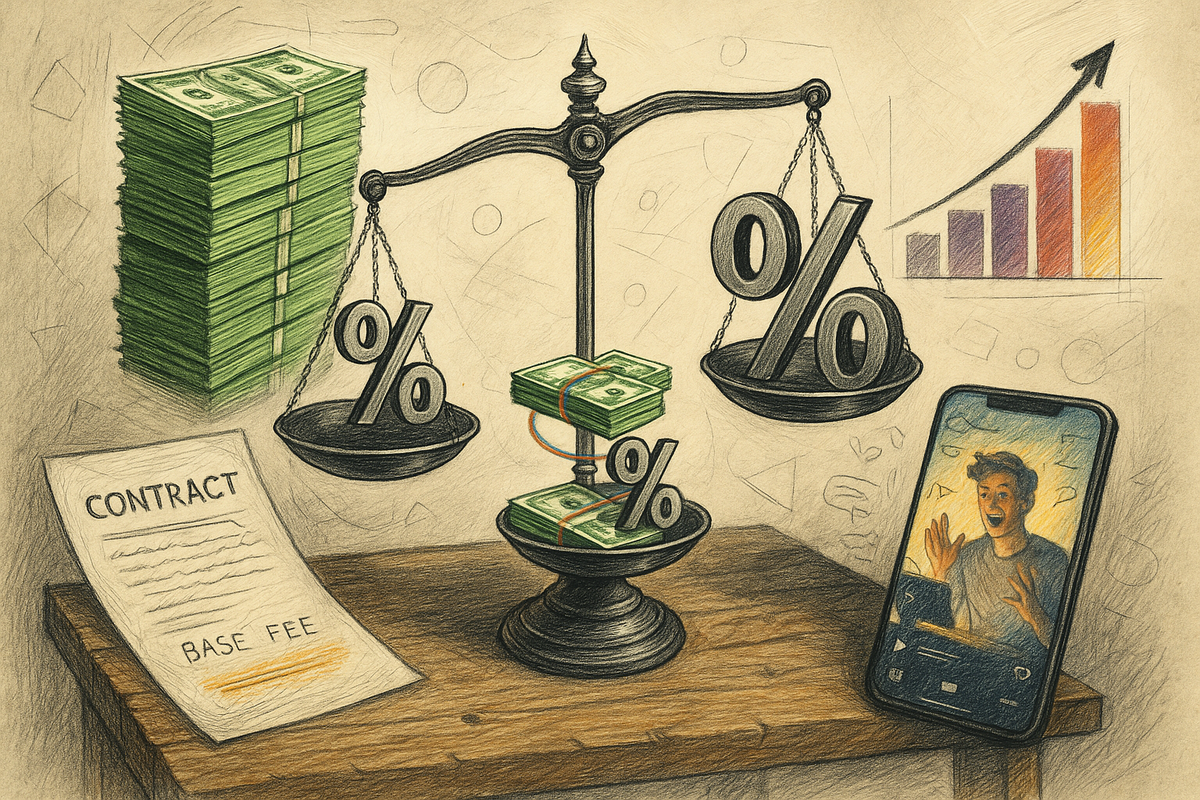
The three models are really one sliding scale of who holds the risk. Flat fee: the brand holds it. Revenue share: the creator holds it. Hybrid: the base fee pays the creator for the labor you cannot measure (the shoot, the edit, the audience they built over four years) and the commission splits the outcome you can. That is the reason it became the default, and I don't think it is a fad.
If your program still opens every conversation with a flat number, try one thing this week. Take your next three creator briefs, cut the fee to half, add 12% on a tracked code with a 30-day window, and add a $250 bonus at $5,000. Some creators will say no. The ones who say yes are the ones who believe they can sell your product, and honestly, that is the only list worth having.
Notice Me Senpai Editorial