LinkedIn's Algorithm in 2026: What Gets Reach and What Gets Buried
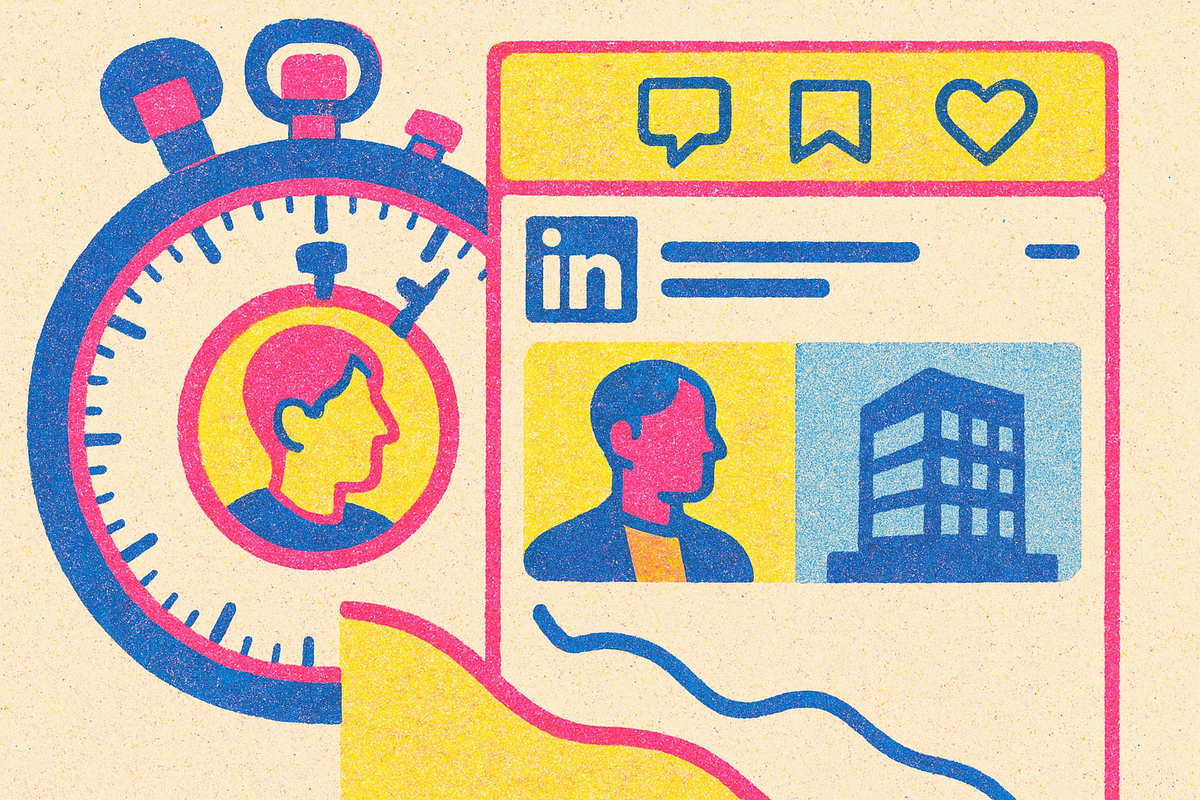
In 2026, LinkedIn's algorithm ranks posts on dwell time and comment depth, not likes or follower count, and it sends most organic reach through personal profiles instead of company pages, which now reach roughly 5% of their own followers. A single external link in the post body cuts median reach by about 18.8%, according to Richard van der Blom's study of 1.3 million posts. The reach didn't vanish. It relocated to individual people who publish things worth reading slowly.
Reach didn't disappear. It moved to people.
LinkedIn spent 2024 and 2025 quietly rerouting distribution away from company pages and toward individuals. The numbers are grim if you run a brand account. DSMN8's feed analysis found first-degree connections make up about 42% of what shows in the average feed, while organic company page posts account for roughly 5%. When you publish from a company page now, LinkedIn initially shows it to something like 2 to 5% of your own followers, per Ordinal's teardown of the decline. That is not a reach problem you fix with better copy. It is structural.
The counterweight is employee advocacy: the same content, published from personal accounts. You will see the "561% more reach" figure everywhere, and I'd treat it with some caution. It traces back to a single GaggleAMP analysis, so read it as one vendor's measurement, not a law of physics. What holds up across more studies is the direction and the rough size. DSMN8's look at 500,000 employee posts found personal posts pulled around 9x the total engagement of curated company posts, about 63 average engagements versus 7. Personal accounts simply have more first-degree connections, and first-degree is where the algorithm starts.
The part most teams get wrong is simpler than that. They turn advocacy into a copy-paste chore. DSMN8 found only 3.6% of employees actually edit the suggested post before sharing, and the ones who do see roughly 3.6x more engagement than the copy-paste crowd. Posts with under 30% similarity to the original template got over 4x the engagement. Identical reshares read as spam to both humans and the ranking system. It is the same lesson creators learned when their own voice became the media kit: the personal layer is the distribution, not the brand template on top of it.
If I ran a B2B page tomorrow, I'd stop treating the company page as the main channel and start treating it as a b-roll archive. The primary distribution is five to ten employees posting in their own words, once or twice a week. Benchmark: if your company page sits at 2 to 5% follower reach and your best employee posts clear 15 to 20% of their connections, you already know where the next hire's time should go.
Dwell time is the whole game now
The single biggest shift in the 2026 algorithm is what it measures. It stopped counting reactions as the primary signal and started timing you. Dwell time, how long someone actually stops on your post, is now the core quality measure. LinkedIn's classifiers reportedly flag anything read for 0 to 3 seconds as a "click bounce" and treat 60-plus seconds as the threshold that earns expanded distribution, according to dwell-time breakdowns like Linkmate's 2026 guide. A post someone reads for 30 seconds beats a post with 50 fast likes.
Engagement types are now weighted by how much effort they take. Hootsuite's rundown puts a save at roughly 5x the reach value of a like and about 2x a comment. Comments themselves are commonly cited at around 15x the weight of a like, and posts that collect real comments are far more likely to spill into second and third-degree feeds. The logic is consistent: the harder an action is to fake, the more the algorithm trusts it.
Then there is the golden hour. Early engagement in the first 60 to 90 minutes largely decides whether LinkedIn keeps pushing a post, per breakdowns like Growleads' first-60-minutes analysis. Replying to comments inside that window feeds the loop, because each reply is another comment and another signal.
None of this rewards what marketers historically optimized for. Posting streaks, follower counts, hashtag stuffing: mostly noise now. From what I've seen, the practical move is to write posts that take a little longer to read on purpose. Open with a hook that makes someone stop, then give them a reason to stay for a minute. Concretely: aim for a post that takes 45 to 70 seconds to read, ends with a genuine question, and block out the first hour after publishing to answer every reply by hand. It is a boring answer. It also happens to be the one the data keeps pointing at.
The link penalty is real. The workaround everyone still uses is dead.
You have heard that links kill your reach. It is true, with an asterisk. Van der Blom's 1.3-million-post report found one external link in the post body dropped median reach by about 18.8%. Not catastrophic, but real, and it compounds when reach is already down 50 to 60% year over year for active creators. This is part of a wider squeeze, the same one where AI Overviews cut clicks nearly 40% in a randomized test. Platforms keep tightening the outbound tap.
The classic dodge was "link in comments." That one is basically finished. Multiple 2026 breakdowns report LinkedIn now suppresses comments containing external links by up to 80%, so the trick everyone taught in 2023 is now actively working against you. If you are still dropping your Substack link in the first comment out of habit, that is a habit worth killing this week.
Here is where I have to be honest that the data is messier than the confident guides admit. A separate Q1 2026 analysis by Saywhat, reported around 400,000 posts, found posts with several external links outperformed posts with none. The likely explanation: the algorithm reads a curated resource post, four or five links to real sources, differently from a single self-promotional redirect. I would not bet a content strategy on that yet. It is one study against a much larger one. But it tells you the penalty is about intent, not links as a category.
The workable rule: keep the one promotional link out of the body when reach matters most, and add it a few minutes later in an edit or share it natively instead. Reserve multi-link posts for genuine roundups where the links are the actual value. And stop using the comment-link trick entirely.
Stop optimizing for format. The format data contradicts itself.
Every LinkedIn guide will tell you which format wins. The problem is they disagree, loudly. Buffer's State of Social Engagement report, drawn from more than 52 million posts, found carousels outperform text posts by about 585%. DSMN8's own dataset found close to the opposite: plain text-only posts led with 16.5 average engagements, ahead of carousels at 12.1 and video trailing at 6.9. Both are real studies. Both cannot be your rule.
What that contradiction actually tells you is that format is downstream of depth. A carousel wins when it is a genuinely useful 8-slide breakdown, because it manufactures dwell time. A text post wins when it says something people stop to read. The format is a container. The dwell time is the product. Personal carousels also beat company-page carousels by around 63%, per the Metricool 2026 study cited across the coverage, which loops right back to the first point: who posts matters more than what shape it comes in.
So I would not chase the format of the month. I'd pick the one format your team can consistently make deep, and get good at manufacturing 60 seconds of attention inside it. If that is documents, build a real template. If it is text, learn to write a hook. Consistency inside one deep format beats rotating through all of them badly.
One honest caveat: video is the exception worth watching. LinkedIn reported its third straight quarter of double-digit growth in video uploads in Q1 2026, and the platform tends to over-distribute whatever it is trying to grow. That looks like a supply-and-demand window, a little like how early Reels inventory was cheap before the market caught up. It might be worth a small test even though the aggregate engagement numbers look weak today.
Publish less from the brand, more from the humans
If you take one thing from all of this: LinkedIn in 2026 rewards individual credibility and reader attention, and it quietly penalizes the brand-account, high-frequency, link-out playbook most teams still run. The company page is not where your reach lives anymore.
The reallocation I would make: cut company page posting to two or three real posts a week, redirect that energy into helping five employees post in their own voice, write for a 60-second read instead of a scroll-past, and protect the first hour after every post. It is less scalable than a content calendar full of brand posts. It also matches where the distribution actually goes now.
I don't think the accounts winning on LinkedIn next year are the ones posting the most. From what the data keeps showing, they are the ones whose people are worth reading slowly.
Common questions about the 2026 LinkedIn algorithm
Does LinkedIn penalize external links in 2026?
Yes, mildly. One external link in the post body cut median reach about 18.8% in van der Blom's study. The bigger change is that links buried in the first comment are now suppressed up to 80%, so the old workaround backfires. Curated posts with several source links can still do fine, because the algorithm seems to judge intent, not links on their own.
How often should you post on LinkedIn in 2026?
Less than the old advice suggested. Hootsuite's data ties weekly posting to roughly a 2x engagement lift, but frequency past that shows diminishing returns because dwell time and depth now outweigh volume. Two or three strong posts a week from a personal profile beats daily brand-page filler.
Do hashtags still help reach on LinkedIn?
Barely. The 2026 algorithm leans on interest and dwell-time signals over hashtag matching, so a wall of tags does little. One or two relevant ones are fine. Your first sentence and your first hour matter far more than your tags.
Notice Me Senpai Editorial