Marketing Team Structure: Org Charts That Actually Ship
Marketing team structure guide: the four models, headcount benchmarks by company size, what to build at each stage, and the handoff test that shows whether you need a reorg.
Marketing team structure is how you split ownership of channels, decisions, and budget across people, partners, and software. The model you pick (functional, channel, product, or pod) matters less than how many handoffs an ordinary campaign needs before it ships. If a standard launch needs more than four approvals, the org chart is the bottleneck, and more headcount usually makes it slower.
Most guides on this topic hand you four org charts and wish you luck. They're mostly fine, the way a map of city districts is fine when you need directions to the pharmacy. They tell you what the boxes are called. They rarely tell you who gets to say "ship it."
That's the part this guide is about. We'll cover the standard models briefly, then the numbers on team size, how the structure should change at each stage, where agencies and AI fit, and the mistakes I see repeated in reorgs. We've also published deeper pieces on the parts around the org chart: your first marketing hire, the martech stack audit, budget allocation, and reporting leadership will actually read. This page ties them together.
The four marketing team structures, and why picking one is the easy part
Almost every structure in the wild is a variation on four shapes:
- Functional (by discipline). Content people sit with content people, performance with performance, design with design. Simple, good for skill depth, and the default at most companies under about 50 people.
- Channel. One owner each for paid search, paid social, email, SEO, and so on. Clear accountability for channel numbers, and also the fastest way to get five people arguing about who gets credit for the same conversion.
- Product or segment. Marketing splits by product line, region, or customer segment, with each group running its own mix. Common in enterprises with genuinely different buyers.
- Pods (sometimes called squads). Small cross-functional teams that own an outcome, like activation or a launch, with a strategist, a creator, and an analyst in the same unit. Meagan White, CMO at Kibo, laid out the pods-plus-guilds version in CMSWire: pods deliver, while guilds are communities of practice (analytics, martech, content) that keep standards consistent across pods.
All four can work. All four can also produce a team that spends Tuesday in a meeting about Thursday's meeting. The structure itself doesn't decide which outcome you get.
What decides it, from what I've seen, is the number of handoffs between "someone had an idea" and "a customer saw it." So before you redraw anything, run this test on your last three campaigns. Write down every person who had to touch, review, or approve each one before it went live, and count.
Two to four handoffs: your structure is probably fine and your problem lives somewhere else (usually strategy or budget). Five to seven: you have a decision-rights problem dressed up as a capacity problem. Eight or more, and honestly, no org chart redesign will help until you strip out approvals. Those thresholds are my own rule of thumb, not an industry standard, and I'd love to hear from a team in the eight-plus bucket that still ships quickly.
The takeaway: pick the model that matches your size (more on that below), then spend most of your energy on who owns which decision.
How big should a marketing team be? The actual benchmarks
The cleanest public data on marketing team size comes from Pave's analysis of 2,914 companies with more than 50 employees. Median marketing share of total headcount:
- 51 to 100 employees: 4.2%
- 101 to 200: 3.8%
- 201 to 500: 3.4%
- 501 to 1,000: 3.5%
- 1,001 to 3,000: 3.3%
- 3,001+: 2.6%
So a 150-person company typically has five or six marketers, and a 400-person company has around 13 or 14. Two caveats. Pave's sample is its own customer base, which skews toward venture-backed tech. And headcount share says nothing about how much work goes to agencies and contractors, which can be a third of the output.
That third isn't a guess, by the way. In The CMO Survey's 2026 topline report (308 senior marketers at US companies, fielded January 2026), respondents said external agencies, partners, and services perform 33.59% of their digital marketing activities on average, and they expect 34.27% two years from now. The median answer was 25%. Outsourcing is flat, not shrinking, which is worth knowing if someone at your company is convinced the whole industry is in-housing everything.
The same survey has the headcount numbers that matter most for planning. Marketing organizations grew 2.49% on average over the prior year, and the median was zero. Expected change in marketing hires for the coming year: a mean of 2.64%, median zero again. Marketing spending rose 1.74% overall, while digital spending rose 8.20%.
Read those together and the picture is pretty plain: budgets are drifting toward digital, headcount is basically frozen, and the typical marketing leader is being asked to do more with the same team. Which means structure matters more than it did when you could just hire your way out of a bottleneck.
Small aside, because this tripped me up during research. Several "marketing statistics" roundups claim the 2026 CMO Survey found "59.5% of marketing activity is built in-house." That number is real, but the question behind it asks how companies develop new marketing capabilities (training or hiring versus partnering versus acquiring). It says nothing about who does the day-to-day work. If you're building a business case on secondhand stats, open the PDF.
The takeaway: benchmark your team at roughly 3% to 4% of company headcount if you're mid-size, then add your agency and contractor spend before you decide you're understaffed.
Building or rebuilding a marketing team? Notice Me Senpai is a free daily email on what changed in marketing and what to do about it. Subscribe here, it takes ten seconds.
Marketing team structure by stage: what to build at 1, 5, 15, and 40 people
Org charts copied from a company ten times your size are the most common structural mistake I can think of. A 6-person team does not need a "Director of Integrated Campaigns." Here's how I'd think about the progression.
One marketer (or a founder doing marketing)
No structure, just priorities. This person needs a revenue number, a short list of channels, and the authority to stop doing things. Jason Lemkin's argument at SaaStr still holds up: underhired first marketers drift into "content and social" because nobody gave them a number, and the fix is to hire someone who has actually owned a number before. Our first-hire decision framework goes deeper on generalist versus specialist, and I'd argue the more useful question is what the hire will own in their first 90 days.
Three to eight people
Functional structure, one leader, everyone reporting directly to them. The roles that tend to matter most at this size: a demand or growth owner, a content and brand owner, someone strong on product marketing (positioning, launches, sales enablement), and, as early as you can afford it, a marketing ops or analytics person. That last one is the hire teams delay longest and regret most. Without it, every report becomes a two-day project and nobody trusts the numbers.
At this stage, buy specialist execution (paid media management, design overflow, video) from freelancers or a small agency rather than hiring for it. You don't have enough volume to keep a specialist busy and learning.
Ten to twenty-five people
This is where most teams get stuck. The functional model starts creaking because the leader can't review everything, and the channel model starts producing turf wars over attribution. Two moves help.
First, add a layer of leads who own decisions, not just people. A paid media lead who can approve spend shifts up to a set amount without escalation is worth more than one who just manages two buyers.
Second, form one or two pods around your most important outcomes (say, pipeline from new logos, or expansion revenue) and leave everything else functional. You don't have to go all-in on pods. A hybrid is normal and, I think, healthier than a full reorg.
Twenty-five and up
Now you need explicit centers of shared standards: analytics, martech, brand. Guilds work here. So does a proper marketing operations function that owns the stack, the data, and the planning calendar. If you're at this size and still running the martech audit as a side project, that's a sign ops is under-resourced.
The takeaway: match the structure to your current size plus about 12 months, not to where you hope to be in three years.
Stack and process: the parts of the org chart nobody draws
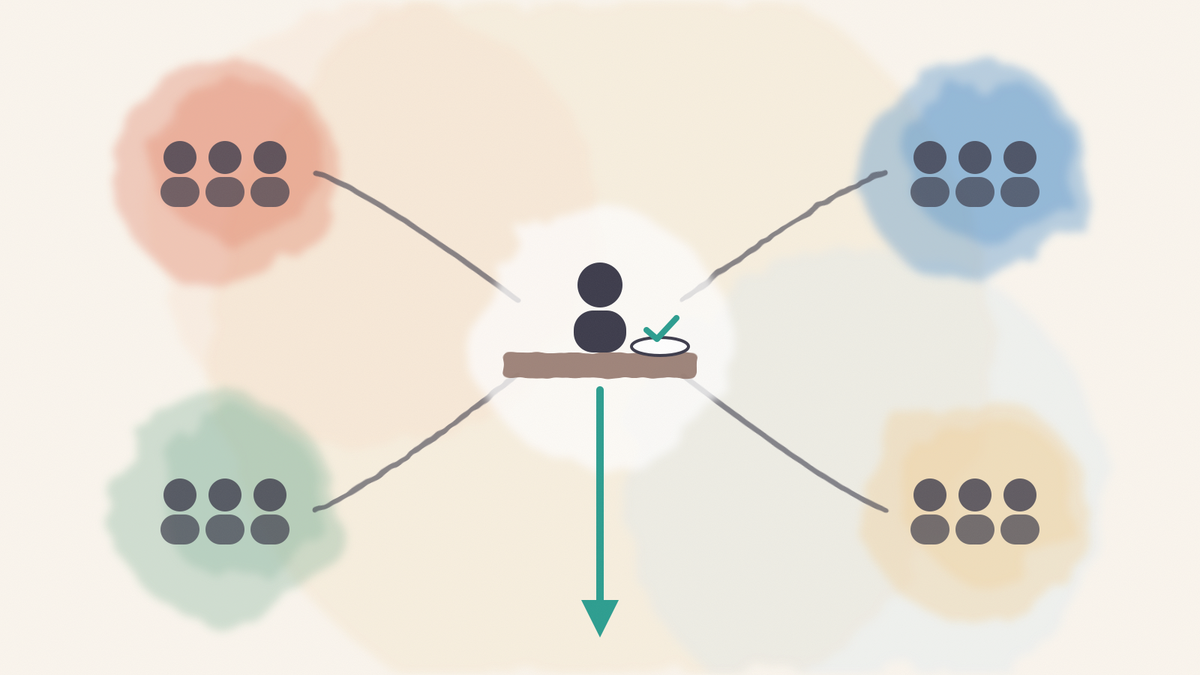
I keep coming back to a restaurant kitchen when I think about this. Stations (grill, sauté, pastry) look like the structure, and they matter. But the thing that makes a kitchen fast is the pass: the single spot where one person checks every plate before it leaves. Kitchens with a clear pass can survive a mediocre station layout. Kitchens without one fall apart on a busy Friday no matter how the stations are arranged.
Marketing teams need a pass, too. Usually it's three things that never appear as boxes on the org chart.
One owner per decision type. Write down the ten decisions your team makes most often (launch a campaign, shift budget between channels, publish a blog post, change pricing-page copy, approve a partnership) and put exactly one name next to each. Not a committee, not "marketing leadership." If you can't fill in a name, that decision is why things are slow. The "alignment tax" we wrote about earlier this year is mostly this problem in a trench coat.
A budget that moves without a meeting. If every reallocation needs a quarterly planning cycle, your channel owners are steering with the parking brake on. Set guardrails (for example, any owner can move up to 15% of their monthly budget across campaigns without approval) and review the shifts monthly. Our budget allocation framework covers how to set the guardrails without giving up control.
A reporting rhythm leadership actually reads. A weekly one-page view, owned by ops, that names the decision it's asking for. We built a one-page template for exactly this. When reporting works, a lot of the approval layers people add "for visibility" can come out, because leadership already has visibility.
On stack: tools should follow structure, not the other way round. It's easy to reorganize around a new marketing automation platform and then discover the platform assumed a team shape you don't have. Buy for the decisions you need to make faster.
The takeaway: before changing any reporting lines, build the decision-owner list. It takes about an hour and it'll tell you whether you need a reorg at all.
Agency, in-house, or hybrid: split the work by judgment and volume
The in-housing trend is real and also more stable than the headlines suggest. The ANA's last full penetration study found 82% of its members had an in-house agency in 2023, up from 42% in 2008. Its 2026 State of In-Housing report says the momentum continues, with jurors five times more likely to say marketers are in-housing more than ever than to say they're pulling back. And yet, as the CMO Survey shows, about a third of digital work still goes outside. Both are true. Most companies run hybrid.
The agency side is shifting underneath that. The UK's IPA Agency Census, published in February 2026, counted headcount in creative and other non-media agencies down 14.3% in a year (14,775 to 12,659), while media agency headcount rose 2.4%. Employees aged 25 and under fell 19.2%. 8% of agencies said they'd cut staff as a direct result of AI, and 24% expected to in the following 12 months. Production-heavy creative work is getting cheaper and is the easiest thing to pull in-house or hand to software. Media buying, with its scale and platform relationships, is holding up better.
So here's the split I'd use. Keep in-house anything where the core skill is judgment about your customer: positioning, messaging, offer strategy, which tests to run, and how to read the results. Outsource where the core skill is volume or specialist access: production at scale, media buying in channels you spend less than you'd pay a full-time specialist, and anything you only need a few times a year.
And whatever you outsource, someone in-house has to own the agency's output against a number. An agency without an internal owner tends to optimize for the metrics in its own report. (Meta forcing agency spend disclosure into invoices by 2027 will make some of this easier to police, for what it's worth.) We'll publish a full cost comparison of agency, in-house, and hybrid at each stage soon as part of this series.
The takeaway: list every recurring activity, mark it "judgment" or "volume," and check whether your current split matches. Mismatches are where money leaks.
Four structural mistakes that keep showing up
1. Reorganizing to solve a strategy problem. If the team doesn't agree on who the customer is or what the main channel bet is, moving boxes around just relocates the argument. Fix the strategy first.
2. Channel silos with separate attribution. When each channel owner reports their own platform's numbers, the claimed conversions can easily add up to more than 100% of what actually happened, and every owner looks great. Structure by channel only if one shared measurement source (owned by ops) settles disputes. If GA4 is that source, at least fix these seven settings first.
3. Hiring managers before you have work to manage. A "Head of Content" with no writers either becomes the writer (fine, but then pay and title them for it) or spends six months building a hiring plan instead of content.
4. Reorging every two quarters. My guess is every reorg costs something like a quarter of momentum while people figure out new decision rights. Twice a year means you're permanently in transition. I'd rather tolerate an imperfect structure for 18 months than chase a perfect one every six.
The takeaway: if you recognize two or more of these, start with the decision-owner list before you touch the chart.
The case that structure barely matters (and where it's right)
There's a serious argument that this whole topic is overrated. It goes like this: great marketers will route around any org chart, mediocre ones will fail inside any org chart, and so the real gains are all in hiring and coaching. The CMO Survey sort of supports it. When asked to rank drivers of future organic growth, 34.5% of marketing leaders put "having the right talent" first, ahead of every other factor in the list.
I think this argument is mostly right at small sizes. With five people who trust each other, structure mostly lives in conversation. If your team is that size and working well, don't let a blog post (this one included) talk you into formalizing things.
Where it breaks down is somewhere around 12 to 15 people. Past that point, nobody can hold the whole picture in their head anymore, and talented people start making reasonable decisions that conflict with each other. That's when decision rights and handoff counts stop being bureaucracy and start being the only thing preventing duplicated work. Good people inside a bad structure don't fail, exactly. They just burn out faster, and they leave.
So the honest version is: hiring well matters more than structure until you're too big for everyone to talk daily, and after that, structure is what lets good hiring pay off.
The takeaway: under about 12 people, invest in hiring and keep structure light. Above that, write down decision rights even if it feels bureaucratic.
Pods, guilds, and the AI-shaped hole in most org charts
AI is changing the shape of marketing teams more slowly than LinkedIn would have you believe, but it's changing it. Spencer Stuart's survey of senior marketers, published in December 2025, found 17% had reduced headcount because of AI in the prior year, while 69% kept team size the same and shifted skills. Looking ahead 12 to 24 months, 36% expected reductions. Company size matters a lot: 32% of marketers at companies with revenue over $20 billion had already cut headcount due to AI, versus 13% at companies under $5 billion.
The CMO Survey adds a useful detail. Marketing leaders estimated AI had improved marketing overhead costs by 14.64% on average. That's meaningful, but nowhere near the "AI replaces the team" story. It's more consistent with the same team producing more, which, honestly, matches one Spencer Stuart respondent's line almost exactly: "The same people will be able to do more, and baseline expectations will go up."
Structurally, I think three things follow.
First, the review step gets more important, not less. When drafts are cheap, the bottleneck moves to whoever decides what's good enough to ship. Most org charts don't have a box for that. We wrote about one version of this gap in agencies, where AI buying agents hallucinate pricing and nobody has been hired to check. In-house teams have the same hole.
Second, pods get more attractive. A pod of three people with good AI tooling can cover strategy, production, and analysis for a single outcome, which was hard to staff when production needed its own team. If you've been curious about pods, the economics probably tilt in their favor now.
Third, the guild layer (shared standards for brand voice, measurement, and data) becomes the thing that keeps AI-assisted output from drifting. Without it, five pods with five prompt libraries produce five slightly different brands.
A prediction, with the usual caveat that I could be wrong: by the end of 2027, I expect at least a third of marketing teams with more than 20 people will have a named role whose main job is reviewing and approving AI-assisted output before it ships, whatever title it ends up with. The teams that create that role on purpose will be in better shape than the ones that discover they need it after a public mistake.
I'll admit I'm less sure about the junior pipeline. The IPA figure on under-25s (down 19.2%) suggests entry-level roles are where cuts land first, and I don't think anyone has a good answer yet for where the next generation of senior marketers learns the craft if the junior work is automated. It's a structural problem that won't show up on anyone's org chart for about five years.
The takeaway: add an explicit review owner to your decision list, and if you're over 20 people, pilot one pod for a single outcome for a quarter before deciding on anything bigger.
FAQ: marketing team structure, common questions answered
What are the main types of marketing team structure?
The four common models are functional (organized by discipline, like content or performance), channel (one owner per channel), product or segment (separate groups per product line or customer type), and pods (small cross-functional teams owning one outcome). Most companies above 20 people run a hybrid, often functional with one or two pods.
How many people should be on a marketing team?
Pave's data on 2,914 companies puts the median at 4.2% of total headcount for companies with 51 to 100 employees, falling to 2.6% at 3,001+ employees. Count your agency and contractor capacity too, since external partners perform about a third of digital marketing work according to the 2026 CMO Survey.
What roles does a small marketing team need?
For a team of three to eight, prioritize a demand or growth owner with a revenue number, a content and brand owner, product marketing coverage, and marketing operations or analytics as early as you can. Buy specialist execution like paid media management or design overflow from freelancers or agencies until volume justifies a hire.
Should marketing work be done by an agency or an in-house team?
Keep judgment work (positioning, messaging, test strategy, reading results) in-house and outsource volume or specialist work (production at scale, media buying in smaller channels, occasional projects). Whatever goes outside needs an internal owner accountable for the agency's results against a business number.
How is AI changing marketing team structure?
Mostly by shifting skills rather than cutting teams so far. Spencer Stuart found 69% of senior marketers kept headcount steady while shifting capabilities toward AI, and 17% reduced headcount. The structural effect is that review and quality control become bottlenecks, and small pods become more practical because one person with AI tools can cover more production.
Where I'd start on Monday
If you take one thing from all this: count the handoffs on your last three campaigns and write down one owner for each of your ten most common decisions. That's an afternoon of work, and it'll tell you more than any org chart template.
I don't think there's a perfect structure waiting to be found. The teams I'd want to work on are mostly the ones where everyone knows who decides what, and nobody has to schedule a meeting to find out.
If this was useful, the daily version is free: subscribe to Notice Me Senpai. One email a day on what changed in marketing and what to do about it.