When to Start Brand Marketing (Most Startups Wait Too Long)
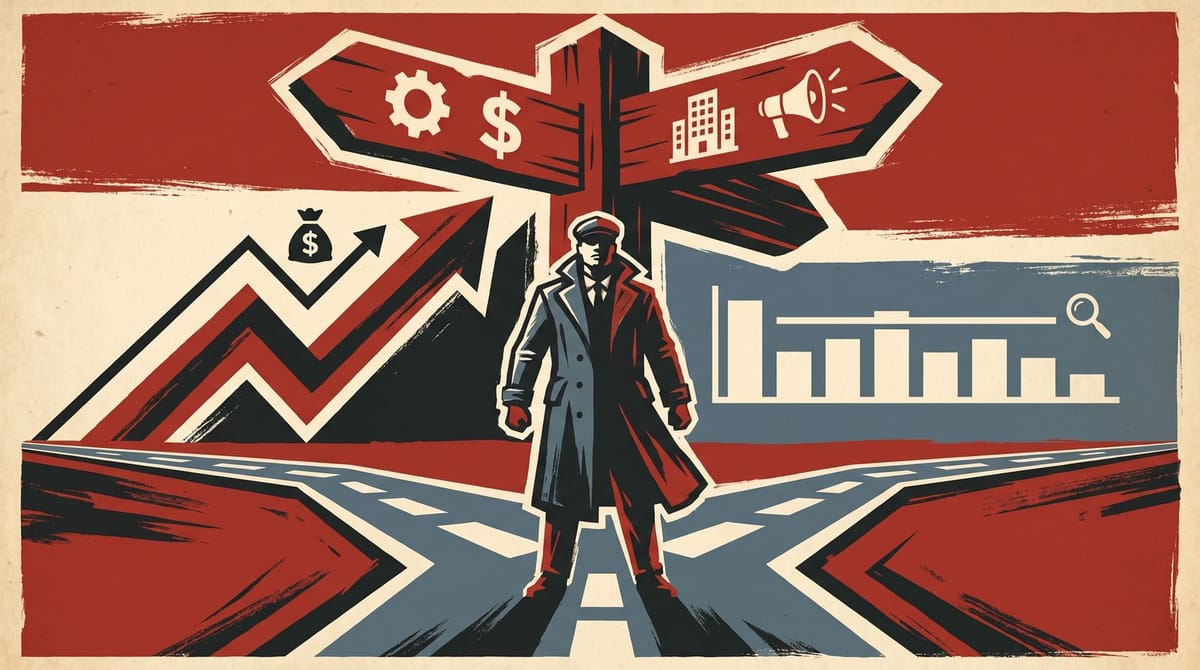
Most startups treat brand marketing as a switch they flip after Series A. That timing is wrong in both directions. The cheap part of brand work has no reason to wait, and the expensive part should wait for a measurable signal instead of a funding round. The real trigger to add brand budget is rising acquisition cost while your branded search stays flat, not a line item a board member asked about.
I keep seeing the same pattern. A founder decides brand is a "later" problem, then quietly delays the free version of it along with the paid version. By the time they revisit, they have spent two years renting demand from Meta and Google without building any of their own. The full startup brand marketing playbook covers the channels and the budget math. This piece is a zoom-in on the one question that guide leaves mostly open: when do you actually start, and what tells you it is time to spend real money.
"Brand" is two separate budgets, and only one of them should wait
The word "brand" hides two very different line items, and most of the confusion about timing comes from treating them as one thing.
The first costs hours. A founder posting on LinkedIn three times a week. A one-page voice document so your homepage, your onboarding emails, and your support replies sound like the same company. Showing up in the three communities where your buyers already argue with each other. Getting written about by someone other than you. None of this needs a media budget. It needs consistency and a few hours a week, which is a different kind of expensive.
The second costs media dollars. Paid brand campaigns, sponsorships, out-of-home, the polished video shoot, the podcast you bought a quarter of. This is the part with real cash risk and a payback window measured in quarters, not weeks.
When a founder says "we will do brand later," they almost always mean the second bucket. The problem is they delay the first bucket by accident, because it got filed under the same word. That is the actual mistake. Not starting brand too late in some abstract sense, but letting the free, compounding work sit untouched because it shares a label with the scary expensive work.
So before anything else: split your brand work into "costs hours" and "costs media." Everything in the first column starts this quarter, regardless of stage. Everything in the second column waits for a signal. The rest of this piece is about reading that signal.
The funding round is the wrong trigger. Watch these four signals instead.
"Wait until Series A" is a tidy heuristic and a bad one. A funding round tells you a partnership decided your equity story checks out. It tells you almost nothing about whether your acquisition is starting to strain, which is the thing that should actually move money toward brand. From what I have seen, the better trigger is a set of measurable signals you can pull from tools you already pay for.
Signal one: branded search going flat while paid spend climbs. Pull branded query impressions from Search Console (or branded interest from Google Trends) over the trailing six months, then lay your paid spend next to it. If spend is up 30 percent or more and branded search has not moved, you are buying clicks, not demand. You are renting an audience that forgets you the moment the campaign pauses. That gap is the clearest early sign that performance is doing a job brand should be sharing.
Signal two: CAC rising faster than your conversion rate is improving. If it costs more every quarter to acquire the same customer and your funnel is not getting worse, the cost is coming from the auction, not your site. Worth one caveat here. A chunk of what looks like rising CAC is actually signal loss from privacy changes and broken tracking, not genuinely more expensive demand. EasyInsights has a decent breakdown of how to separate signal loss from real CAC inflation before you blame the market. Diagnose that first, because brand spend will not fix a measurement problem.
Signal three: ROAS compression on your best channel with nothing changed. Same creative, same targeting, same offer, and the return keeps sliding. That is the auction getting more crowded around you. It tends to hit your single best channel first, which is also the one you are most tempted to keep feeding.
Signal four: channel concentration. If one channel drives more than 60 to 70 percent of new customers, you are one algorithm update or one CPM spike away from a bad quarter. Brand is partly how you build a second source of demand that does not live inside someone else's ad auction.
None of these is a funding milestone. Build them into a one-page monthly dashboard and the question "is it time?" stops being a vibe and starts being something you can point at.
Start the free 80 percent in month one anyway
Here is the part that genuinely cannot wait, and the part most founders get wrong by waiting. The hours-not-dollars brand work compounds, and compounding is unforgiving about start dates. Begin it in month one even while performance marketing is carrying the whole load.
Concretely, in the first quarter: get the founder publishing on one platform two to three times a week, write a short voice document so the company sounds like one person instead of five contractors (we wrote a whole framework for keeping brand voice consistent across a team), pick the one or two communities your buyers actually live in and become a real participant, and start one repeatable earned-media motion. Our earned media arbitrage piece walks through turning a single moment into a month of coverage on basically no budget.
Then do the one thing almost nobody does: take a baseline reading of your branded search today. You cannot prove brand lift in twelve months if you never wrote down where you started. Screenshot your branded impressions now.
Be honest about the timeline, though. This stuff shows up slowly. Most practitioners and the pillar both land in the same range: meaningful results somewhere between month six and month twelve of consistent effort. Which is exactly why starting late is so costly. If you begin the free work at month twelve, you are looking at month eighteen to twenty-four before it pays. The cost of waiting is not the hours. It is the calendar.
When the paid-brand math flips (and why 60/40 is not your number yet)
Now the expensive bucket. The case for paid brand rests on a number worth internalizing: at any given moment, only about 5 percent of your potential buyers are actually in the market. The other 95 percent will not buy for months or years. The 95-5 framing, popularized by LinkedIn's B2B Institute research with John Dawes of the Ehrenberg-Bass Institute, is the whole argument for brand in one stat. Performance media can only ever reach the 5 percent who are shopping today. Brand is how you get into the consideration set of the 95 percent before they start.
This is where founders grab the famous Binet and Field 60/40 split (60 percent brand, 40 percent activation) and apply it on day one. Do not. That ratio came from analyzing mature brands with established demand, and even Binet has said it is not an iron rule. For B2B the same research shifts the optimal mix closer to 46/54 toward activation, because longer sales cycles give activation more time to work. And for an unproven startup with eighteen months of runway, the honest split is more like 20 to 30 percent brand, scaling up only as you prove the engine works.
First Round's framework for performance versus brand puts it well: you need proof that acquisition can work before you invest heavily in something that takes years to compound. So the flip point is not a date. It is a condition. From what I have seen, it reads roughly like this: paid CAC has climbed two quarters running despite real optimization, one of your other three signals is also lit, and you have more than twelve months of runway. When all of that is true, move 10 to 15 percent of paid budget into brand and commit to holding it for at least two quarters. Brand measured over six weeks always looks like a waste, because that is not the timeframe it works on.
And to be fair, this is not a clean line. Some categories are so winner-take-all that you flood paid early and sort out brand never, or much later. Most startups are not in that category and just tell themselves they are.
Quick answers to the questions founders actually ask
How much should a startup spend on brand marketing? Early on, treat the free bucket as non-negotiable and cap the paid bucket at 10 to 15 percent of marketing spend until acquisition economics are proven. The mature 60/40 split is a destination, not a starting point. Push toward more brand only as performance channels plateau.
Can you do brand marketing before product-market fit? The free version, yes, and you basically have to, because founder credibility and a consistent voice cost nothing and help you sell. The paid version, no. Spending media dollars to build awareness for a product that might still pivot is how you light cash on fire. Get to product-market fit on performance and organic first.
How long until brand marketing shows results? Plan for six to twelve months on the free work before branded search and inbound move in a way you can measure. Paid brand campaigns need at least two quarters before you judge them. If you need a return inside ninety days, that is a performance problem, not a brand one.
The asymmetry nobody priced in
The startups that lose this one are rarely the ones who started paid brand campaigns a quarter late. That is a recoverable, visible mistake. The ones who actually pay for it are the ones who left the free work sitting in a drawer for two years because it shared a name with the expensive stuff, then tried to buy in twelve months what consistency would have given them for the cost of a few hours a week. The cheap part rewards an early start more than almost anything else you will do. Spend the hours now, and let the signals tell you when to spend the dollars.
Notice Me Senpai Editorial