
Adorn Cosmetics Kept Buying Meta Ads Into a Store Converting 30% Worse
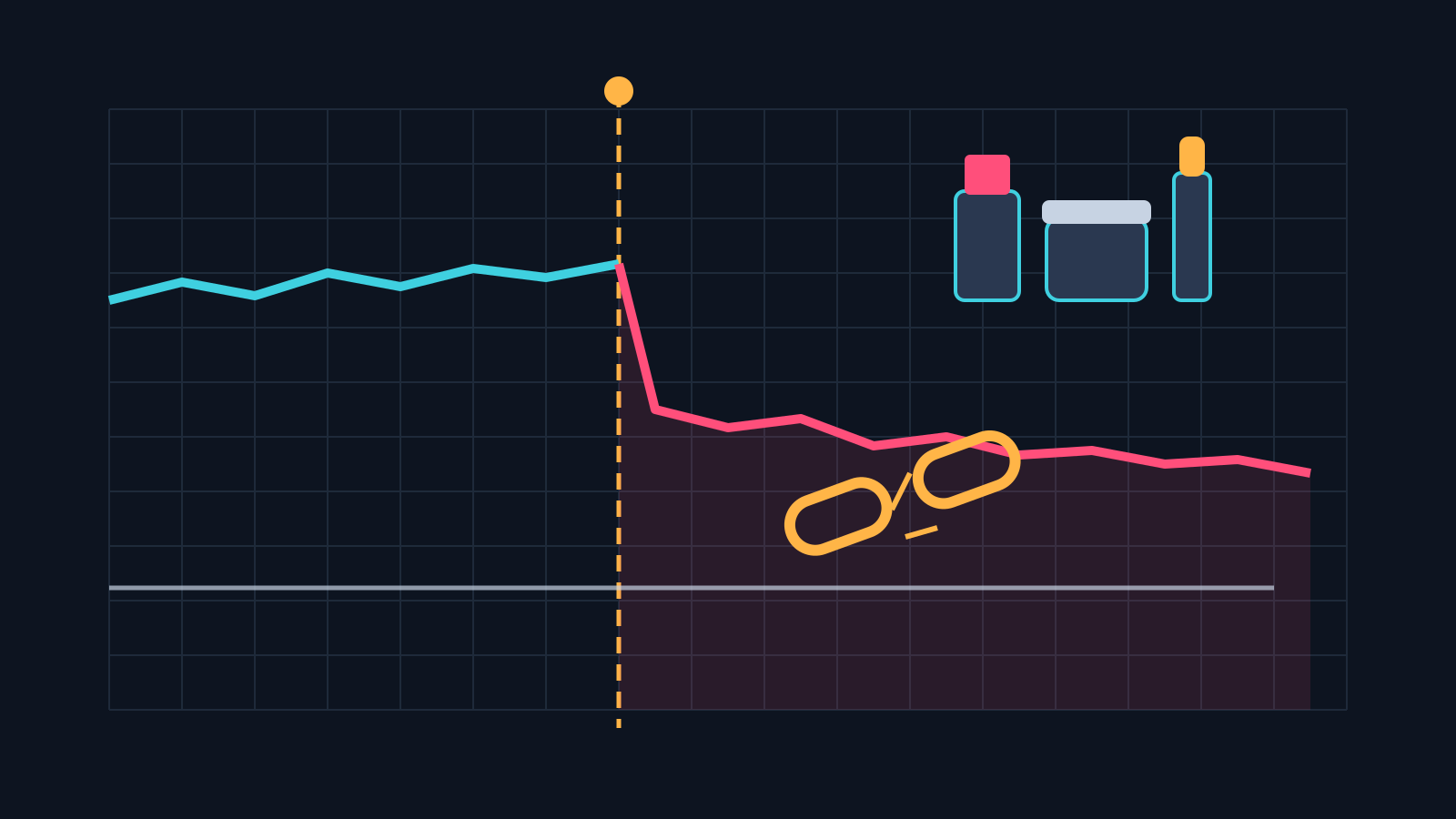
Melbourne skincare brand Adorn Cosmetics is facing closure after founder Briony Kennedy told 7NEWS that sales fell about 30% the moment its new Adobe Commerce site launched, while roughly $1 million a year in Facebook and Instagram ads kept running. Her account is one-sided and Adobe declined to comment, but the mechanism is common: paid traffic kept flowing into a store that converted worse, and nobody set a threshold to stop it.
I want to be careful here, because almost everything we know comes from one interview. PPC Land's write-up lays out the gaps pretty honestly: no migration timeline, no contract terms, no technical explanation for why the ads broke, and a local agency (Convert Digital) that 7NEWS says implemented the build but whose role isn't described. Adobe declined to comment "for legal reasons." So this is not an article about who's to blame. I genuinely don't know, and neither does anyone posting hot takes about it.
What I do think is worth your time is the part of the story that has nothing to do with Adobe at all. A brand reportedly spending around $1M a year on paid social watched its conversion rate fall off a cliff, and the ad spend apparently kept going. That failure mode can happen on Shopify, on WooCommerce, on a custom headless build. It happens on every platform, honestly.
The quote that should worry every media buyer
Kennedy's line to 7NEWS: "All of those ads that we were paying for were not linking back to the website."
Read that twice. If it's accurate, the ad account was paying for clicks that landed somewhere other than a working product page. The usual suspects in a replatform are boring ones. Old product URLs change structure and nobody maps redirects. The Meta pixel or Conversions API integration doesn't get reinstalled on the new templates. The product catalog feed still points at the old URL pattern, so dynamic ads send people to dead pages. Any one of those is enough to wreck a month.
We don't know which of these (if any) happened at Adorn. But the point stands either way: a paid social account is the fastest conversion monitor most DTC brands own. It reports every day, by ad set, with spend attached. Organic traffic takes weeks to show damage after a migration. Your Meta account shows it within 48 hours, if anyone is looking.
Why a 30% drop costs more than 30% in Meta
This part gets talked about less. Meta's own peak-season guidance, reported by PPC Land in October, says ad sets getting fewer than roughly 50 conversions a week cost about 28% more per purchase. Meta hasn't published the method behind that figure, so treat it as directional.
Still, the math is ugly. Picture an ad set doing 60 purchases a week. A 30% conversion drop takes it to 42, which is under the line. Now you're paying the lower conversion rate AND, if Meta's number holds, a higher cost per purchase on top of it, because the delivery system has less signal to optimize against. The losses compound instead of adding. I think this is part of why replatform disasters seem to snowball so fast for ad-heavy brands; it's not just one thing getting worse, it's the feedback loop.
And to be fair, this isn't entirely new. Ad platforms have always punished broken funnels. It just used to take longer to notice, and the budgets were smaller.
The vendor pitch versus the launch-day reality
Back in September 2021, B&T covered the move as a success story. Adorn had run an open-source version of Magento since launch and was moving its "entire e-commerce environment" to Adobe Commerce, with promises of real-time product recommendations, a unified KPI dashboard and a rebuilt loyalty program. Kennedy said analytics that better inform social and email campaigns were "paramount for achieving better ROI." Adobe promoted the project as a customer story at the time, too.
Five years later, the same project is the reason the founder says she sold her family home.
Replatforming is a bit like moving house while still hosting dinner every night. The new kitchen might be better, but if the guests can't find the front door on moving day, they eat somewhere else, and some of them don't come back.
The other piece of this that bothers me is the contract. Kennedy says she "wasn't allowed to get out of the contract." We don't know the terms. But PPC Land points back to the 2024 FTC complaint against Adobe, which alleged early termination fees of up to 50% of remaining payments on some subscription plans. That case was about consumer software, not enterprise commerce, so I wouldn't draw a straight line. It's still a reminder that "can we leave if this goes badly" is a question you ask before signing, not after launch.
A migration tripwire you can set up in 10 minutes
None of this needs an enterprise budget. If you run paid traffic into a store that's being rebuilt (or might be in the next year), this is roughly what I'd do.
Before launch:
- Export every active destination URL from Meta Ads Manager and Google Ads, plus the URL column from your product catalog feed. Crawl that list against staging. Every URL should return a 200 or a single 301 to the right product. Google's site move documentation covers the redirect mapping side, and the same map protects your ads.
- Write down a baseline: conversion rate by channel (paid social, paid search, email, organic) for the last 28 days, same weekdays. Screenshot it. You will want it later, and people forget how good things were remarkably fast.
- Confirm the pixel, Conversions API and GA4 tags fire on the new templates with a test purchase. Not "the agency said it's done." An actual test order. Our earlier piece on GA4 capturing only 32% of one retailer's Christmas orders shows how quietly tracking can break without anyone noticing.
After launch, the tripwire: if paid social conversion rate sits more than 15% below the baseline for three consecutive days, cut paid budgets by half until the cause is found. That threshold is my opinion, not an industry standard, so tune it to your normal day-to-day volatility. The point is deciding the number in advance, when nobody's emotional about it.
For context on how small things move conversion, PPC Land has covered Shopify data linking each extra 100ms of load time to roughly 3.5% lower conversion. That's a correlation, not a controlled test. But a heavier new theme could plausibly cost you double digits before a single link breaks.
In the contract: ask for a performance-linked exit. Something like: if checkout conversion stays below the pre-launch baseline by more than 20% for 60 days, either party can terminate without the remaining-term fee. A vendor confident in their build should be able to live with that. If they won't even discuss it, that tells you something.
What the SEO crowd got right (and slightly wrong)
The story has been all over marketing X since the weekend. Lily Ray called it a site migration gone wrong and urged brands to hire SEO teams with real migration experience before moving an e-commerce site. Gagan Ghotra posted Adorn's organic search visibility to show the damage on the search side.
They're right, mostly. But I'd add one thing: for a brand spending $1M a year on Meta, SEO probably wasn't the first line of defense. The paid team was. Organic visibility drops are a slow-motion signal; a 30% drop in ad-driven purchases is a fire alarm. From what I've seen, the paid team often finds out last because nobody told them a launch was happening that week. Which is a slightly absurd thing to say out loud, but here we are.
On paper, a replatform is a dev project. In practice, it's a media-buying risk event, and it should get the same pre-flight checklist you'd use for a Black Friday launch.
Where my sympathy actually lands
Most of the online reaction splits two ways: Adobe and the agency failed her, or the founder should have done better diligence. Neither take helps the next founder much. Non-technical owners hire experts precisely because they can't audit the work themselves.
The fix that's actually available is smaller and less satisfying. Pick one number, set one threshold, and make sure someone with access to the ad account knows when the new site goes live. I don't know if that would have saved Adorn. I suspect it would have saved a lot of the money that was spent finding out.