The AI Overviews CTR Rebound Tracks Google's Impressions Bug, Not a SERP Shift
Seer Interactive's April 2026 study of 53 brands and 2.43 billion impressions reports organic CTR on AI Overview queries climbed from 1.3% (December 2025) to 2.4% (February 2026), an 85% increase. That window overlaps Google's 11-month Search Console impressions bug, disclosed April 3 and now being fixed. A smaller denominator can recreate an 85% recovery with zero extra clicks.
What Seer actually measured
The study pulled 5.47 million queries across 53 brands from January 2025 to February 2026, all tracked through Google Search Console. Three findings drove the headline.
First, organic CTR on queries that triggered an AI Overview bottomed at 1.3% in December 2025, then climbed to 2.4% by February 2026. That's the 85% figure every outlet ran with.
Second, CTR on queries without an AI Overview rose from 2.8% in early 2025 to 3.8% by February 2026. No-AIO queries are getting more valuable, not less.
Third, being cited inside an AI Overview delivers roughly 120% more organic clicks than competing uncited sites on the same query. On informational queries, Seer clocks cited sites at about 20,743 clicks per million impressions versus 9,445 for uncited.
All of that is useful. The framing is where I'd slow down.
The number nobody asked about: impressions
On April 3, 2026, Google quietly updated its Data Anomalies page to confirm a logging error that inflated Search Console impression counts from May 13, 2025 onward. Clicks were not affected. CTR was, because CTR is clicks divided by impressions, and the denominator had been wrong for almost eleven months.
Passionfruit's analysis of 17 properties estimates 30 to 50 percent impression inflation across most sites during the bug window, with some edge cases showing near-total artificial data. That is across the same period Seer's dataset covers.
There were actually three overlapping issues. The logging bug (May 13, 2025). AI Mode data getting merged into the Performance report without a segment (June 17, 2025). And Google deprecating the &num=100 URL parameter in September 2025, which killed a huge pipe of scraper-driven impressions. Search Engine Roundtable has the forensic timeline if you want it in one place.
Why the math flatters CTR recovery
If your impressions were inflated for 11 months, your measured CTR was artificially low. As the fix rolls out through Q2 2026, impressions fall. Same clicks, smaller denominator, higher CTR.
Seer's bottom (1.3% in December 2025) sits inside the inflation window. February 2026, where the "recovery" shows up, is also inside that window, but after the &num=100 fix stripped scraper impressions out. Mechanically, you would expect a CTR bump in exactly that period, even if nothing about user behavior on SERPs changed.
I don't think this invalidates the study. Seer measured what happened in GSC, and that's what most SEOs measure too. But the headline reads as "AI Overviews aren't hurting CTR as much as feared," and that isn't the same claim as "the denominator got smaller." One of those implies user behavior shifted. The other implies a reporting pipeline got cleaned up. They have very different implications for your 2026 plan.
What Seer got right anyway
Strip the recovery framing and three conclusions still hold.
Citation is the KPI. If you're in the Overview, you get a meaningful share of the click. If you're not, the click mostly disappears to the Overview itself. That conclusion doesn't hinge on the denominator at all.
Query type is destiny. Comparison queries trigger AIOs 95% of the time. Question-format queries, 86%. Transactional, 5%. If your top-performing pages are "best X for Y" or "how to X," you are living inside the displacement zone, and your traffic chart this year is already telling you this.
No-AIO queries are where the remaining revenue is hiding. CTR climbed from 2.8% to 3.8% on those, which roughly matches what small publishers watching their search traffic collapse 60% already figured out the hard way: the clicks that still exist cluster on the remaining non-AIO queries. The people who kept showing up for narrow, lower-funnel, branded, or intent-heavy queries are still getting traffic. Everyone else is watching their informational inventory drain.
The GSC audit that actually answers the question
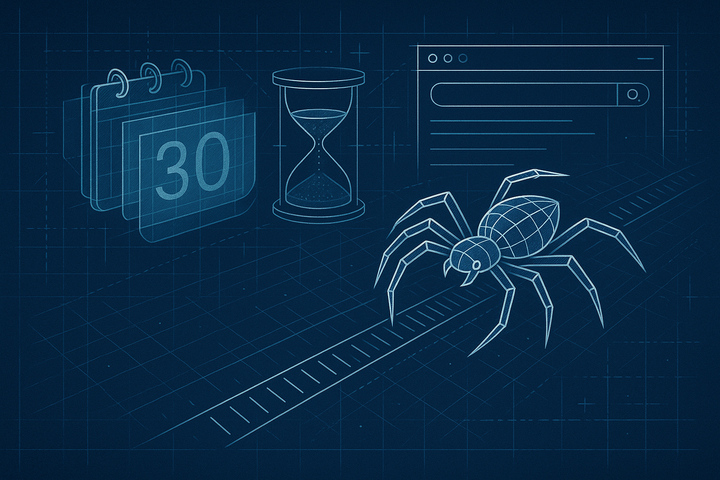
This is the part I'd spend 30 minutes on this week.
Pull your GSC Performance report for the last 16 months. Stack these comparisons side by side:
One. Impressions in the week of May 6, 2025 versus the week of May 20, 2025. That is the inflation step. If you see a visible jump, that is your inflation baseline.
Two. Impressions in the week of September 1, 2025 versus the week of September 20, 2025. That is the &num=100 drop. Big sites with lots of scraper traffic saw steep impression declines right there, and the cleaner your site was before, the less you'll see here.
Three. CTR month over month across that same window. If your CTR "recovery" coincides with the September drop or the April 2026 fix rollout, most of it is denominator correction, not behavior.
Four. Segment by query intent. Filter for queries containing "vs," "best," "how to," "what is," "near me." Those are your AIO-exposure buckets. Compare their CTR trend to your brand-term CTR trend. If only brand terms recovered, good signal. If AIO-exposed queries recovered proportionally, check them against the bug timeline before calling it a win.
Five. Cross-reference with GA4 sessions from organic Google. Sessions don't care about the impressions bug at all. If GA4 sessions look flat while GSC clicks look flat but CTR is up, you have confirmation the denominator is doing the work.
None of this replaces the Seer study. It just tells you whether your own recovery is Seer's recovery or your GSC catching up to reality.
The quieter read on all this
Most of the SEO commentary I've seen on the Seer release is treating the 85% number as a green light to stop worrying about AI Overviews. I'd push back gently. The citation premium is real, the no-AIO uplift is real, and the displacement on comparison and question queries hasn't budged. What may not be real, at least not in the proportion people are going to assume, is the idea that AI Overviews somehow got easier to coexist with between December and February.
There's also the awkward part. The SERP volatility that lit up Google's trackers again on April 23 isn't going to help this analysis either. The April fix rollout, another core update jolt, and AI Mode impressions all sloshing through GSC at the same time is a reporting environment where "recovery" and "noise" look almost identical.
If I were running a content team today, I would stop reading the aggregate benchmark trends as market commentary and go back to Liz Reid's own admission that AI Mode queries run 2-3x longer than traditional keyword tools capture. The numbers we're all tracking were incomplete before the bug and are being corrected now. Our model of what's happening lags the actual data by about a quarter. Plan for that, or at least don't bet a Q2 forecast on a two-month rebound inside a denominator correction.
Notice Me Senpai Editorial